
Overview
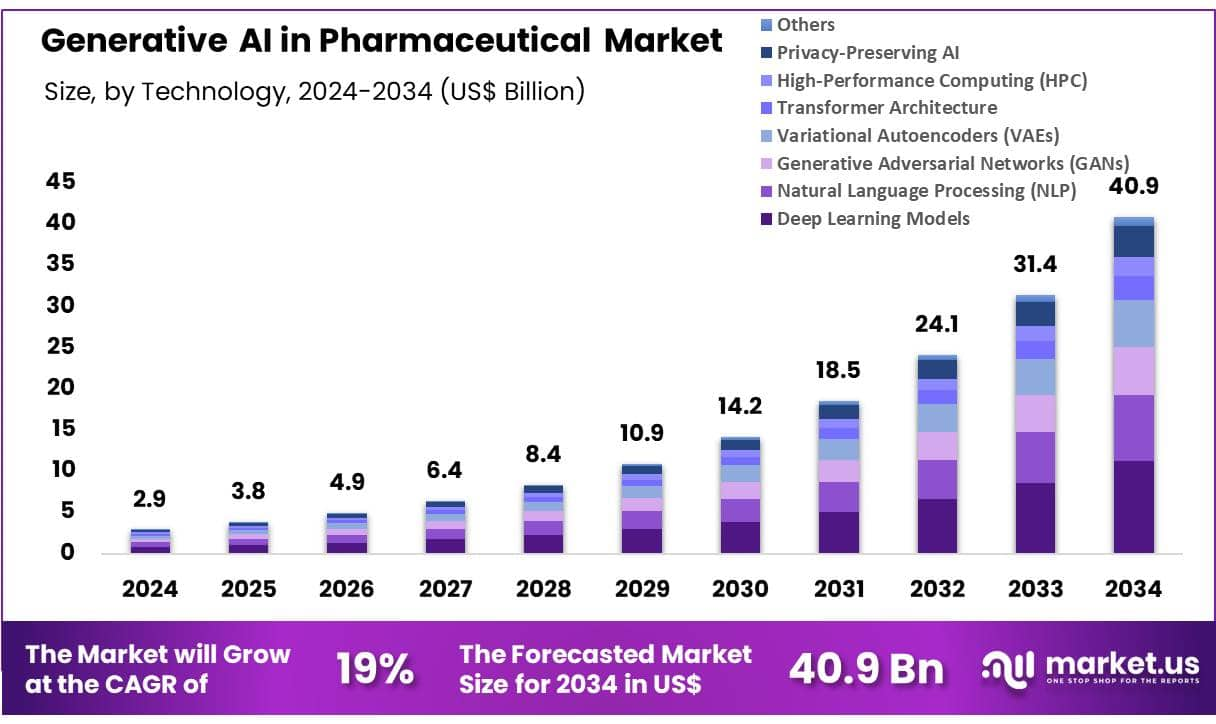
Global Generative AI in Pharmaceutical Market size is expected to be worth around US$ 40.88 Billion by 2034 from US$ 2.92 Billion in 2024, growing at a CAGR of 30.2% during the forecast period 2025 to 2034
The pharmaceutical industry is witnessing a transformative shift through the integration of Generative Artificial Intelligence (AI), which is accelerating innovation in drug development, clinical trials, and personalized medicine. Generative AI refers to machine learning models capable of creating new and original outputs such as molecular structures, protein sequences, and clinical trial designs. This technology is revolutionizing traditional R&D methods by significantly reducing time and cost in drug discovery.
Pharmaceutical companies are increasingly deploying generative AI to simulate compound interactions, predict drug efficacy, and optimize molecular properties. By analyzing massive biological and chemical datasets, generative AI platforms can propose novel drug candidates with improved accuracy and reduced failure rates. Furthermore, AI-driven modeling enhances patient stratification in clinical trials, ensuring better trial outcomes and regulatory compliance.
Recent collaborations between biotech firms and AI technology providers underscore the rising adoption of generative models in the preclinical and clinical pipeline. For instance, large pharmaceutical enterprises are using AI to repurpose existing drugs and forecast off-target effects early in development.
In addition to R&D, generative AI is contributing to smarter manufacturing processes and real-time pharmacovigilance, helping ensure consistent quality and compliance with global health regulations.
As regulatory frameworks evolve to accommodate AI-driven discoveries, the pharmaceutical sector is expected to undergo further digital transformation, driving innovation, safety, and accessibility in global healthcare.
Click here to get a Sample report copy@ https://market.us/report/generative-ai-in-pharmaceutical-market/free-sample/
Key Takeaways
- In 2024, the global market for Generative AI in the pharmaceutical sector generated revenue amounting to US$ 2.92 billion. The market is projected to expand at a compound annual growth rate (CAGR) of 30.2%, reaching approximately US$ 40.88 billion by 2034.
- Based on technology, the market is segmented into Deep Learning Models, Natural Language Processing (NLP), Generative Adversarial Networks (GANs), Variational Autoencoders (VAEs), Transformer Architectures, High-Performance Computing (HPC), Privacy-Preserving AI, and others. Among these, Deep Learning Models accounted for the largest share in 2024, contributing 27.4% to the total market revenue.
- By method type, the market includes Text Generation, Image Generation, Audio Generation, and other techniques. Text Generation emerged as the leading segment, holding a notable 39.7% share of the overall market.
- In terms of application, the market is categorized into Commercial, Research and Development, Drug Discovery, Clinical Development, Operations, and others. The Research and Development segment dominated the market in 2024, capturing 22.4% of the total revenue share.
- Regionally, North America led the global market, commanding a significant 46.8% share in 2024. This regional dominance is attributed to early AI adoption, strong pharmaceutical R&D infrastructure, and favorable regulatory frameworks.
Segmentation Analysis
- Technology Analysis: In 2024, deep learning models led the generative AI market in pharmaceuticals, capturing a 27.4% share. Their ability to process complex biomedical data makes them central to drug design and target prediction. NLP is widely used for extracting insights from clinical records and research publications. GANs support synthetic data creation and drug repurposing. Notably, PhaseV’s adaptive and causal ML platforms are now used by top global pharmaceutical firms, emphasizing the industry’s rapid shift toward data-driven drug development.
- Method Analysis: Text generation dominated the market in 2024 with a 39.7% share, playing a critical role in automating scientific reporting, regulatory filing, and synthetic patient data generation. Image generation is gaining traction in simulating molecular structures and enhancing drug interaction visualizations. Audio generation, though emerging, supports AI-based healthcare assistants and education tools. Yseop’s partnership with AWS highlights the growing integration of LLM infrastructure to accelerate drug and vaccine development across major biopharma companies.
- Application Analysis: The Research and Development (R&D) segment accounted for the largest market share at 22.4% in 2024. Generative AI is driving innovation by designing novel drug compounds, predicting pharmacological outcomes, and reducing preclinical development time. These models enhance molecular property optimization and biological activity simulations, supporting faster, more cost-effective discovery cycles. R&D teams benefit from AI-generated insights that improve success rates and streamline candidate selection across therapeutic areas such as oncology, neurology, and respiratory disorders.
Market Segments
Technology
- Deep Learning Models
- Natural Language Processing (NLP)
- Generative Adversarial Networks (GANs)
- Variational Autoencoders (VAEs)
- Transformer Architecture
- High-Performance Computing (HPC)
- Privacy-Preserving AI
- Others
Method
- Text Generation
- Image Generation
- Audio Generation
- Others
Application
- Commercial
- Research and Development
- Drug Discovery
- Clinical Development
- Operations
- Others
To Purchase this Premium Report@ https://market.us/purchase-report/?report_id=143458
Regional Analysis
In 2024, deep learning models emerged as the leading technology in the generative AI pharmaceutical market, holding a 27.4% share. These models are instrumental in processing complex biomedical datasets, enabling advanced drug design and precise target identification. Natural Language Processing (NLP) is extensively applied to mine insights from clinical records and scientific literature. Generative Adversarial Networks (GANs) facilitate synthetic data generation, aiding in drug efficacy prediction and repurposing efforts. Companies such as PhaseV are driving adoption with adaptive and causal machine learning platforms, now widely utilized by global pharmaceutical firms to optimize clinical development.
By method, text generation dominated with a 39.7% market share in 2024. It plays a crucial role in automating regulatory documentation, scientific reporting, and synthetic data creation. Image generation supports molecular simulation and visual analytics, while audio generation is being explored for AI-driven patient interaction and education. In May 2024, Yseop partnered with AWS to strengthen LLM capabilities for accelerating biopharma innovation.
On the application front, the Research and Development (R&D) segment led the market with a 22.4% share. Generative AI enables faster, cost-efficient drug discovery, simulating compound behavior and optimizing properties across high-priority therapeutic areas like oncology, immunology, and CNS disorders.
Key Players Analysis
Prominent companies shaping the generative AI pharmaceutical landscape include Insilico Medicine, BenevolentAI, Atomwise, Exscientia, Recursion Pharmaceuticals, Zymergen, Schrödinger, BioXcel Therapeutics, Bayer AI, Cloud Pharmaceuticals, Vir Biotechnology, PathAI, Sanofi AI, AstraZeneca, DeepMind, among others.
Insilico Medicine is a leading AI-driven biotech company focused on accelerating drug discovery and development. It employs deep learning and reinforcement learning models to identify novel therapeutic compounds efficiently.
BenevolentAI harnesses machine learning, NLP, and generative AI to mine vast datasets, including clinical records and scientific publications. Its platform specializes in drug repurposing and identifying new therapeutic targets, aiding in faster drug development cycles.
Atomwise is renowned for its deep learning–based platform, AtomNet, which predicts the interaction of small molecules with biological targets. The company focuses on virtual screening to expedite early-stage drug discovery, with particular emphasis on oncology, infectious diseases, and neurological disorders.
These companies, along with other key innovators, are advancing AI-powered solutions that are reshaping how pharmaceuticals are discovered, validated, and brought to market.
Market Key Players
- Insilico Medicine
- BenevolentAI
- Atomwise
- Exscientia
- Recursion Pharmaceuticals
- Zymergen
- Schrödinger
- BioXcel Therapeutics
- Bayer AI
- Cloud Pharmaceuticals
- Vir Biotechnology
- PathAI
- Sanofi AI
- AstraZeneca
- DeepMind
- Other Key Players
Market Dynamics
- Market Driver: The primary driver of the generative AI in pharmaceutical market is the increasing demand for faster and cost-effective drug discovery. Traditional R&D processes are time-consuming and expensive, often taking over a decade to bring a drug to market. Generative AI enables rapid compound screening, target identification, and molecular optimization, significantly reducing development timelines and costs. This efficiency is driving widespread adoption across pharmaceutical companies seeking to enhance productivity and improve early-phase success rates.
- Market Trend: A key trend in the market is the integration of generative AI with large language models (LLMs) and real-world data analytics. Companies are combining AI with electronic health records, genomic data, and clinical trial outputs to generate more accurate predictions and personalized therapies. Additionally, strategic collaborations between pharmaceutical firms and AI technology providers, such as NVIDIA, AWS, and DeepMind, are accelerating the deployment of AI in clinical pipelines, fostering an ecosystem of data-driven, adaptive drug development platforms.
- Market Opportunity: Significant growth opportunities lie in expanding the use of generative AI in rare disease research and personalized medicine. As AI tools become more precise, they can identify novel targets for underexplored conditions with limited treatment options. Additionally, AI-powered predictive modeling can help develop customized therapies tailored to individual genetic profiles. With increasing regulatory openness to AI integration, there is strong potential for generative AI to address unmet medical needs and improve therapeutic outcomes globally.
Conclusion
The generative AI in pharmaceutical market is undergoing rapid transformation, driven by advancements in deep learning, NLP, and AI-driven drug discovery platforms. With a projected CAGR of 30.2%, the market is poised to reach over US$ 40.88 billion by 2034. Key players such as Insilico Medicine, Atomwise, and BenevolentAI are leading innovation, while strategic collaborations and regulatory support further enhance growth.
As generative AI reshapes R&D, clinical development, and personalized medicine, it offers substantial opportunities to accelerate treatment breakthroughs, reduce costs, and address complex therapeutic challenges across global healthcare systems.
View More Reports:
Healthcare Interoperability Solutions Market to Hit USD 14.7 Billion by 2034
Healthcare Interoperability Solutions Market to Hit USD 14.7 Billion by 2034
Electrophysiology Market Set for 15.2% CAGR Through 2034
Radiology Information Systems Market To Reach USD 3.6 Billion By 2034
Radiology Information Systems Market To Reach USD 3.6 Billion By 2034



