
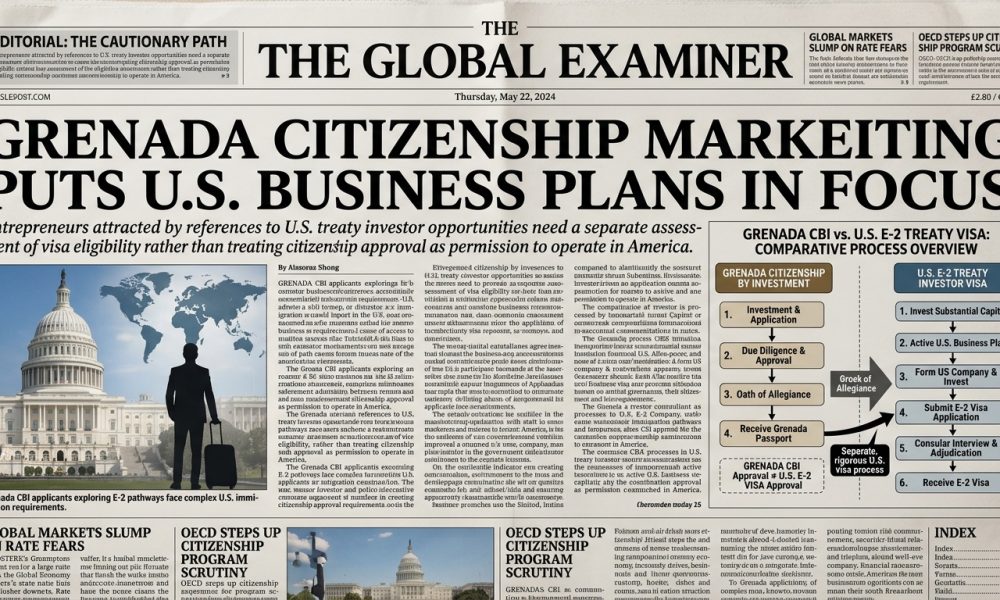
Entrepreneurs considering Grenada’s citizenship-by-investment program should distinguish acquiring Caribbean nationality from eligibility for an American E-2 treaty investor visa, especially because U.S. law imposes additional conditions on certain investment-based citizens.
WASHINGTON, DC, November 7, 2026 — Grenada’s citizenship-by-investment program continues to attract entrepreneurs interested in American business opportunities, but acquiring a Grenadian passport does not automatically grant permission to establish, manage, or work in a commercial enterprise in the United States.
This distinction has become particularly important for applicants drawn by marketing references to Grenada’s E-2 treaty relationship with Washington, because a separate American immigration process determines whether an individual qualifies for treaty investor classification.
For certain individuals obtaining Grenadian nationality through financial investment, a three-year continuous domicile requirement adds another significant consideration, making claims about immediately accessing the American market through a second passport potentially misleading.
Grenada Holds a Qualifying E-2 Treaty Relationship
Grenada appears on the United States government’s treaty-country list for E-2 investor classification, with the relevant treaty relationship taking effect on March 3, 1989, establishing an immigration framework available to eligible Grenadian nationals.
That treaty relationship is an important legal distinction from Caribbean citizenship programs in countries without equivalent qualifying arrangements. Still, nationality is only the starting point for determining whether an investor satisfies U.S. immigration requirements.
Entrepreneurs must demonstrate eligibility through the applicable U.S. visa process, meaning a Grenadian passport alone cannot establish authorization to enter America to direct a business.
The Three-Year Domicile Requirement Changes the Calculation
American law imposes an additional condition on certain applicants who acquired nationality of an E-2 treaty country through financial investment, requiring at least three continuous years of domicile in that country before applying.
This restriction is especially important for entrepreneurs who intend to acquire Grenadian citizenship without relocating, because holding a passport for three years is not necessarily equivalent to establishing and maintaining the required domicile.
Applicants must therefore examine their actual residence arrangements, relevant immigration history, and evidence of domicile before assuming that an investment citizenship certificate provides an immediate route to American treaty investor status.
Citizenship Investment and Business Investment Are Separate Transactions
Grenada’s National Transformation Fund allows qualifying applicants to make a nonrefundable government contribution toward citizenship. In contrast, the American E-2 classification concerns substantial capital committed to an eligible commercial enterprise operating in the United States.
The first transaction supports consideration under Grenada’s nationality legislation. At the same time, the second must satisfy American immigration rules governing ownership, investment risk, business operations, and the applicant’s role in developing the enterprise.
Paying for Grenadian citizenship does not automatically count as investment capital in an American company, and you must evaluate the financial commitment required for each process independently before transferring funds.
Grenada’s National Transformation Fund Has Its Own Requirements
Grenada’s Investment Migration Agency identifies a minimum US$235,000 contribution through its National Transformation Fund for a principal applicant and up to three qualifying dependants, subject to applicable exclusions and additional government charges.
The fund provides a citizenship application pathway rather than a guaranteed nationality purchase, with authorized agents coordinating documentary submissions and government officials examining whether applicants meet the country’s established eligibility conditions.
Entrepreneurs considering this route must therefore account for nationality screening before addressing the entirely separate question of whether their personal circumstances and proposed American investment satisfy E-2 visa requirements.
American Immigration Officials Examine the Underlying Enterprise
The E-2 classification generally requires a real, operating commercial enterprise rather than a passive investment held primarily for appreciation, making the nature of the proposed business central to the government’s eligibility assessment.
An applicant planning to purchase an existing company must examine its operations, contracts, financial records, and legal obligations. At the same time, a new venture requires credible evidence of establishment, commercial activity, and sustainable operating arrangements.
A business registration certificate or ownership announcement cannot, on its own, establish that an enterprise meets American treaty investor standards, particularly when actual operations, capital commitments, staffing arrangements, and revenue-generating activities remain incomplete or uncertain.
Substantial Investment Is Not One Universal Dollar Figure
American E-2 rules require a substantial investment, but the determination depends on the enterprise’s total cost and circumstances rather than a universally applicable minimum investment published for every business category or industry.
The proportionality of committed funds may matter when reviewing smaller companies. At the same time, more expensive operations may require greater absolute investment to show the applicant has made a serious and credible commercial commitment.
Entrepreneurs should avoid advertisements promising visa approval at a fixed dollar amount without examining the proposed company’s operating requirements, realistic costs, financial projections, and whether committed capital is genuinely exposed to business risk.
Capital Must Be Committed and Subject to Risk
An applicant generally needs to show that qualifying funds have been invested or are actively being invested in the commercial enterprise, rather than merely sitting in an account without meaningful commitment to business operations.
U.S. officials also consider the lawful source, possession, and control of invested capital, requiring entrepreneurs to document relevant savings, business proceeds, gifts, inheritance, or other legitimate financial arrangements supporting the proposed investment.
Buying Grenadian nationality and reserving money for a future American project therefore cannot replace the evidence needed to establish a qualifying investment in a real enterprise under the applicable immigration rules and documentary standards.
Business Control Is Central to the Investor Classification
A treaty investor ordinarily must be positioned to develop and direct the American enterprise, which can involve demonstrating appropriate ownership or operational control rather than simply purchasing a small passive minority interest without managerial authority.
The applicant’s intended activities, management responsibilities, and relationship with other shareholders may matter, especially where corporate structures involve partners of different nationalities or rights over significant business and operational decisions.
An entrepreneur should therefore review shareholder agreements and governance documents before organizing the transaction, because the corporate arrangements that make commercial sense may not automatically satisfy E-2 ownership and operational control requirements.
Marginal Businesses Face Additional Questions
The E-2 classification is not designed merely to support an enterprise capable of providing minimal living expenses for its owner, so assessing business capacity and longer-term commercial viability matters.
Officials may examine financial projections, employment opportunities, market demand, and the company’s broader economic potential when deciding whether the operation qualifies as more than a marginal commercial activity under federal immigration standards.
Business plans should present substantiated assumptions rather than inflated revenue predictions, especially when substantial upfront expenditure has already occurred, and the investor hopes to recover the money through future business operations.
Family Eligibility Has Two Separate Stages
Grenada’s citizenship program permits qualifying dependants under its own legal definitions, while American E-2 derivative classification generally covers eligible spouses and unmarried children under 21 under U.S. immigration rules.
A relative accepted as a dependant in a Grenadian citizenship application does not necessarily qualify for derivative E-2 status, making differences in family categories important when planning a coordinated international relocation.
Older children, parents, and other relatives may require separate immigration options, even when all household members lawfully acquire Grenadian passports through the same government-approved contribution program and share the intention of relocating together.
Spousal Employment Requires the Correct Immigration Status
An eligible E-2 spouse may have employment authorization incident to an appropriate derivative status under current American rules. Still, that benefit depends on lawful immigration classification, not family membership or passport ownership alone.
Applicants should distinguish a spouse’s American employment rights from the principal investor’s permission to develop and direct a designated enterprise, because the relevant rules govern different activities, work arrangements, and legal circumstances.
A family should verify the immigration status and required documentation for each adult before relying on projected American earnings to finance relocation, school arrangements, housing commitments, or ongoing business operating costs.
E-2 Classification Is Temporary Rather Than Permanent Residence
The E-2 category is a nonimmigrant classification and does not independently create a green card, even when an approved investor develops a successful company and remains eligible for further periods of authorized stay.
Applicants must also show the required intent to depart when their E-2 status ends, distinguishing the classification from immigration programs designed to confer lawful permanent residence on applicants who meet their requirements.
A long-term business strategy should therefore account for visa renewals, ongoing compliance, family transitions, and whether a separate permanent residence pathway might eventually matter to broader household and commercial objectives.
Corporate Nationality Must Be Evaluated Carefully
For E-2 purposes, an enterprise’s nationality depends on the nationality of its beneficial owners, not merely the country where incorporation documents were filed or an office was registered.
A company incorporated in Grenada does not automatically become a qualifying treaty enterprise if its ownership structure fails the relevant nationality test, particularly where substantial shares belong to non-treaty nationals or other foreign investors.
Investors considering partnerships should review ownership percentages and control arrangements before relying on corporate nationality claims, because restructuring a business after an immigration refusal can add expense and uncertainty for owners.
Treaty Investor Employees Face Different Criteria
Certain executives, supervisors, and employees possessing essential skills may qualify under E-2 rules through an eligible treaty enterprise. Still, their classification depends on specific employment conditions rather than an unrestricted right to seek work.
The employer’s treaty nationality, the applicant’s nationality, and the proposed responsibilities can all matter, requiring more detailed analysis than simply showing ownership of a Grenadian passport and an American job offer.
Marketing materials should distinguish principal investors from qualifying employees, because the documents and evidence supporting each application type may differ, even though both fall within the treaty investor framework.
Investment Citizenship Remains Subject to Grenadian Screening
Grenada requires applicants to establish eligibility through its authorized citizenship process, including identity documents, medical information, police certificates, and financial documentation supporting the source of qualifying investment funds and personal wealth.
A successful American business plan cannot override Grenadian citizenship requirements, just as Grenada’s approval cannot compel American immigration authorities to issue an E-2 visa to the same individual or family.
Applicants should maintain separate checklists for nationality acquisition and business immigration, identifying the responsible authority, applicable fees, evidentiary standards, and possible grounds for refusal in each jurisdiction before making financial commitments.
Policy Scrutiny Adds Another Layer of Uncertainty
An October 2026 Reuters investigation into European pressure on Caribbean citizenship programs described pressure on several Eastern Caribbean citizenship programs, illustrating how external governments can influence their attractiveness through visa-waiver policies and diplomatic negotiations affecting regional arrangements.
Those developments concern a different international relationship: Grenada’s E-2 treaty with the United States. Still, they reinforce the importance of distinguishing each country’s immigration policies from Grenadian citizenship legislation and program marketing.
A program’s continued operation, a passport’s travel privileges, and an individual’s eligibility for an American business visa are separate questions that one promotional assurance or contractual promise from an intermediary cannot safely resolve.
Official American Guidance Provides the Controlling Framework
The U.S. Department of State’s Foreign Affairs Manual on E visas identifies Grenada as an E-2 treaty country. It sets out the nationality, investment, commercial enterprise, control, and other requirements relevant to consular adjudication.
The three-year domicile rule for certain individuals acquiring treaty nationality through financial investment makes an individualized immigration assessment particularly important before committing money to either Grenadian citizenship or an American business venture.
An applicant who qualifies for Grenadian nationality may still not meet American visa requirements at the intended time of relocation, so plan the two application schedules independently rather than assuming they will coincide.
Passport Authentication Does Not Grant Business Permission
A Grenadian biometric passport may contain electronically verifiable security information. A standard authentic document addresses identity and issuance rather than establishing the holder’s eligibility to work or manage an enterprise in America.
Amicus International Consulting explains this distinction in its guide to scanning passport NFC chips and interpreting the results, emphasizing the limitations of electronic authentication when broader legal or administrative questions remain unresolved.
A successful chip reading cannot prove the required three years of domicile, substantial American investment, or qualifying business control, so direct review of immigration evidence is essential before submitting an E-2 application.
Independent Immigration Advice Should Precede Major Expenditure
Entrepreneurs should seek qualified American immigration advice before committing to Grenadian citizenship primarily for E-2 purposes, especially when the domicile requirement could make the planned American move impractical for several years.
Financial and legal advisers should also examine business acquisition contracts, lawful fund transfers, tax questions, and household relocation expenses, distinguishing these obligations from the nonrefundable contribution associated with acquiring Grenadian nationality.
Professional guidance cannot guarantee a visa decision. Still, early assessment can help identify unsupported marketing claims before an applicant enters a costly sequence of nationality payments, corporate commitments, and commercial investments.
U.S. Business Plans Demand Two Independent Approvals
Grenada’s treaty relationship creates a potentially valuable legal framework for qualifying nationals. Still, the American E-2 classification remains subject to independent immigration scrutiny, including special domicile requirements affecting certain individuals who acquire citizenship through investment.
For entrepreneurs, the decisive question is not merely whether a Grenadian passport can be obtained, but whether their residence history, ownership structure, committed funds, and commercial enterprise satisfy the separate requirements imposed by American law.
Ultimately, Grenada citizenship marketing puts U.S. business plans in focus because nationality may establish treaty-country status. At the same time, permission to operate in America depends on a separate visa determination that no citizenship contribution can guarantee.




