
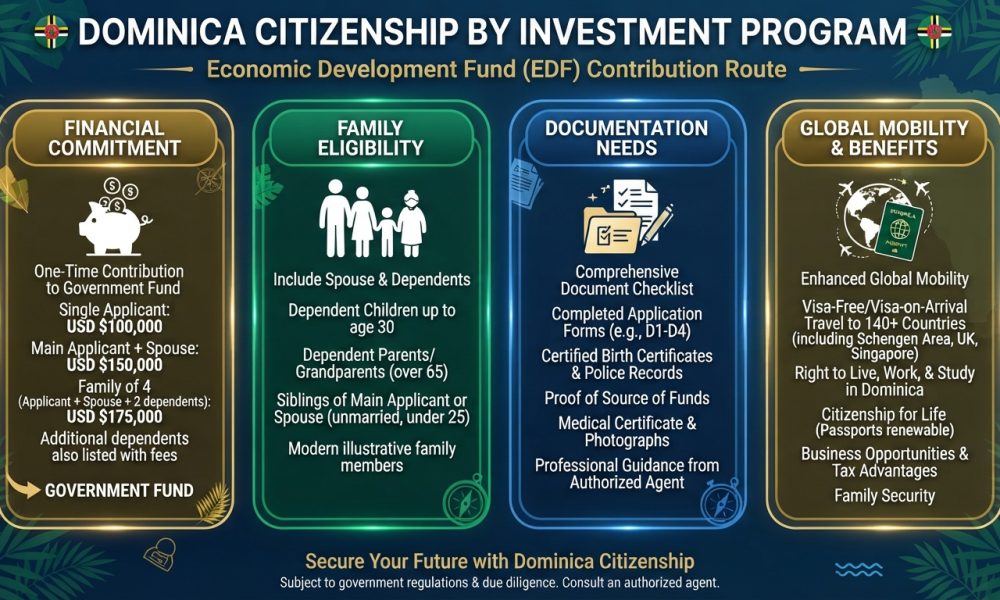
Dominica’s Economic Diversification Fund offers a contribution-based citizenship pathway. Still, prospective applicants must examine nonrefundable payments, dependent eligibility, identity screening, government approval, and changing international travel privileges before committing substantial family resources.
WASHINGTON, DC, November 7, 2026 — Dominica’s Economic Diversification Fund remains a prominent option in Caribbean second citizenship comparisons, but families evaluating the program must consider financial, documentary, and international policy requirements that extend well beyond its advertised minimum contribution.
A qualifying contribution can support an application for Dominican nationality without requiring ownership of approved resort property. However, applicants must still complete official screening, establish eligible family relationships, and receive a sovereign government decision.
As European authorities scrutinize regional investor citizenship arrangements, households must also distinguish the enduring domestic rights associated with lawfully granted nationality from visitor privileges tied to other governments’ immigration policies, particularly when planning family relocation.
The Economic Diversification Fund Has a Defined Public Purpose
Dominica established its Economic Diversification Fund to mobilize contributions for national development, with the citizenship authority identifying infrastructure, education, healthcare, tourism, agriculture, and related initiatives among the sectors receiving support from the program.
For participating applicants, that public purpose does not transform the contribution into an ownership interest, since money paid into the fund is generally nonrefundable and does not provide contractual repayment or investment income.
The financial decision therefore involves weighing the potential legal benefits of citizenship against the permanent transfer of capital, rather than estimating a conventional rate of return on the government contribution, particularly for families preserving substantial financial reserves.
Current Minimum Contributions Differ Across Household Sizes
Dominica’s published schedule identifies US$200,000 for an individual applicant and US$250,000 for a principal applicant with up to three qualifying dependants, making household composition central to the initial financial comparison, especially where several generations are participating.
For additional qualifying dependants beyond that grouping, the current fund schedule adds US$25,000 for each person younger than eighteen and US$40,000 for each person aged eighteen or older, under the rules governing these applications.
These figures describe the main qualifying contribution, not a complete passport package, because background investigation charges, interviews, processing, naturalization certificates, and private professional services must be assessed separately for every participating family member.
Screening Costs Can Change the Effective Price
The government publishes a US$1,000 application processing fee and a US$7,500 due diligence charge for the principal applicant, with US$4,000 charged for each qualifying dependent aged sixteen or older, under applicable government program requirements.
Mandatory interviews for applicants aged sixteen and above generally carry a US$1,000 charge for each interview. In comparison, naturalization certificates cost US$500 per person under the published government schedule, depending on each applicant’s circumstances.
For a household with older children or dependent adults, those separate charges can materially increase the budget even when its qualifying fund contribution remains within the standard family category, making individualized quotations especially important.
A Family of Four Needs a More Detailed Quotation
Consider a principal applicant, spouse, and two children younger than sixteen, for whom the published US$250,000 fund contribution is only the beginning of the calculation, not the full government cost under current rules.
The family’s eventual charges depend on applicable due diligence, interview, processing, and certificate requirements, as well as passport issuance and the professional work needed to collect its supporting documents for government review.
If either child is sixteen or older, mandatory screening and interview costs change, demonstrating why generalized family-of-four advertisements cannot replace an age-specific written quotation prepared under the rules governing current applications.
Eligibility Is Determined Individually for Every Relative
The program permits specified spouses, children, parents, and grandparents to be included as dependants. Still, each relationship must satisfy the government definition and be supported by documents establishing identity and lawful family connections.
An adult child’s financial circumstances or an older relative’s dependency can change the requirements, so it’s unsafe to assume that everyone listed in a family group automatically qualifies for nationality.
Households should confirm eligibility before transferring substantial funds, especially when future relocation plans depend on several generations obtaining citizenship together rather than leaving one relative with separate immigration permission requirements that could disrupt a coordinated move.
Authentic Civil Records Form the Documentary Foundation
Applications may require birth and marriage certificates, police records, financial statements, identity documents, and evidence of lawful residence or family relationships, with additional requirements reflecting the applicant’s personal and professional circumstances, including historical nationality connections.
Records issued in different countries can require official translations, certifications, or correction of genuine clerical errors, adding time and expense where historical names and dates do not match consistently, under applicable government program requirements.
Applicants should resolve such discrepancies lawfully rather than accept promises that a commercial provider can manufacture an unrelated identity, replace historical family connections, or evade official verification by issuing different documents under a new identity.
Financial Review Examines More Than Available Cash
Dominica’s due diligence framework includes source-of-wealth and source-of-funds checks, which distinguish the broader history of how an applicant acquired assets from the specific origin of the money being contributed, under applicable government program requirements.
Employment income, business ownership, inheritance, investments, and property sales can each require different supporting records, especially when financial arrangements span countries or involve complex corporate structures and ownership interests that require independent confirmation.
An applicant with sufficient liquid resources may still face requests for clarification, because meeting the contribution threshold does not substitute for demonstrating that the money was obtained and transferred lawfully through appropriate financial institutions.
A Donation does not waive Mandatory Interviews.
Government guidance issued in 2026 states that citizenship applicants aged sixteen or older must attend an interview, generally through a secure virtual arrangement, while authorized representatives cannot answer questions in their place.
The procedure provides another opportunity to confirm identity and examine information submitted with the application, so an advertisement claiming that the process involves no travel should not be interpreted as interview-free.
Families should obtain the current scheduling requirements and prepare each eligible participant separately, particularly when relatives live in different jurisdictions or need language and accessibility arrangements for their appointments, under applicable government program requirements.
Only Authorized Agents Can Submit Applications
Dominica requires applicants to work through an authorized agent, whose role is to organize documents, perform preliminary checks, and communicate with the Citizenship by Investment Unit as the file proceeds through government review.
An agent can coordinate a legitimate application but cannot independently award nationality, guarantee successful screening, or exempt a client from published government requirements through confidential relationships or extra payments made outside the formal process.
Written contracts should identify the representative’s responsibilities, professional compensation, government charges, and how withdrawal or refusal will be handled before any applicant assumes an initial retainer constitutes official approval under the rules governing these applications.
Approval in Principle Comes Before the Main Contribution
Dominica’s published application sequence generally places the final qualifying fund payment after preliminary government approval, reducing the need to transfer the principal contribution before the authorities complete their initial assessment, under applicable program requirements.
However, earlier processing, investigation, and professional fees may already have been incurred, so the absence of an initial US$200,000 transfer does not mean an unsuccessful application carries no financial consequences for participating families.
After the relevant conditions and payment are completed, citizenship documentation can follow. At the same time, issuance of an actual passport remains a further administrative step that families should include in their travel timelines and departure planning.
The Property Alternative Carries Different Financial Exposure
Dominica also permits qualifying investment of at least US$200,000 in a government-approved real estate project, with separate government fees beginning at US$75,000 for an individual application under the published schedule and applicable program requirements.
Unlike a donation, ownership may allow eventual resale, but holding restrictions, management expenses, property performance, and market demand determine whether the investor can recover substantial capital from the original purchase.
The government’s approval of a project for citizenship purposes is not a financial guarantee, and families should compare commercial risk against the known nonrecoverable nature of the Economic Diversification Fund contribution under current rules.
Processing Estimates Depend on Complete Information
Dominica’s recent government guidance describes an overall process that may take approximately three to six months. However, incomplete records, enhanced due diligence, and requests for additional evidence can extend the timetable for affected households.
Applicants should not schedule irreversible relocation arrangements around the shortest promotional estimate, especially when children’s schooling, professional commitments, or overseas accommodation depends on every participating relative receiving final documents under applicable government program requirements.
Treat government approval, contribution payment, naturalization certificates, and passport issuance as distinct milestones, because a favorable preliminary decision is not an acceptable international travel document for families considering this citizenship route.
Development Revenue Has Wider Economic Significance
The fund’s stated purpose links investor contributions to public projects. Still, applicants should distinguish broad development objectives from independent verification of specific spending, project completion, and measurable benefits to Dominican residents.
Citizenship revenues can support government budgets and resilience initiatives. Yet, dependence on international demand creates exposure when foreign policy shifts or competition reduces the number of applications the responsible authorities receive.
Transparent public reporting and responsible fiscal planning therefore matter beyond the individual investor, particularly when programs help finance infrastructure whose maintenance obligations continue long after a particular year’s contribution receipts have been collected.
European Policy Pressure Creates a Material Comparison Risk
An October 29, 2026, Reuters report examining European pressure on Caribbean investor citizenship described negotiations over proposed program phaseouts and their possible consequences for the budgets of participating island governments, including Dominica.
Dominica’s government separately stated on October 28 that the European Union had indicated a June 2028 transition deadline tied to retaining visa-free Schengen access, while regional discussions continued without an announced final settlement.
Those statements do not establish that citizenships already issued have been revoked or that the program has closed. Still, they highlight uncertainty for applicants who value access to Europe under the applicable international arrangements.
Visitor Privileges Differ From Domestic Citizenship Rights
A Dominican citizen may gain domestic residence and employment rights under the country’s laws. At the same time, short visits to other destinations still depend on each destination’s current visa rules and border decisions affecting international visitors.
Visa-free travel does not normally authorize indefinite settlement or employment abroad, making passport destination rankings an incomplete measure for families intending to relocate permanently to Europe, North America, or Asia under different immigration systems.
Applicants should therefore place greater emphasis on where they genuinely expect to live and work than on a promotional list of destinations whose entry permissions might change after naturalization, depending on future foreign government decisions.
Americans Need Separate Advice on Continuing Obligations
The U.S. Department of State’s guidance on dual nationality explains that United States citizens generally remain subject to American passport and other legal obligations even after acquiring an additional nationality abroad.
A second passport does not eliminate tax reporting, establish a new tax residence, or guarantee approval for overseas banking, so cross-border financial advice is valuable before making major decisions involving international assets.
Families holding retirement accounts, businesses, foreign property, or trusts should examine the consequences of any actual relocation separately from the passport, rather than assume citizenship automatically changes existing financial responsibilities under applicable laws.
Passport Electronics Cannot Confirm Every Legal Question.
Biometric passports contain contactless chips and cryptographic protections that compatible readers can examine. Still, successful electronic authentication cannot independently prove how a citizenship application was assessed or whether a document remains administratively valid.
Amicus International Consulting discusses these limits in its guide on scanning a passport’s NFC chip and understanding the results, distinguishing technical inspection from government nationality decisions and document validity.
An authentic electronic passport may nevertheless be expired or canceled, so families should confirm current issuance records and travel requirements through appropriate authorities rather than relying on a smartphone scan alone for verification.
Practical Settlement Costs Belong in the Same Decision
A household contemplating life in Dominica must plan for housing, healthcare, transport, education, and reliable income in addition to the government contribution and official citizenship documentation charges under the applicable rules governing applications.
Retirees and families supporting vulnerable relatives should investigate medical access and suitable accommodation before committing permanently to the contribution, because legal nationality does not automatically provide every needed public or private service in the destination.
Keeping adequate reserves after payment can matter more than achieving an attractive advertised passport ranking, especially when family circumstances change, or international relocation creates unexpected costs in the household’s long-term financial plans.
The Most Relevant Comparison Is Personal and Financial
For applicants who do not want to acquire real estate, the Economic Diversification Fund offers a more direct contribution structure. However, its permanent cost and screening requirements must still align with available household resources.
For those hoping to recover capital, an approved property route introduces a different mixture of financial risks and restrictions that should be examined independently rather than treated as inherently superior for qualifying family members.
Ultimately, Dominica’s development fund deserves consideration in Caribbean citizenship comparisons because its value depends on verified eligibility, total family costs, government approval, and realistic residency goals, not the advertised contribution alone.




