
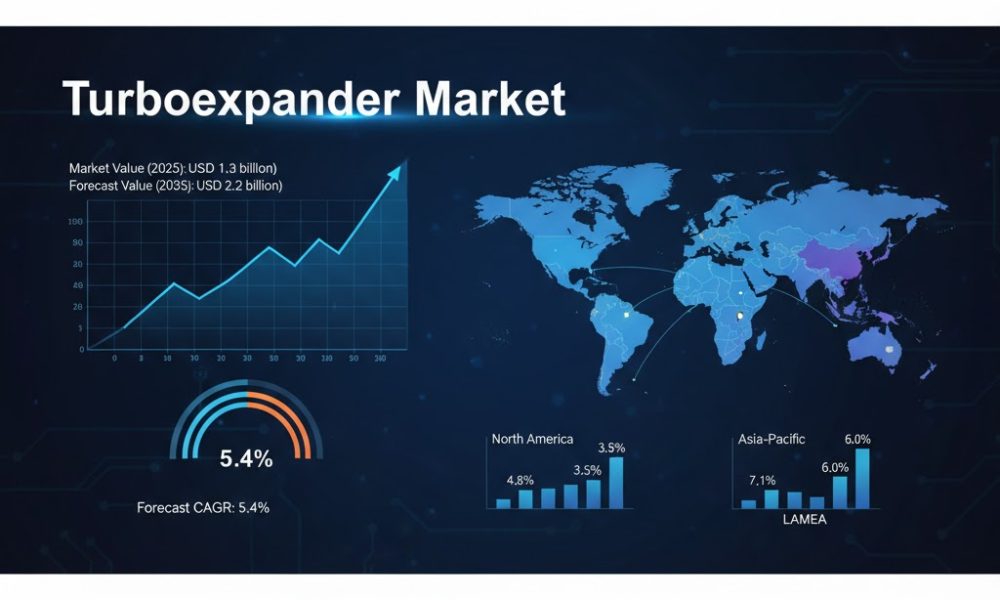
The global turboexpander market is on track to reach USD 2.2 billion by 2035, up from USD 1.3 billion in 2025, reflecting a CAGR of 5.4%, according to the latest industry analysis. This growth represents a 1.7x increase in market valuation over the decade, fueled by rising investments in natural gas processing, LNG export infrastructure, hydrogen production, and cryogenic process optimization worldwide.
Turboexpanders are emerging as critical enablers of industrial energy efficiency, delivering substantial operational cost savings and supporting industrial decarbonization initiatives. They are increasingly integrated into LNG liquefaction plants, air separation units, and cryogenic gas production facilities, where governments are enforcing energy efficiency mandates and carbon-reduction policies.
- Turboexpanders enable 25–35% energy recovery from high-pressure gas streams.
- They offer cost-effective solutions to reduce operational energy consumption.
- Their adoption supports low-carbon industrial operations and sustainability targets.
“Turboexpanders are redefining how industries recover energy from gas processes. The combination of efficiency gains, emission reductions, and digital monitoring capabilities positions them as a cornerstone technology in the low-carbon industrial era,” said a senior industry analyst from Market Research Insights.
Subscribe for Year-Round Insights → Stay ahead with quarterly and annual data updates:
Market Growth Outlook: 2025–2035
Between 2025 and 2030, the market is projected to grow by USD 0.4 billion, reaching USD 1.7 billion, accounting for 44% of the decade’s expansion. Growth in this period will be driven by:
- Expansion of LNG facilities in Asia-Pacific and the Middle East.
- Innovations in magnetic bearing systems and digital twin monitoring.
- Process electrification and efficiency optimization in industrial gas applications.
From 2030 to 2035, the market is expected to add an additional USD 0.5 billion, led by:
- Increasing hydrogen production and integration with carbon capture systems.
- Focused process energy optimization initiatives in oil & gas, petrochemicals, and industrial gas sectors.
- Adoption of high-performance turboexpander systems supporting sustainability and efficiency.
Regional Highlights: Asia-Pacific Leads
The Asia-Pacific region will remain the fastest-growing market, with India and South Korea leading adoption.
- India: 6.7% CAGR, driven by gas pipeline expansion and refinery modernization programs.
- South Korea: 6.4% CAGR, with growth supported by hydrogen infrastructure and petrochemical investments.
- China: 6% CAGR, driven by LNG terminal expansion and air separation capacity growth.
In Europe, the UK (6.1% CAGR) and Germany (4.8% CAGR) are driving growth through industrial decarbonization and waste-heat recovery initiatives, while the U.S. (5.6% CAGR) continues to lead in shale gas processing and LNG export capacity.
Segment Insights: Axial Flow and Compressor-Loaded Systems Dominate
The axial flow turboexpander segment is the market leader, accounting for 56% share in 2025. Its multi-stage expansion design and efficiency exceeding 90% make it the preferred choice for high-volume gas processing and LNG liquefaction plants.
- Compressor-loaded turboexpanders hold 47% market share, offering direct mechanical coupling for enhanced process integration.
- These systems are widely deployed in LNG and natural gas facilities, where refrigeration and recompression duties are critical.
By application, the oil & gas processing segment dominates with 41% of global demand, reflecting ongoing LNG export infrastructure and NGL recovery projects. Other key applications include:
- Air separation units (28%), benefiting from energy recovery solutions.
- Cryogenic processes (19%), which rely on turboexpanders for process optimization and efficiency gains.
Outlook: Industrial Energy Recovery and Sustainability
Turboexpanders are poised to become central to industrial energy recovery and decarbonization strategies. Innovations in digital monitoring, magnetic bearing technology, and process electrification will continue to enhance system efficiency, reliability, and lifecycle performance.
- Turboexpanders support industrial sustainability through reduced emissions and optimized energy usage.
- Their role in hydrogen production and LNG infrastructure ensures they remain critical for future low-carbon energy systems.
- The next decade will see wider adoption across oil & gas, petrochemical, and cryogenic sectors as global energy efficiency mandates tighten.
As industries worldwide pursue cost-effective energy recovery and carbon reduction, turboexpanders are becoming indispensable in bridging the gap between industrial efficiency and sustainable operations.
Key Market Drivers and Challenges
Drivers:
- LNG Infrastructure Expansion: Global LNG investments are increasing by 15–20% annually, necessitating multiple turboexpander units per facility.
- Industrial Energy Efficiency: Turboexpanders enable a 25–35% reduction in auxiliary power consumption, improving economics and emissions performance.
- Decarbonization Momentum: Governments are implementing energy recovery incentives and industrial efficiency programs, promoting technology adoption.
Challenges:
- High Capital Expenditure: Turboexpander systems can cost 3–5 times more than traditional throttling valves, limiting adoption among smaller facilities.
- Technical Complexity: The systems require specialized expertise for high-speed operations (up to 30,000 rpm), advanced maintenance, and vibration monitoring.
Get data that aligns with your strategic priorities — ask for report customization today:
Technological and Competitive Landscape
The market is witnessing rapid advancements in magnetic bearing systems, enabling oil-free operation with 99.5% uptime and 70% lower maintenance costs. Meanwhile, the rise of digital twin technology and AI-driven predictive maintenance is transforming operational reliability across process industries.
The global landscape remains moderately consolidated, with the top three players—Atlas Copco Gas & Process, Cryostar, and Air Products and Chemicals Inc.—collectively holding around 35–40% of the market share. Other prominent participants include Baker Hughes, GE Vernova, Siemens Energy, Elliott Group, and L.A. Turbine (Chart Industries), all focusing on aerodynamic design, control systems, and integrated service solutions.
Regional manufacturers in India and China are increasingly competitive due to faster production cycles and cost-efficient engineering, contributing to localized supply resilience and shorter project timelines.
Have a specific Requirements and Need Assistant on Report Pricing or Limited Budget please contact us – [email protected]
About Future Market Insights (FMI)
Future Market Insights, Inc. (FMI) is an ESOMAR-certified, ISO 9001:2015 market research and consulting organization, trusted by Fortune 500 clients and global enterprises. With operations in the U.S., UK, India, and Dubai, FMI provides data-backed insights and strategic intelligence across 30+ industries and 1200 markets worldwide.
Contact Us:
Future Market Insights Inc.
Christiana Corporate, 200 Continental Drive,
Suite 401, Newark, Delaware – 19713, USA
T: +1-347-918-3531



