
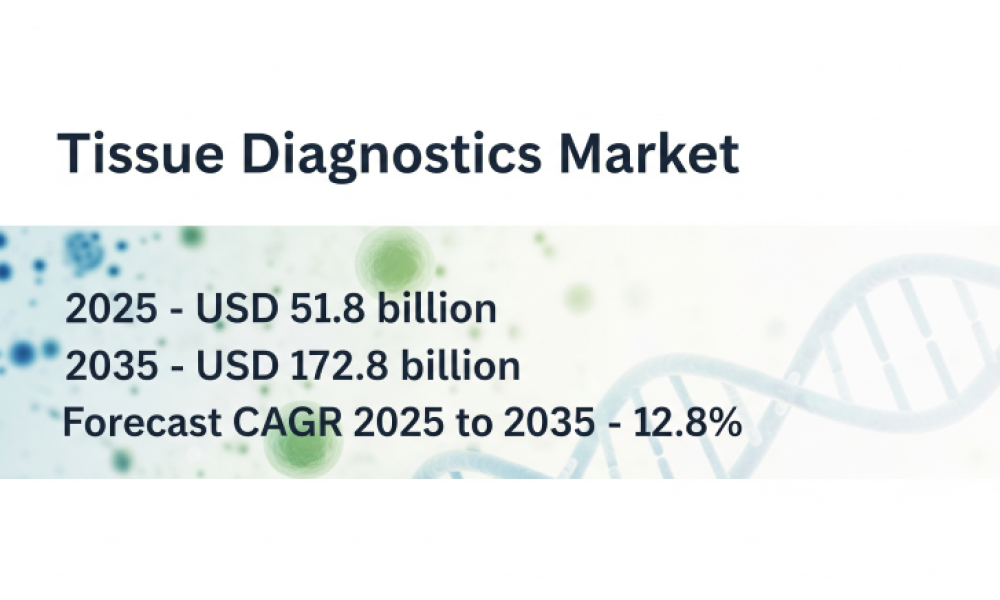
The global tissue diagnostics market, valued at an estimated USD 51.8 billion in 2025, is poised to expand at a compound annual growth rate (CAGR) of 12.8%, reaching USD 172.8 billion by 2035. This rapid growth is fueled by increasing demand for precise and early detection methods, particularly for cancer, as well as advances in diagnostic technologies. Key players such as Agilent Technologies, Danaher Corporation, and Roche are driving innovation in this highly competitive space.
Unlock detailed analytics – Request your personalized report now! https://www.futuremarketinsights.com/reports/sample/rep-gb-406
Growth Drivers in Tissue Diagnostics
The tissue diagnostics market is being propelled by a combination of factors. With cancer rates on the rise worldwide, the need for accurate and early detection is more critical than ever. Tissue diagnostics provides the sensitivity, accuracy, and speed required for effective cancer diagnosis, which is driving both clinical and research adoption. Immunohistochemistry (IHC) and molecular assays, which allow for precise tissue analysis, are becoming integral to healthcare institutions and laboratories globally.
Regional Growth Opportunities
North America is expected to maintain a dominant position in the global market, thanks to significant investments in research and development, as well as a high prevalence of advanced diagnostic technologies. The U.S. leads in terms of adoption of cutting-edge diagnostic tools, including tissue diagnostics for cancer and chronic disease management.
However, the Asia-Pacific region, with a projected growth rate of 16.0% in countries like India and China, is set to emerge as the fastest-growing market. The growing medical tourism industry in these regions, coupled with rising cancer rates, has created strong demand for advanced diagnostic solutions.
Leading Market Segments
- Consumables: The consumables segment, which includes reagents, assay kits, slides, and staining tools, is projected to account for 21.3% of the tissue diagnostics market by 2025. This segment benefits from the recurring nature of consumables in diagnostic workflows, and the increasing adoption of automated platforms to streamline lab operations.
- Breast Cancer Diagnostics: As the leading disease segment, breast cancer diagnostics is set to account for 29.3% of the total market in 2025. Advances in molecular profiling and receptor testing are improving the precision of breast cancer diagnoses, enabling clinicians to better personalize treatment plans. Increased awareness and government initiatives in screening programs are expected to continue driving growth in this segment.
- Immunohistochemistry (IHC): IHC is projected to dominate the application segment, holding 53.2% of the market share by 2025. IHC’s role in cancer diagnostics, as well as biomarker detection and personalized therapy, has positioned it as an essential diagnostic tool. The increasing adoption of multiplex IHC platforms and automated staining systems is further boosting the segment’s growth.
Download Brochure for Full Insights: https://www.futuremarketinsights.com/reports/brochure/rep-gb-406
Competitive Landscape
Leading players such as Agilent Technologies, Danaher Corporation, Roche, and Merck KGaA are continuously innovating to capture the growing market share. These companies are focusing on developing high-sensitivity assays and automated platforms, as well as expanding their consumables portfolios to address the rising demand from both hospitals and research organizations.
For example, Agilent Technologies and Roche are investing heavily in digital pathology and automation, enabling laboratories to increase throughput and improve diagnostic accuracy. Similarly, Danaher Corporation and General Electric (GE Healthcare) are pushing forward with advancements in imaging and molecular diagnostics, positioning themselves at the forefront of the tissue diagnostics revolution.
Growth Outlook
The global tissue diagnostics market will continue to benefit from innovations in diagnostic technologies, the growing demand for cancer detection, and an increase in government spending on healthcare infrastructure. The transition towards personalized medicine is expected to further propel the demand for precise, reliable, and timely diagnostic tools.
Conclusion
The tissue diagnostics market is on track to see unprecedented growth in the coming decade, driven by advances in diagnostic technologies, the increasing prevalence of cancer, and the rise of personalized medicine. As companies innovate and expand their portfolios, the industry is set to make significant strides in improving patient care and outcomes globally.
About Future Market Insights (FMI)
Future Market Insights, Inc. (ESOMAR certified, recipient of the Stevie Award, and a member of the Greater New York Chamber of Commerce) offers profound insights into the driving factors that are boosting demand in the market. FMI stands as the leading global provider of market intelligence, advisory services, consulting, and events for the Packaging, Food and Beverage, Consumer Technology, Healthcare, Industrial, and Chemicals markets. With a vast team of over 400 analysts worldwide, FMI provides global, regional, and local expertise on diverse domains and industry trends across more than 110 countries.



