
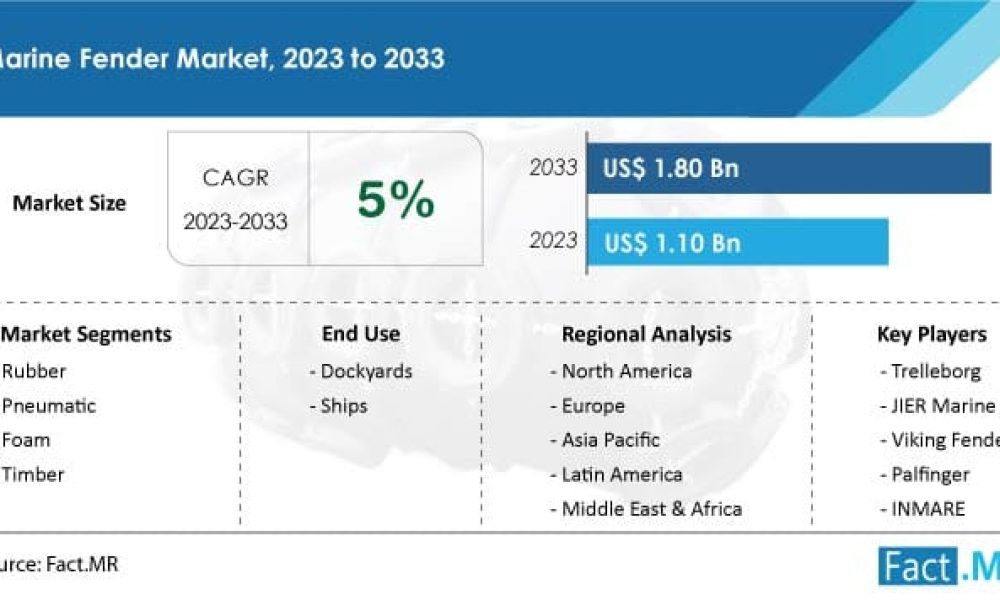
Global demand for marine fenders is predicted to increase at a CAGR of 5% from 2023 to 2033. The global marine fender market is valued at US$ 1.1 billion in 2023 and is thus expected to reach US$ 1.8 billion by 2033-end.
Seaborne trade is a prominent contributor to the global economy and it is likely to increase over the coming years. As a result, more ships will be sailing around the world’s oceans. This increase in seaborne trade activities will generate high demand for marine fenders.
Marine fenders are essential for protecting vessels from damage. They prevent ships from colliding with jetties and other structures. Growing adoption of marine fenders to protect ships and marine structures from damage will fuel sales. Increasing demand for efficient and cost-effective marine fenders will also boost the market.
Download a Sample Copy of This Report:
https://www.factmr.com/connectus/sample?flag=S&rep_id=5361?PJ
Rise in offshore infrastructure and high spending on defense naval vessels will fuel marine fender demand. Besides this, growing popularity of maritime tourism is likely to propel marine fender sales.
Construction of new ports and terminals worldwide will create new growth opportunities for marine fender manufacturers.
Metal skinning energy absorbers are becoming popular in the marine industry. This is due to their ability to provide protection and long-life span compared to traditional rubber fenders. This has led to an increased demand for marine fenders with metal skinning. Development of new high-performance, advanced marine fender systems will boost the market through 2033.
Currently, rubber fenders dominate the global marine fender market. This is due to their ease of installation, cost-effectiveness, and low maintenance cost. These fenders are designed to absorb the kinetic energy of vessels during docking or mooring operations. They also ensure safety of ships and other vessels.
They are durable and provide excellent performance in all weather conditions. This makes them a preferred choice for marine applications. Advancements in technology have enabled the production of rubber fenders with improved properties. It includes improved flexibility and tensile strength.
Asia Pacific is likely to remain the most lucrative market for marine fenders over the next ten years. Currently, Asia Pacific holds around 50% share of the global marine fender market. This region is home to a few of the world’s leading economies. This includes China, India, and Japan.
Rising seaborne trade activities across these nations is driving the Asia Pacific marine fender market. As per United Nations Conference on Trade and Development, emerging economies hold a prominent share of worldwide seaborne trade. They loaded 55% and discharged 61% of the world’s total. Driven by this, demand for marine fenders will rise at a healthy pace across Asia Pacific.
Key Takeaways:
- Based on component, mounting structure holds around 60% share of the global marine fender market.
- By fender, demand is forecast to remain high for rubber marine fenders globally.
- Asia pacific currently holds around 1/2 of the global marine fender market.
- The United States is set to account for a significant share of the global marine fender market.
- Demand for marine fenders in Germany will surge at a steady pace through 2033.
- With rising sea-borne trade, Japan is likely to emerge as a lucrative market for marine fenders.
Growth Drivers:
- Rising usage of marine fenders to avoid damage while docking is driving the global market.
- Increasing seaborne trade activities worldwide will elevate marine fender demand.
- Innovations in marine fenders will bolster sales through 2033.
- Expanding offshore infrastructure to create lucrative growth opportunities for marine fender manufacturers.
- High investments in offshore oil exploration and drilling activities support market expansion.
Restraints:
- Increasing penetration of defective fenders/counterfeit products might restrain market development.
- High maintenance cost of marine fenders is also limiting market expansion.
Competitive Landscape:
Manufacturers are looking to expand their product lines by strengthening research and development capabilities. They are also partnering with industry stakeholders to maximize their market share. Further, they are focusing on marketing strategies such as product branding and awareness campaigns.
For instance,
- In April 2022, YOKOHAMA announced the launch of its floating and fixed fenders on its new, updated worldwide website.
- In April 2020, Urethane Technologies (UTI), a renowned producer of specialized buoys and maritime fenders was acquired by Marine Fender International.
Key Companies Profiled by Fact.MR
- Trelleborg
- JIER Marine
- Viking Fender
- Palfinger
- INMARE
- The Rubber Company
- Horizon Marine Construction
- Sumitomo Rubber Industries, Ltd.
More Valuable Insights on Marine Fender Market
In the latest study, Fact.MR offers a detailed study on global marine fender market for the forecast period of 2023 to 2033. This study also highlights key drivers promoting the sales of marine fender through detailed segmentation as follows:
By Component:
- Mounting Structures
- Face Pads
- Others
By Fender:
- Rubber
- Pneumatic
- Foam
- Timber
- Others
By Ownership:
- Public
- Private
By Manufacturing Process:
- Molding
- Extrusion
- Others
By End Use:
- Dockyards
- Ships
By Region:
- North America
- Europe
- Asia Pacific
- Latin America
- Middle East & Africa
Get Customization on this Report for Specific Research Solutions:https://www.factmr.com/connectus/sample?flag=RC&rep_id=5361?PJ
Key Questions Covered in the Marine Fender Market Report
- What is the projected value of the marine fender market in 2023?
- At what rate will the global marine fender market grow until 2033?
- Which are the factors hampering the growth in the marine fender market?
- Which region is expected to lead in the global marine fender market during 2023 to 2033?
- Which are the factors driving the marine fender market during the forecast period?
- What is the expected market value of the marine fender market during the forecast period?
Contact:
US Sales Office:
11140 Rockville Pike
Suite 400
Rockville, MD 20852
United States
Tel: +1 (628) 251-1583
E Mail : [email protected]




