
Glass Recycling Market Overview
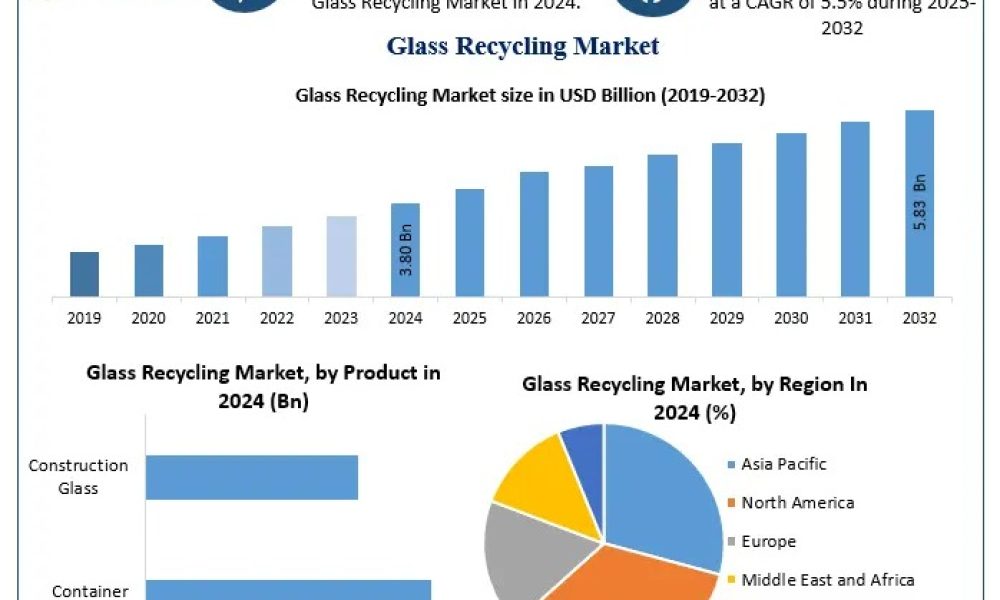
Glass Recycling Market reached a value of USD 3.80 billion in 2024 and is projected to grow at a CAGR of 5.5% to nearly USD 5.83 billion by 2032, driven by global moves towards sustainability, efficiency, and circular economy practices. Glass recycling, defined by the reprocessing of post-consumer glass into new commodities, is unique in being 100% recyclable without quality loss, making it pivotal in waste reduction and resource conservation.
Key Highlights & Insight
Dominant Region:
North America leads global market share, supported by strong regulatory frameworks and deposit-return programs that encourage consumer participation. Europe is also key, with some countries achieving beverage glass recycling rates above 90%, while Asia Pacific leads in growth due to urbanization and new environmental policies.
Leading Segment:
Container glass constitutes the largest segment, accounting for 62.1% of market share in Europe and over half globally. Its dominance stems from beverage and food packaging demand and the efficacy of bottle-to-bottle recycling systems.
Key Driver:
The primary drivers include regulatory mandates, growing environmental consciousness, active deposit-return schemes, a rise in circular economy business models, and expanded use of recycled glass in construction, automotive, and specialty products.
Recent Developments
Progressive deposit-return systems have been implemented in regions such as the US (Oregon’s 10-cent return) and England, directly impacting consumer behavior and recycling rates.
Industrial advancements, notably in China, see the deployment of large-scale reprocessing plants, aided by increased demand, technology upgrades, and better segregation practices.
Government initiatives such as Singapore’s Sustainable Blueprint are promoting zero-waste goals and integrated recycling infrastructure.
Market Dynamics
Growth Drivers:
Environmental campaigns and legislative mandates in Europe and North America support market expansion.
Advances in sorting and mechanical processing now allow for high-purity cullet and broader product applications.
Waste management companies and manufacturers increasingly integrate glass recycling into operational strategies.
Restraints:
Contaminants in waste streams and mixed collection hinder quality and process efficiency.
In regions with low consumer education or infrastructure, collection rates and economic viability are suppressed.
The economic gap between primary glass production and recycling, especially in energy costs and materials logistics.
Regional Analysis
North America:
Has a sophisticated recycling infrastructure but recycles only about one-third of its glass, largely due to consumer habits and economic factors. GMIC and GPI are actively working to bridge the gap to meet European standards.Europe:
Market leader in glass recycling rates, legislative action, and industry best practices.Asia Pacific:
Showing fastest growth; China’s manufacturing demand and government rules make it a key future player.Latin America, Africa, MEA:
Growing participation as policies and awareness rise; still in infrastructure-building phase.
Product Segmentation
Products: Container glass, construction glass, specialty/tableware glass
Applications: Bottles and containers, fiberglass insulation, concrete aggregate, ceramic/fiberglass production, landscaping
Processes: Collection, mechanical separation, optical sorting, cleaning, remelting
Key Trends
Shift to advanced fourth-generation recycling facilities featuring optical sorting and drying systems for impurity reduction.
Innovative uses in construction and automotive sectors supplement traditional bottle-to-bottle recycling.
Expansion of zero-waste and circular economy initiatives, especially in developing markets.
Technologies for sorting ceramics and non-glass contaminants, paving the way for higher-purity recycled materials.
Industry Quote
“As sustainability and policy align worldwide, glass recycling emerges as a cornerstone of the circular economy—enabling resource conservation, new business models, and a cleaner environment across geographies.”
Conclusion:
Through regulatory action, technological innovation, and expanding consumer engagement, the global glass recycling market is on a path to higher rates, broader usage, and fundamental contributions to climate and resource goals over the next decade.




