
Conductive Polymer Market Overview
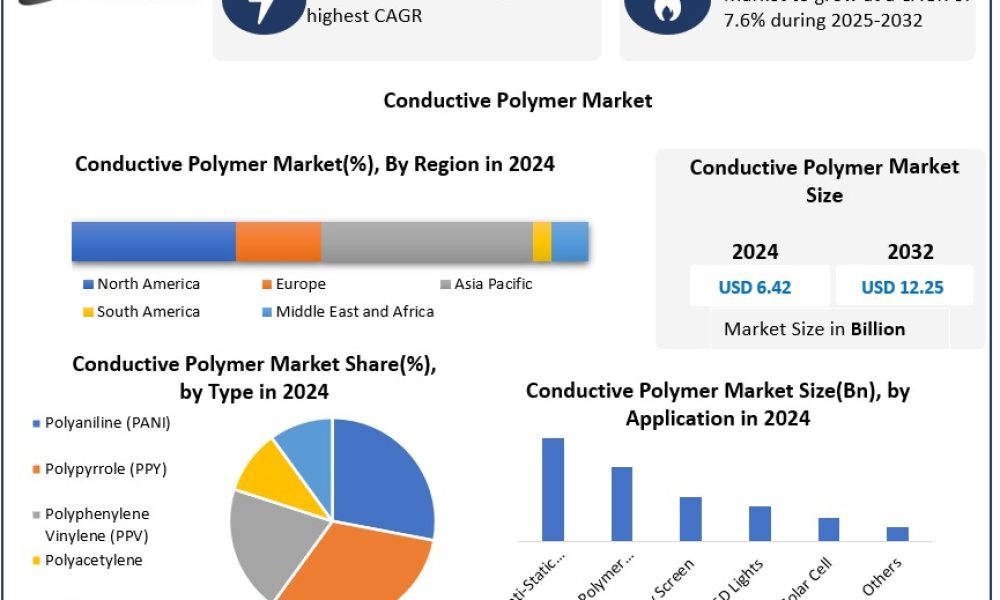
Conductive Polymer Market was valued at USD 6.82 billion in 2024 and is projected to grow at a compound annual growth rate (CAGR) of 7.6%, reaching an estimated USD 12.25 billion by 2032. Conductive polymers, including types such as polyaniline, polypyrrole, polyphenylene vinylene, and polyacetylene, are experiencing rapid adoption across industries due to a unique combination of electrical conductivity, lightweight, and mechanical flexibility. These polymers occupy a middle ground between conventional polymers (insulators) and metals, offering tunable electrical and optical properties, manufacturability, and chemical stability.
Key Market Insights & Drivers
Expanding Applications:
Conductive polymers are now key materials in several verticals: consumer electronics, automotive sensors and wiring, energy storage systems (batteries, capacitors, solar cells), healthcare (biosensors, drug delivery), antistatic packaging, and electromagnetic shielding. The pressure for miniaturized, flexible, and lightweight components—especially in wearable technology, flexible displays, smartphones, photovoltaics, and electric vehicles—has dramatically accelerated demand.Biotechnological and Medical Innovations:
In healthcare, advanced conductive polymers like PPY are enabling tissue engineering, nerve regeneration, and bioelectronic interfaces. Their bio-compatibility and responsiveness to electrical stimulation open large-scale opportunities in medical devices.Sustainability and Green Energy:
These polymers facilitate the manufacture of efficient, lightweight solar panels and energy storage modules. With rising renewable energy investments—especially in Asia Pacific and Europe—conductive polymers are positioned as eco-friendly alternatives in the emerging green economy.R&D and Material Science Advancements:
Innovations such as nanocomposites and hybrid blends (with graphene, carbon nanotubes, or metallic fillers) have enhanced conductivity, thermal stability, and processability, fueling new applications in aerospace, automotive, and advanced manufacturing.
Regional Dynamics
Asia Pacific:
The region dominates the global market (accounting for nearly 49% of global revenue in 2023), anchored by thriving electronics and automotive industries in China, Japan, South Korea, and Taiwan. Aggressive expansion in renewable energy and infrastructure projects (e.g., solar panel installations, EV manufacturing) ensures continued leadership and the highest growth rate through 2032.North America:
Significant growth is forecast, supported by robust innovation ecosystems, the presence of key international players, and heavy R&D investments in electronics and healthcare. The North American market is projected to contribute over 35% of overall revenue by 2030, driven by the U.S. semiconductor, automotive, and bioelectronics industries.Europe:
Leadership in automotive sensor technology, sustainable energy adoption, and strong regulatory frameworks drive advanced conductive polymer applications, including electric vehicles and building-integrated photovoltaics.
𝐈𝐧𝐭𝐞𝐫𝐞𝐬𝐭𝐞𝐝 𝐢𝐧 𝐝𝐞𝐭𝐚𝐢𝐥𝐞𝐝 𝐢𝐧𝐬𝐢𝐠𝐡𝐭𝐬? 𝐈𝐧𝐪𝐮𝐢𝐫𝐞 𝐟𝐨𝐫 𝐚 𝐬𝐚𝐦𝐩𝐥𝐞 𝐫𝐞𝐩𝐨𝐫𝐭 :https://www.maximizemarketresearch.com/request-sample/31525/
Market Segmentation
By Type:
Polyaniline (PANI)
Polypyrrole (PPY)
Polyphenylene Vinylene (PPV)
Polyacetylene
Others
By Application:
Anti-static packaging and coatings (fastest-growing, 5.8% CAGR)
Photographic film
Solar cells
Display screens
Polymer capacitors
LED lights
Others
By End Use Industry:
Electronics (largest segment)
Automotive
Energy storage
Healthcare
Aerospace
Trends and Opportunities
Automotive & Mobility:
Integration of conductive polymers in electric vehicles (EVs), autonomous driving sensors, lightweight wiring, and energy storage is a primary growth engine, fueled by global shifts toward e-mobility and sustainable transport.Wearable and Flexible Electronics:
Demand for materials that can bend, stretch, and adapt to complex shapes is boosting use in wearables and biomedical devices, further driven by consumer preference for smart, health-monitoring gadgets.Smart Packaging:
Adoption in anti-static packaging to protect sensitive electronic goods during storage and transit is surging, especially with the growth of e-commerce and global electronics trade.
Competitive Landscape
Key players include DowDuPont, 3M Company, Solvay, RTP Company, Lubrizol, Henkel, Heraeus, Covestro, Premix Oy, PolyOne, Celanese, Eeonyx Corporation, Hyperion Catalysis, KEMET Corporation, MacDermid, Merck, and others. Leading firms focus on R&D for advanced polymer formulations, nanocomposites, and scalable manufacturing techniques, alongside strategic alliances with electronics and automotive OEMs.
Industry Quote
Conductive polymers are transforming the landscape of advanced materials—offering a combination of electrical performance, flexibility, and environmental benefits. As miniaturization and sustainable design take center stage across industries, these polymers are establishing themselves as cornerstone materials for next-generation electronics, energy solutions, and healthcare technologies.”
With robust R&D, proliferation of application domains, and support from the clean energy transition and connectivity revolution, the global conductive polymer market will see sustained, innovation-driven expansion through 2032.




