
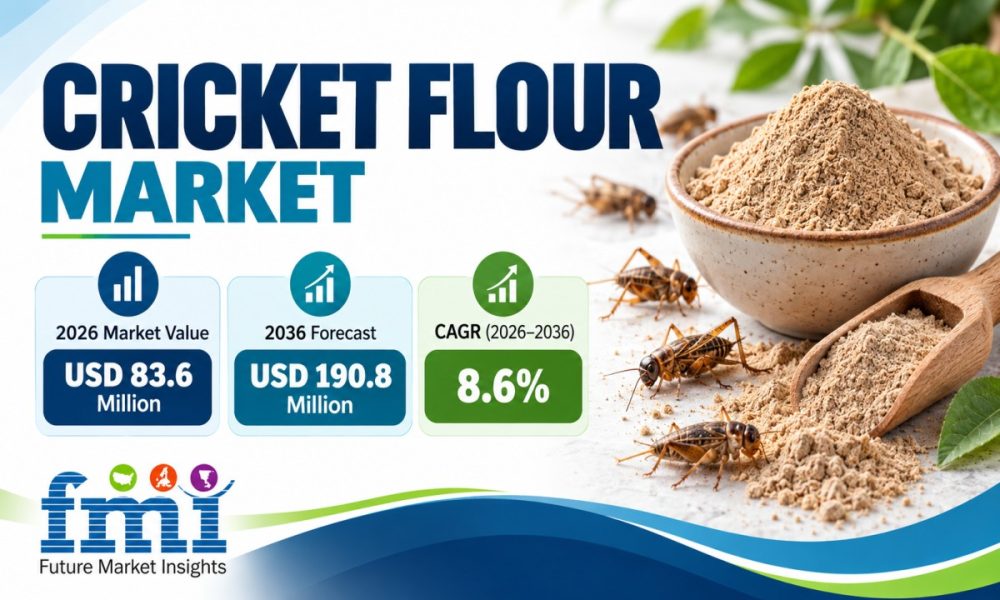
Summary: Global cricket flour market is set to reach USD 190.8 million by 2036, driven by demand for alternative protein ingredients, bakery applications, and standardized insect-derived powders for commercial food production.
The global cricket flour market is expanding as food manufacturers explore insect-derived protein ingredients for bakery products and other food applications. The market is projected to grow from USD 83.6 million in 2026 to USD 190.8 million by 2036, registering an 8.6% CAGR during the forecast period, according to the latest insights by Future Market Insights (FMI).
Global Cricket Flour Market Snapshot
· 2026 market value: USD 83.6 million
· 2036 forecast: USD 190.8 million
· CAGR, 2026–2036: 8.6%
· Leading grade: Standard milling grade
· Standard milling grade share, 2026: 38.0%
· Leading form: Powder – dry
· Dry powder share, 2026: 41.0%
· Leading application: Bread & rolls
Get detailed market forecasts, competitive benchmarking, and pricing trends:
https://www.futuremarketinsights.com/reports/sample/rep-gb-34768
Why Is the Cricket Flour Market Growing?
Demand for cricket flour is supported by food manufacturers seeking alternative protein ingredients that can meet nutritional, processing, and food-safety requirements. Commercial adoption depends on consistent powder quality, controlled flavor, and compatibility with established bakery production systems.
In August 2026, a USDA National Institute of Food and Agriculture project reported an active USD 650,000 award for cricket protein powder development. Its focus on sensory performance and production costs addresses two important factors influencing whether initial bakery trials can become repeat commercial orders.
Standard Milling Grade Leads the Grade Category
Standard milling grade is projected to account for 38.0% of grade demand in 2026, making it the leading category.
Its position reflects the usefulness of broad ingredient specifications during initial bakery formulation and qualification. Manufacturers can evaluate particle size, moisture, flavor, and microbiological performance before moving toward specialized certified grades.
Why Does Dry Powder Lead the Form Category?
Dry powder is forecast to represent 41.0% of form demand in 2026.
The format fits established flour-receiving, storage, blending, and metering systems used by industrial bakeries. Manufacturers can preblend cricket powder with other dry ingredients before evaluating dough performance and finished-product quality.
However, food safety remains essential. The U.S. Food and Drug Administration’s August 2026 Import Alert 99-43 includes milled edible-insect products and edible-insect bakery products within Salmonella-related detention controls. Documented hygiene practices and consistent ingredient specifications are therefore important during commercial qualification.
Bread & Rolls Lead Application Demand
Bread and rolls are projected to account for 36.0% of application demand in 2026.
These products provide recurring production cycles through which manufacturers can evaluate cricket flour’s water absorption, dough development, crumb quality, and flavor. Small variations in particle size or moisture can affect processing performance and finished-product consistency.
Industrial bakeries must therefore assess dough tolerance during scale-up before approving cricket flour for regular production. Repeatable performance across batches is particularly important when manufacturers incorporate unfamiliar ingredients into established recipes.
Direct Sales to Industrial Bakeries Strengthen Commercial Adoption
Direct sales to industrial bakeries are expected to capture 48.0% of sales channel demand in 2026.
Direct technical engagement allows cricket flour producers to address formulation, quality, and labeling questions before customers commit to recurring volumes. Ingredient distributors remain important for smaller manufacturers that require local inventory and regulatory support.
Regulatory Clarity Creates Opportunities, While Food Safety Remains a Challenge
Novel-food procedures can help manufacturers determine which documentation is required before investing in formulation development. In December 2025, Saudi Arabia’s Food and Drug Authority reported work on an integrated novel-food regulatory framework intended to establish clearer pathways.
Nevertheless, allergen management, microbiological controls, and sensory acceptance remain important adoption barriers. The UK Food Standards Agency highlighted allergen information and hygiene requirements for edible insects in June 2026. Producers that align regulatory documentation with application data can address compliance and formulation questions during the same qualification process.
UAE Leads the Profiled Country Growth
The UAE is projected to register a 10.1% CAGR through 2036, supported by established import channels and access to commercial bakery and hospitality customers. Complete registration documentation and consistent ingredient specifications remain essential for converting trials into repeat orders.
Saudi Arabia follows with a 9.7% CAGR, supported by specialist import channels and demand for compliant food ingredients. Regulatory documentation and early dossier review are important for managing qualification costs.
South Korea is projected to grow at 9.4% CAGR, benefiting from its recognized edible-insect ingredient base. Familiar food formats and localized flavor development can help manufacturers introduce cricket flour to broader consumer markets.
The USA is forecast to register a 9.1% CAGR, supported by established industrial bakery development channels. Food-safety documentation and consistent microbiological controls remain important for commercial acceptance.
The UK is projected to record an 8.8% CAGR through 2036. Changes in novel-food authorization requirements make regulatory monitoring and timely product-file updates important for ingredient suppliers.
Competitive Landscape: Entomo Farms, Aspire Food Group and Cricket One Strengthen Supply Capabilities
The competitive environment includes cricket producers, ingredient processors, and application-focused suppliers.
Entomo Farms and Aspire Food Group bring integrated cricket production and processing capabilities. Cricket One, Global Bugs Asia, and JR Unique Foods serve ingredient markets through cricket processing and supply networks, while All Things Bugs, Protanica, and Thai Ento Food focus on ingredient processing and customer-specific solutions.
Competition depends on consistent powder specifications, food-safety documentation, production reliability, and technical support. Suppliers that help bakeries manage hydration, flavor, and quality variation are better positioned to convert initial trials into repeat commercial orders.
What Does the Market Mean for Industry Decision-Makers?
The 8.6% CAGR indicates growing commercial interest in cricket flour as an alternative protein ingredient, particularly across bakery applications.
For manufacturers, the priority is evaluating ingredient consistency, dough performance, sensory acceptance, and food-safety requirements before scaling production. For suppliers, standardized milling specifications and practical formulation support can strengthen customer qualification and repeat purchasing.
The strongest opportunities are likely to emerge where regulatory readiness, reliable powder performance, and application-specific technical expertise come together.
Get the Complete Story—Read More About Our Latest Report:
https://www.futuremarketinsights.com/reports/cricket-flour-market
Related Food & Beverages Industry Reports
For companies tracking alternative proteins and insect-derived food ingredients, relevant FMI research areas include:
· Insect Protein Market
· Alternative Protein Market
· Plant-Based Protein Market
· Bakery Ingredients Market
· Protein Ingredients Market
About Future Market Insights (FMI)
Future Market Insights, Inc. is an ESOMAR-certified, ISO 9001:2015 market research and consulting organization trusted by Fortune 500 companies. With a global presence across the U.S., UK, India and Dubai, FMI delivers data-driven insights across 30+ industries and 1,200 markets worldwide.



