
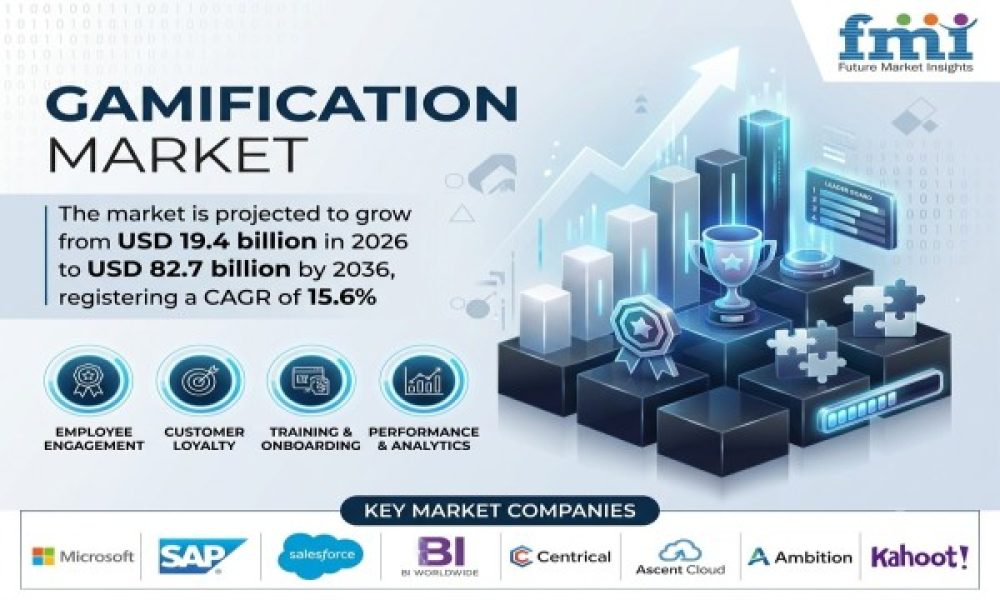
NEWARK, Del., October 12, 2026. The global gamification market is projected to grow from USD 19.4 billion in 2026 to USD 82.7 billion by 2036, registering a compound annual growth rate (CAGR) of 15.6%, according to Future Market Insights (FMI). The market is expected to add USD 63.3 billion over the forecast period as businesses incorporate points, badges, leaderboards and progress tracking into employee training, sales performance, customer loyalty and digital learning programmes.
The shift is moving gamification beyond stand-alone competitions. Organizations are connecting game mechanics with customer relationship management systems, learning platforms and performance records to measure whether participation leads to useful outcomes. Cloud deployment is helping administrators manage programmes across distributed teams and customer groups, while increasing the need for clear data permissions and transparent reward rules. <Cite refs={[“turn967181search0″,”turn967181view0”]}/>
Digital adoption creates new opportunities for measurable engagement
The strongest demand signal comes from established digital workflows that already record employee and customer activity. Learning platforms track course completion, sales systems record performance and retailers maintain transaction histories. These records give organizations a basis for setting goals, assigning rewards and measuring results without relying entirely on manual scoring.
Country-level data cited by FMI illustrates the commercial conditions behind adoption. Japan’s Ministry of Economy, Trade and Industry (METI) reported in August 2025 that business-to-consumer e-commerce grew 5.1% during 2024, with a 9.8% e-commerce ratio. In the United Kingdom, the Office for National Statistics reported in January 2026 that online spending in the fourth quarter of 2025 rose 8.4% year over year across Great Britain.
These figures provide context for digital engagement and customer loyalty applications. They do not directly measure spending on gamification software. The business case still depends on whether reward systems improve retention, learning completion or other outcomes that organizations can verify.
Request a Sample Report — Unlock Key Market Insights!
https://www.futuremarketinsights.com/reports/sample/rep-gb-34530
Where growth is fastest
FMI’s country forecasts show Japan leading the five profiled markets, followed by the United Kingdom and the United States. European demand is also supported by enterprise digitization, although integration work, internal approvals and data-governance requirements can affect implementation schedules.
- Japan — 15.5% CAGR: Digital commerce supplies transaction data that businesses can use to design loyalty programmes. Localization, domestic system integration and lengthy enterprise approvals can extend implementation.
- United Kingdom — 15.2% CAGR: Established online commerce supports customer engagement and workforce learning applications. Privacy reviews and incentive-transparency requirements can lengthen procurement.
- United States — 14.9% CAGR: Existing customer relationship management connections and workforce programmes support adoption. Security reviews and complex integrations can delay deployment.
- France — 14.6% CAGR: Digital support initiatives provide opportunities for wider adoption among smaller businesses. Limited staff time and difficulty selecting suitable providers remain barriers.
- Germany — 14.3% CAGR: Cloud adoption supports integration with enterprise learning systems. Works council consultation, employee-data controls and legacy systems can extend implementation schedules.
The CAGRs indicate expected market growth from 2026 to 2036. They should not be interpreted as guaranteed sales growth for individual vendors.
What leads the market
Four segments account for substantial portions of projected 2026 demand. Their shares highlight where organizations are directing investment and where suppliers need to demonstrate practical value.
- Software — 71.0% of component demand: Software leads because centralized rules, analytics and reward administration allow organizations to manage programmes across departments and user groups.
- Cloud deployment — 66.0%: Cloud platforms support access across distributed teams and channels, with coordinated updates and centralized administration.
- Employee engagement — 29.0% of application demand: Established training, coaching and performance-management workflows support adoption of progress tracking and recognition systems.
- Retail and e-commerce — 24.0% of end-use demand: Frequent transactions and digital interactions provide opportunities to connect loyalty milestones with customer behaviour.
These shares refer to different segmentation categories and should not be added together. The report also covers services, managed services, on-premise and hybrid deployment, customer engagement, learning and education, sales and marketing, enterprise size, and other end-use industries. <Cite refs={[“turn967181search0″,”turn967181view0”]}/>
The hurdle: engagement is not the same as performance
The central restraint is the risk that poorly designed reward systems encourage activity without improving the intended outcome. Employees may accumulate points without developing the required skills, while customers may respond to short-term incentives without becoming more loyal.
Customization can add to implementation costs. Businesses may need to connect gamification software with identity management, learning platforms, sales records and customer systems. They must also decide which actions qualify for rewards, how scores are calculated and who can access the underlying data.
FMI identifies AI-personalized challenges and connected coaching as opportunities. These approaches can tailor goals to roles and use verified performance signals to guide feedback. Their value depends on transparent rules and meaningful measurement rather than the volume of badges, points or completed activities.
Recent developments and industry investment
Recent product announcements show how suppliers are connecting gamification with coaching, sales performance and AI-assisted learning.
- March 2026: Ambition released bracket competitions pairing head-to-head challenges with scorecards and coaching linked to measurable revenue behaviours.
- January 2026: Centrical launched AI role-play simulations connecting practice with performance signals and gamified missions across frontline coaching workflows.
- February 2025: Kahoot! launched Kahoot! Energize, an AI-assisted tool designed to support meetings.
These developments illustrate product activity in the sector. They do not, by themselves, establish market share or prove that the products deliver particular business outcomes.
FMI profiles eight companies in the market: Microsoft Corporation, SAP SE, Salesforce, Inc., BI WORLDWIDE, Centrical, Ascent Cloud, Ambition and Kahoot! Their offerings span enterprise learning, customer engagement, workforce recognition, coaching and sales performance management. Competition depends on the breadth of available mechanics, integration with existing systems, workflow coverage and the ability to demonstrate measurable results. <Cite refs={[“turn967181search0″,”turn967181view0”]}/>
Analyst perspective
“Program owners should trace learning completions and customer actions from source systems into transparent reward rules. Platforms lose commercial credibility once short contests generate visible activity without durable behavior change.”
— Sudip saha, Principal Consultant, Future Market Insights
What this means for enterprise buyers
For business leaders evaluating gamification software, the priority should be measurable outcomes, integration requirements and sustained participation rather than the number of features available.
- Define success before selecting a platform. Set clear measures for the intended outcome, such as learning completion, proficiency, sales performance or customer retention. Establish a baseline so the organization can distinguish genuine improvement from increased activity.
- Review integration and data governance early. Map the systems that will supply activity records, define permissions and verify how scores and rewards are calculated. Include implementation, maintenance, customization and training costs when comparing vendors.
- Test whether engagement lasts. Run a limited programme before expanding across the organization. Monitor participation over time, compare results with the original objectives and review whether rewards are encouraging the desired behaviour. Adjust rules when short-term contests generate activity without sustained improvement.
These steps can help procurement and programme teams assess whether gamification fits their workflows and budget, while giving suppliers clearer acceptance criteria.
Report coverage
Future Market Insights’ Gamification Market report examines market size and forecasts through 2036, component and deployment shares, applications, enterprise size, end-use industries, country growth rates, competitive positioning, demand drivers, restraints and emerging opportunities.
Explore More Related Reports –
Harsh-Environment Connectors Market – https://www.futuremarketinsights.com/reports/harsh-environment-connectors-market
Network Processing Unit Market – https://www.futuremarketinsights.com/reports/network-processing-unit-market
About Future Market Insights
Future Market Insights, Inc. (FMI) is an ESOMAR-certified market research and consulting firm headquartered in Delaware, USA, with offices in the United Kingdom, the United Arab Emirates and India. FMI delivers syndicated and custom research across food and beverage, healthcare, chemicals, technology, packaging, consumer goods and industrial sectors.
Media contact
Future Market Insights, Inc.
Email: [email protected]
Phone: +1-347-918-3531



