
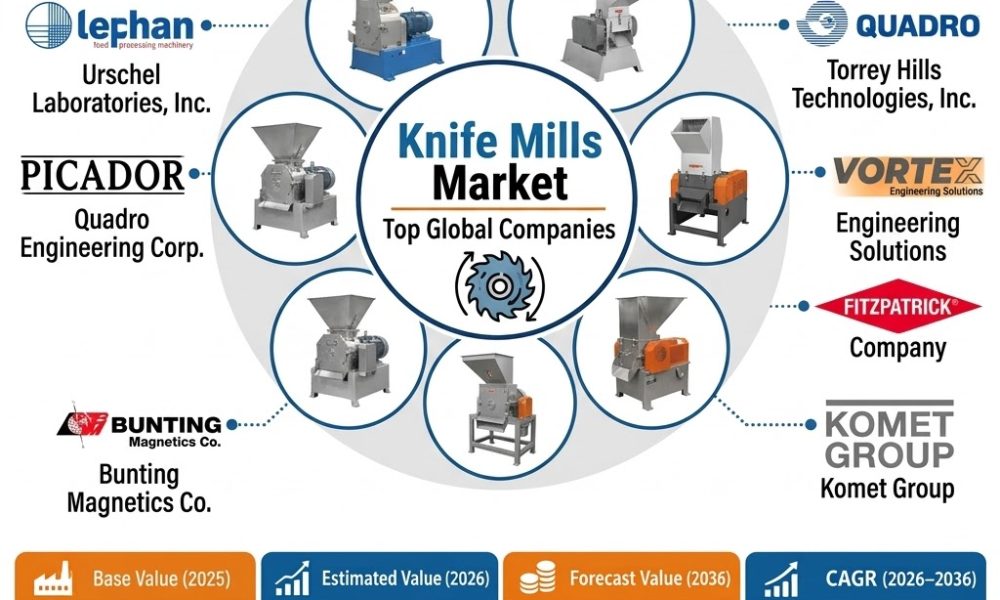
The global knife mills market is projected to increase from USD 529.9 million in 2026 to USD 776.9 million by 2036, expanding at a compound annual growth rate (CAGR) of 3.9%, according to Fact.MR. The market was valued at USD 510.0 million in 2025 and is forecast to generate an additional USD 247.0 million in market value between 2026 and 2036.
Plastic processing accounts for 38.9% of application demand, making plastics recycling, polymer size reduction and regranulation central to equipment procurement. Rotary knife mills represent 36.5% of the product segment in 2026, while medium-capacity mills account for 44.7% of the capacity segment. These segments provide equipment manufacturers and industrial buyers with a clearer view of where demand is concentrated as processors evaluate production requirements and equipment costs.
Get detailed market forecasts, competitive benchmarking, and pricing trends: https://www.factmr.com/connectus/sample?flag=S&rep_id=8577
Circular economy requirements and recycling investment shape demand
Plastics recycling is a major source of demand for knife mills as manufacturers and waste processors seek equipment for reducing plastic waste to usable particle sizes. Fact.MR identifies circular economy requirements in Europe, expanding plastics manufacturing in Asia Pacific, and established recycling and food-processing operations in North America as important regional demand factors.
Food processing is another growth application. Spice grinding, fruit and vegetable processing, and specialty ingredient size reduction support demand for equipment designed around specific material and processing requirements.
At the same time, procurement decisions are becoming more complex. Buyers must balance cutting precision, energy consumption, maintenance requirements and compliance with application-specific specifications. Smart knife mills featuring Internet of Things (IoT)-enabled monitoring, real-time throughput tracking and predictive maintenance are emerging as an area of competitive differentiation.
Where growth is fastest
Fact.MR’s country-level forecasts identify China as the fastest-growing market among the five countries listed below. The projections also highlight continued demand in the United States and European industrial markets.
- China — CAGR 4.6% through 2036: Plastics manufacturing, recycling infrastructure expansion and food-processing modernization support demand. Domestic manufacturers also serve export markets.
- United States — CAGR 3.8%: Plastics recycling and food processing sustain equipment demand, while biomass processing provides an additional application opportunity.
- Germany — CAGR 3.5%: Plastics recycling, circular economy compliance, food processing and pharmaceutical applications support procurement.
- Italy — CAGR 3.4%: Food processing, plastics recycling and packaging applications underpin demand, alongside manufacturers serving European and Mediterranean export markets.
- South Korea — CAGR 3.3%: Plastics manufacturing, food-processing upgrades and chemical processing support demand for equipment with greater precision and automation.
These forecasts suggest that suppliers should assess markets not only by growth rate but also by application mix, service requirements and the specifications buyers prioritize.
What leads the market
Fact.MR’s 2026 segment estimates identify three leading categories:
- Application — Plastic processing: 38.9%. Recycling plastic waste, polymer size reduction and regranulation form the primary demand base.
- Product — Rotary knife mills: 36.5%. Established buyer preferences, application coverage and compatibility with existing processing infrastructure support the segment’s leading share.
- Blade configuration — Straight blade knife mills: 42.1%. The segment leads the blade category, reflecting established demand across major applications.
- Capacity — Medium-capacity mills: 44.7%. This category represents the largest share of the capacity segment.
The figures describe different segmentation categories and should not be added together. Each provides a separate view of product demand and equipment requirements.
The hurdle: Price pressure and procurement complexity
Cost remains a constraint for knife mill manufacturers, particularly in entry-level segments where buyers compare equipment against lower-priced alternatives. Supply chain concentration and material availability can also create procurement uncertainty, while differences in regional specifications and compliance requirements increase market-entry costs.
For buyers, the challenge is to evaluate equipment beyond its purchase price. Cutting performance, material compatibility, expected maintenance needs, energy use and application-specific design requirements can all affect the total cost of ownership.
Manufacturers competing for higher-value applications may need to demonstrate how their equipment meets these requirements without introducing unnecessary complexity or cost.
Industry investment and recent developments
Fact.MR identifies three company developments on its report page. The source lists the years but does not specify the months of announcement.
- GEA Group AG / Stephan Machinery — 2025: The report describes the introduction of a hygienic knife mill series with improved clean-in-place capability and a design intended for dairy, meat and specialty food-processing applications.
- Urschel Laboratories, Inc. — 2025: The report describes enhancements to precision cutting systems, with a focus on cutting consistency and throughput in food processing.
- FAM GmbH — 2026: The report describes an expansion of the company’s Asia Pacific distribution and service network to address demand from food-processing and plastics-recycling operations.
These developments are presented as reported in the Fact.MR market analysis. The report does not provide exact announcement dates or independent supporting links for the individual developments.
The companies profiled in the market include GEA Group AG / Stephan Machinery, Urschel Laboratories, Inc., FAM GmbH, Torrey Hills Technologies, Inc., Vortex Engineering Solutions, Fitzpatrick Company, Komet Group, Bunting Magnetics Co., Quadro Engineering Corp., PICADOR GmbH, Hosokawa Micron Group, Miura Co., Ltd., Kreyenborg GmbH & Co. KG, and Sormac B.V.
Competition centers on cutting precision, material applicability, hygienic design, application engineering and service support. Fact.MR also identifies integrated monitoring and energy optimization as areas in which suppliers may differentiate their equipment.
Analyst perspective
Shambhu Nath Jha, Principal Consultant at Fact.MR, says:
“The knife mills market is a precision cutting equipment category where material-specific engineering and application knowledge differentiate vendors more than hardware specifications alone. Plastic recycling is the largest growth driver, supported by circular economy mandates that are creating dedicated recycling line investment worldwide. Food processing represents the highest-margin application, where hygienic design, contamination control, and food safety certification command premium pricing. Vendors that combine cutting precision with smart monitoring, energy optimization, and application-specific engineering will capture the premium segments.”
What this means for equipment buyers and manufacturers
- Match equipment specifications to the material being processed. Buyers should compare blade configuration, throughput requirements and material compatibility against their actual processing needs. The leading rotary knife mill and straight blade segments provide useful market context, but individual equipment selection should reflect the intended application.
- Evaluate lifecycle costs before committing capital. Purchase price alone may not capture the cost of energy consumption, blade replacement, maintenance and downtime. Where available, monitoring and predictive maintenance features can be assessed against operational requirements and expected savings rather than assumed to deliver the same benefit at every facility.
- Prioritize markets and applications with a clear demand case. Plastics recycling remains the largest identified application, while food processing and biomass processing offer additional opportunities. Manufacturers considering geographic expansion should compare country growth forecasts with distribution coverage, service capabilities, regional specifications and the needs of local customers.
Top Trending Reports:
DNA and RNA Sample Preparation Market
About FactMR
FactMR is an ESOMAR-certified market research and consulting firm headquartered in Delaware, USA, with offices in the United Kingdom, the United Arab Emirates and India. FMI delivers syndicated and custom research across food and beverage, healthcare, chemicals, technology, packaging, consumer goods and industrial sectors.



