
Summary: Global frost recovery additives market is set to reach USD 378.6 million by 2036, driven by demand for crop-stress management, timely agronomic support, and products designed to support plants experiencing recoverable cold stress.
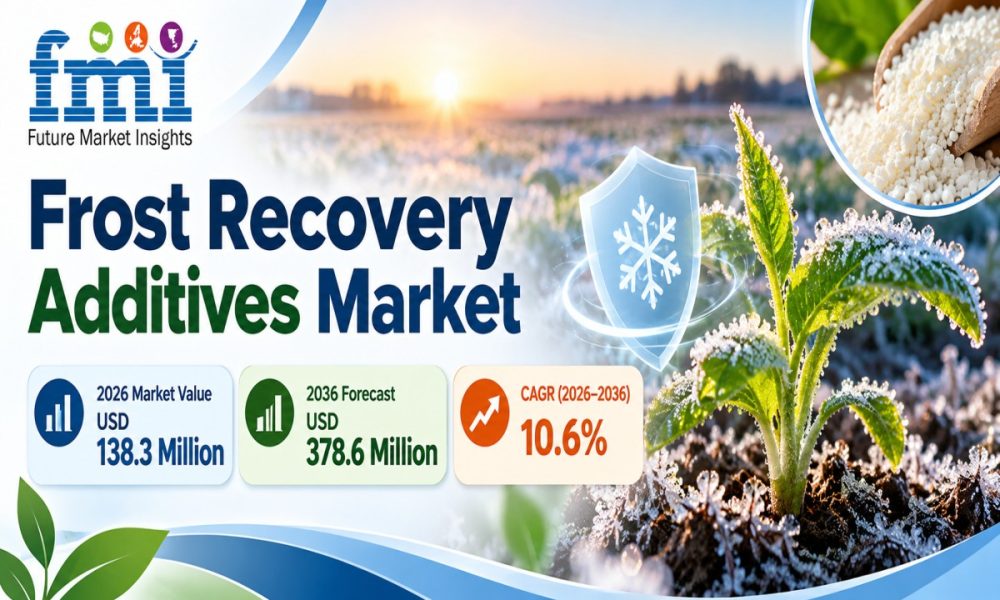
The global frost recovery additives market is expanding as farmers and agricultural input suppliers seek solutions to manage frost-related crop stress. The market is projected to grow from USD 138.3 million in 2026 to USD 378.6 million by 2036, registering a 10.6% CAGR during the forecast period, according to the latest insights by Future Market Insights (FMI).
Global Frost Recovery Additives Market Snapshot
· 2026 market value: USD 138.3 million
· 2036 forecast: USD 378.6 million
· CAGR, 2026–2036: 10.6%
· Leading product type: Osmoprotectant blends
· Osmoprotectant blends share, 2026: 40.9%
· Leading crop type: Cereals and grains
· Cereals and grains share, 2026: 49.3%
· Leading application method: Soil application
Get detailed market forecasts, competitive benchmarking, and pricing trends:
https://www.futuremarketinsights.com/reports/sample/rep-gb-34761
Why Is the Frost Recovery Additives Market Growing?
Frost events can damage crops and create urgent demand for agricultural inputs that support plants experiencing recoverable cold stress. Farmers and distributors must coordinate product availability, agronomic guidance, and application timing because weather alerts can compress purchasing decisions into a few days.
Syngenta reported in May 2025 that its biologicals facility in South Carolina was built for annual biostimulant production capacity of 16,000 tons. Greater production capacity can help distribution networks prepare for weather-driven demand and maintain supplies of biological inputs ahead of critical treatment windows.
Osmoprotectant Blends Lead the Product Type Category
Osmoprotectant blends are estimated to account for 40.9% of product type demand in 2026, making them the leading category.
These formulations are designed to support osmotic adjustment and cellular stress management during cold exposure. Ingredients such as glycine betaine and proline are considered in crop-stress programs according to injury severity, crop stage, and treatment timing.
Why Do Cereals and Grains Lead Crop Type Demand?
Cereals and grains are projected to represent 49.3% of crop type demand in 2026.
The category benefits from broad-acre cultivation and established crop-management programs. Farmers need treatments that fit existing spraying and nutrition schedules without significantly increasing costs per hectare.
Koppert launched Stingray 25 in France in February 2025 as an Ascophyllum nodosum-based biostimulant positioned for root development and stress tolerance. Formulations that integrate with established field operations can offer practical advantages across large commercial farms.
Soil Application Leads Application Method Demand
Soil application is projected to account for 51.7% of application method demand in 2026.
The segment benefits from its compatibility with planned establishment, fertility, and root-zone management programs. Applying suitable inputs through existing soil-management operations can reduce the need for separate interventions when frost warnings emerge.
Syngenta and Ceres Biotics signed a global VIXERAN agreement in February 2025 for a biostimulant designed to support nitrogen access through leaves and roots. This illustrates the broader development of biological input systems that integrate with established agronomic practices.
Agri-Input Distributors Strengthen Market Access
Agri-input distributors are forecast to hold 47.0% of sales channel demand in 2026.
Local inventory and technical support are particularly important when frost warnings leave limited time for purchasing and application. Distributors can coordinate product selection with crop advisers and help farmers distinguish preventive treatments from post-event applications.
Frost Injury and Claim Requirements Create Challenges
Frost recovery additives face practical limits because treatment outcomes depend on crop stage, injury severity, and the availability of viable tissue. Severe freezing can cause irreversible damage, making accurate product claims and clear application guidance essential.
In May 2026, the USDA Risk Management Agency reported that a late-April freeze caused catastrophic perennial-crop damage across thirteen states and required emergency loss procedures. Events of this scale reinforce the importance of combining suitable crop-management inputs with physical frost protection, risk assessment, and insurance where applicable.
USA Leads the Profiled Country Growth
The USA is projected to register a 10.3% CAGR through 2036, supported by established agricultural input distribution and demand for crop-stress management. Formal loss assessment and regional agronomic support influence how growers evaluate preventive treatments and recovery options.
South Korea follows with a 10.0% CAGR, supported by farm-level meteorological warnings and extension services. In April 2026, the Rural Development Administration reported freeze-protection treatment testing at 23 major fruit-growing sites, with effectiveness lasting approximately seven days following application two to three days before cold exposure.
Germany is projected to grow at 9.7% CAGR, supported by mature agricultural distribution and demand for crop-specific stress-management solutions. Seasonal variations in frost damage create opportunities but also make demand less predictable.
The UK is forecast to register a 9.2% CAGR, as growers evaluate frost-management products against per-hectare costs, existing field operations, and evolving fertiliser requirements.
Japan is projected to record an 8.5% CAGR through 2036. Local frost advisories and crop-development monitoring make application timing important, particularly for orchards and cereal production.
Competitive Landscape: Syngenta, Acadian Plant Health and Koppert Expand Biological Solutions
The competitive environment includes global agricultural input suppliers and specialist biostimulant developers.
Syngenta, ICL Group, UPL Ltd. and Corteva Agriscience offer broader crop-input and biological portfolios. Acadian Plant Health and Hello Nature focus on biostimulant solutions, while Koppert and Rovensa Next provide biological crop-management technologies across agricultural markets.
Competition increasingly depends on crop-stage evidence, product availability, distribution readiness, and clearly defined treatment claims. Companies that combine agronomic guidance with reliable supply can better serve growers during short weather-driven purchasing windows.
What Does the Market Mean for Industry Decision-Makers?
The 10.6% CAGR indicates growing demand for agricultural solutions that support crop management around frost and cold-stress events.
For growers, the priority is identifying the correct treatment window and distinguishing recoverable stress from irreversible injury. For suppliers, crop-specific evidence, transparent claims, and nearby inventory are essential to building trust and encouraging repeat purchases.
The strongest opportunities are likely to emerge where biological input innovation, timely weather intelligence, and practical agronomic support come together.
Get the Complete Story—Read More About Our Latest Report:
https://www.futuremarketinsights.com/reports/frost-recovery-additives-market
Related Agriculture Industry Reports
For companies tracking crop-stress management and agricultural biological technologies, relevant FMI research areas include:
· Biostimulants Market
· Agricultural Biologicals Market
· Seaweed Extracts Market
· Specialty Fertilizers Market
· Plant Growth Regulators Market
About Future Market Insights (FMI)
Future Market Insights, Inc. is an ESOMAR-certified, ISO 9001:2015 market research and consulting organization trusted by Fortune 500 companies. With a global presence across the U.S., UK, India and Dubai, FMI delivers data-driven insights across 30+ industries and 1,200 markets worldwide.



