
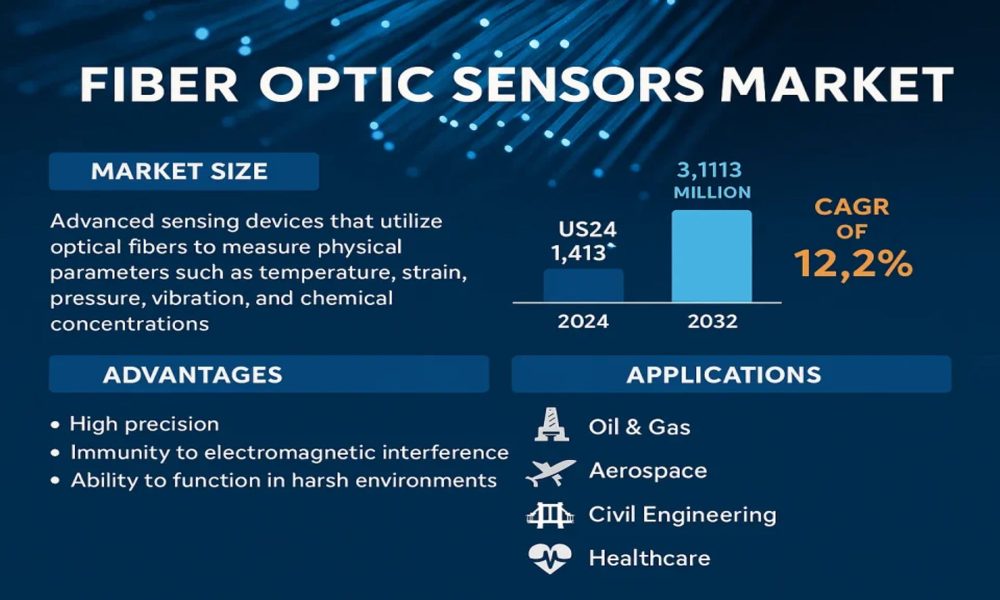
Fiber Optic Sensors Market size was valued at USD 1,413 million in 2024 to USD 3,111 million by 2032, exhibiting a CAGR of 12.2% during the forecast period.
Fiber optic sensors are advanced sensing devices that utilize optical fibers to measure physical parameters such as temperature, strain, pressure, vibration, and chemical concentrations. These sensors operate by transmitting light through an optical fiber and detecting changes in its properties, such as intensity, phase, or wavelength, caused by external stimuli. Their high precision, immunity to electromagnetic interference, and ability to function in harsh environments make them ideal for applications in industries like oil & gas, aerospace, civil engineering, and healthcare.
The market is witnessing robust growth due to increasing demand for real-time monitoring systems in critical infrastructure and industrial applications. The rising adoption of distributed sensing technology, particularly in smart cities and energy sectors, further drives market expansion. Key players such as Micron Optics, Honeywell, and Omron dominate the industry, collectively holding around 39% market share. Additionally, advancements in fiber Bragg grating (FBG) sensors and the expansion of 5G networks are expected to create new opportunities for market growth in the coming years.
Claim Your Free Sample Report- https://semiconductorinsight.com/download-sample-report/?product_id=122747
MARKET DRIVERS
Increasing Demand from Oil & Gas and Infrastructure Sectors
The global push towards renewable energy and the need for efficient infrastructure monitoring are driving demand. Fiber optic sensors provide critical data for structural health monitoring in bridges, tunnels, and wind turbines, while the oil and gas industry uses them for pipeline monitoring and leak detection, reducing environmental risks.
Rising Adoption in Aerospace and Defense Applications
Advanced fiber optic sensors are increasingly used in aerospace for strain and temperature monitoring in aircraft structures, contributing to lighter and safer designs. Defense applications include perimeter security and underwater monitoring, where their immunity to electromagnetic interference is crucial.
➤ Enhanced capabilities in harsh environments drive adoption.
With the ability to operate in extreme temperatures, corrosive environments, and high radiation areas, fiber optic sensors are becoming the preferred choice for nuclear facilities and space applications where traditional sensors fail.
Recent Developments in the Fiber Optic Sensors Market
Rising Demand in Structural Health Monitoring (2025):
The use of fiber optic sensors for monitoring bridges, tunnels, and pipelines is expanding due to their high sensitivity, durability, and resistance to electromagnetic interference. Infrastructure modernization projects in Asia-Pacific and North America are driving large-scale adoption.Advancements in Distributed Sensing Technology:
Recent innovations in Distributed Acoustic Sensing (DAS) and Distributed Temperature Sensing (DTS) systems have improved real-time monitoring capabilities for oil & gas, power, and transportation sectors.Integration with AI and IoT:
Leading companies are integrating AI algorithms with fiber optic sensor networks to enhance predictive maintenance and fault detection efficiency in industrial automation and smart grid systems.Miniaturization and Cost Reduction:
Ongoing R&D focuses on miniaturized optical sensing elements that reduce installation costs and improve compatibility with compact devices for biomedical and aerospace applications.
MARKET OPPORTUNITIES
Emerging Applications in Autonomous Vehicles and Smart Cities
Autonomous vehicles require highly reliable and precise sensing systems for navigation and obstacle detection. Fiber optic sensors offer advantages in size, weight, and electromagnetic immunity. Meanwhile, smart city initiatives are deploying these sensors for traffic monitoring, structural health monitoring of bridges, and utility monitoring, creating new revenue streams.
List of Key Fiber Optic Sensors Companies
Micron Optics
Honeywell
FISO Technologies
Omron
FBGS TECHNOLOGIES GMBH
Proximion
Smart Fibres Limited
Sensornet
ITF Labs / 3SPGroup
Keyence
IFOS
NORTHROP GRUMMAN
O/E LAND, Inc
KVH
Photonics Laboratories
Chiral Photonics
Segment Analysis:
Segment CategorySub-SegmentsKey InsightsBy Type
Intrinsic Sensors
Extrinsic Sensors
Distributed Sensors
Distributed Sensors are gaining significant traction due to their ability to provide continuous monitoring along the entire length of the fiber, making them ideal for large-scale infrastructure monitoring where precise location detection is critical.
By Application
Temperature Sensing
Pressure Sensing
Strain Sensing
Acoustic Sensing
Others
Strain Sensing applications continue to dominate due to their critical role in structural health monitoring across civil engineering, aerospace, and energy infrastructure where precise deformation measurement is paramount.
By End User
Oil & Gas
Manufacturing
Healthcare
Telecommunications
Aerospace & Defense
Aerospace & Defense sector demonstrates the highest growth momentum due to increasing investments in advanced surveillance systems, structural health monitoring of aircraft, and the development of next-generation military equipment requiring precise and immune sensing technologies.
By Technology
FBG (Fiber Bragg Grating)
Interferometric
Raman Scattering
Rayleigh Scattering
Fiber Bragg Grating (FBG) technology maintains dominance due to its maturity, reliability, and cost-effectiveness for multipoint sensing applications, particularly in structural health monitoring and temperature monitoring across industries.
By Region
North America
Europe
Asia Pacific
Rest of World
Asia Pacific region shows the most dynamic growth driven by massive infrastructure development, increasing industrialization, and the rapid adoption of Industry 4.0 technologies across major economies like China, Japan, and South Korea.
Claim Your Free Sample Report- https://semiconductorinsight.com/download-sample-report/?product_id=122747
About Semiconductor Insight:
Established in 2016, Semiconductor Insight specializes in providing comprehensive semiconductor industry research and analysis to support businesses in making well-informed decisions within this dynamic and fast-paced sector. From the beginning, we have been committed to delivering in-depth semiconductor market research, identifying key trends, opportunities, and challenges shaping the global semiconductor industry.
Our expertly developed semiconductor market reports offer actionable intelligence, including detailed semiconductor industry analysis, market forecasts, competitive analysis, and insights into technological advancements, enabling our clients to maintain a competitive edge. With nearly a decade of expertise, we remain at the forefront of innovation, delivering strategic clarity to businesses in the semiconductor sector.
Our commitment to providing insights into semiconductor market share and industry trends ensures that our clients have the information they need to succeed in the ever-evolving semiconductor market.
CONTACT US:
City vista, 203A, Fountain Road, Ashoka Nagar, Kharadi, Pune, Maharashtra 411014
[+91 8087992013]
[email protected]




