
President Donald Trump, in issuing harsh criticisms of Europe’s migration and security policies, has painted a picture of a continent descending into disorder. At the UN, he said Europe is going to hell – and argues that Europe is allowing lawlessness to fester at its heart — and in Spain, his warnings may be closer to reality than many wish to admit.
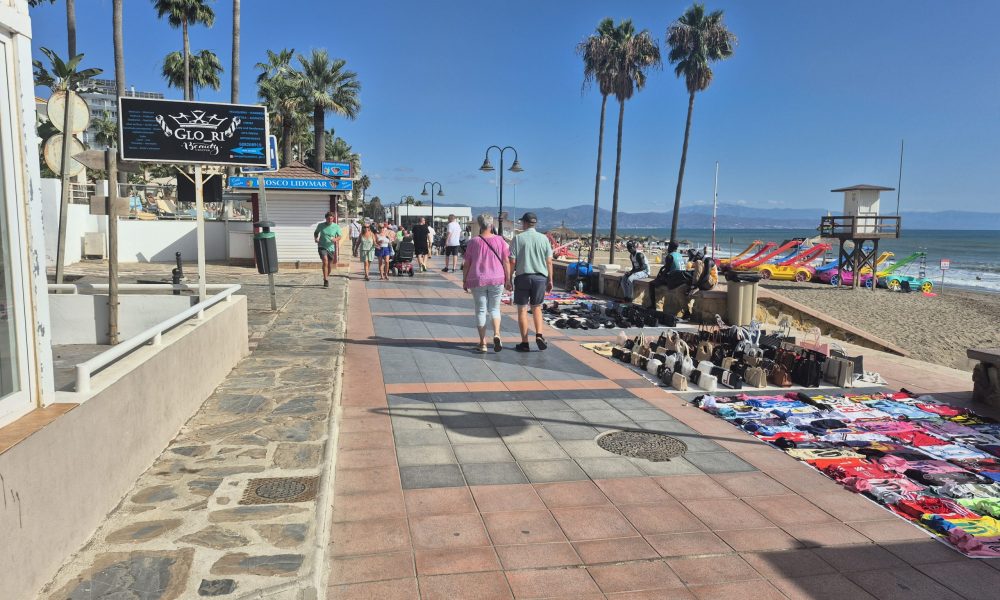
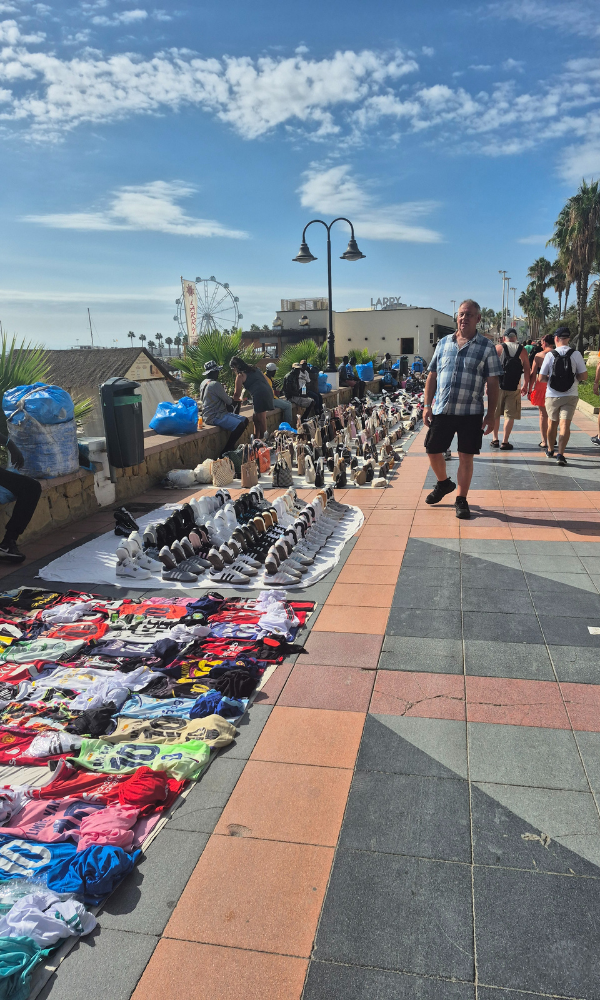
In the historic streets of Madrid, Barcelona, Málaga, Benalmadena / Torremolinos and elsewhere, we documented what can only be described as a brazen takeover of public space. Migrant vendors—many undocumented, unlicensed, and operating under cover of impunity—spread out blankets or foldable stands across half of the sidewalk, hawking counterfeit Adidas, Nike, Gucci and other “designer” items. We uncovered evidence that some are working under networks tied to the Italian mafia, coordinating logistics, supply and street-level sales across multiple cities.
What is most shocking: the police, at least in several neighbourhoods we visited, make no serious effort to stop them. Officers told us flatly: “If we bother these people, they may simply decide to go burgle properties to survive, so we let them make a bit of money from tourism.” In effect, law enforcement has self-immolated — choosing to tolerate visible lawbreaking in hopes of forestalling more harmful crime.
The legacy of impunity: from Rajoy to Sánchez
To understand how Spain reached this point, one must trace policies back through administrations. Under Mariano Rajoy’s government (2011–2018), the Minister of Defence from November 2016 until June 2018 was María Dolores de Cospedal. She was a rising star in the People’s Party (PP), wielding strong influence on security portfolios, and she cast a firm posture on migration and national sovereignty while also presiding over a period in which policing and interior policy often deferred on-the-ground enforcement to political discretion.
Some of the permissive attitudes toward street vending, gaps in enforcement, and tacit toleration of informal economies can be traced to rhythms that began during her tenure and that were never fully reversed. Under Pedro Sánchez, the Socialist government has largely kept the same framework — policing remains underfunded and strategic direction minimal, while enforcement is pushed downward and often left to local officials and foot-soldiers with little political backup.
On the military side, the current Chief of the Defence Staff (JEMAD) is Admiral Teodoro Esteban López Calderón, who has held the post since 27 January 2021. He is Spain’s top military officer and advisor in matters of national security, but by design the armed forces have little role in internal policing, and their priorities remain outward defense rather than domestic order.
For policing, the Director-General of the Police (DGP) is Francisco Pardo Piqueras, an appointment of the Ministry of the Interior since 1 June 2018. The National Police Corps (Cuerpo Nacional de Policía) remains under the authority of his office. Pardo’s tenure has seen growing criticism that his force is reactive rather than proactive — tolerating vendor flotillas rather than confronting them.
Thus Spain today sees a continuity of leadership in security institutions: Cospedal’s policing philosophy and institutional gaps persist under Sánchez, enforced through day-to-day toleration by Pardo, while the military stands apart as a powerless bystander to internal disorder.
Voices from street, shop and citizenry
We asked those on the ground what they see and feel. Their testimonies reveal a two-tiered system of justice.
Maria, a Spanish citizen we met near the Gran Vía in Madrid, said:
“No — I will be arrested and thrown in jail. I do not have these privileges as a Spanish citizen.”
Pablo, a Latino migrant living legally in Spain, added:
“I will definitely get a big fine if I try to do the same — different rules apply to us local people. We also have a two-tier system like the UK.”
Local shop owners were blunt. Maricruz, who runs a clothing boutique in Seville, told us:
“I have to pay a self-employed tax to keep my shop open and VAT on all products — these people come to compete with me. They face no consequences for non-compliance and pay no rent. The system is against me.”
A Dutch immigrant who owns a small business in Valencia observed:
“In the Netherlands they will never allow people to get away with this. What they do here in Spain is against the taxpayer. They are essentially targeting visible shops and citizens for easy taxes and let the rest get away with it.”
Why police “stand down”
We confronted local police commanders in one city district. They repeatedly declined to enforce vendor clearances or confiscate stock, citing resource constraints, political directives, and fears of unleashing worse crime. One sergeant we spoke to said:
“If we bother these people, they may simply decide to go and burglar properties to survive, so we let them make a bit of money from tourism.”
This logic — that turning a blind eye is a lesser evil — has become official policy in many neighborhoods. In effect, public authorities have sanctioned disorder, externalized enforcement to informal actors, and abandoned the expectation of equal rule of law.
Even major news outlets have documented similar dynamics. The Guardian, for example, has probed how “manteros” (blanket vendors) in Barcelona, many undocumented, sell pirated goods with scant interference from authorities. Another analysis described Madrid’s “blanket of freedom” over street vending, allowing hundreds to operate daily under tacit toleration. politicalcritique.org
Spain as Europe’s canary in the coal mine
What is happening on Spain’s sidewalks should alarm all of Europe. What Trump warns of — a weakening of sovereignty, erosion of enforcement, informal cartels moving into public space — is playing out in front of pedestrians and tourists. The inability (or unwillingness) of states to reclaim control of streets invites the logic of lawlessness to metastasize.
In effect, the continent is being asked to absorb not just migration flows, but the governance failure behind them. Rather than setting hard limits, many European nations have drifted toward permissiveness. The result: criminal networks — aligned across national boundaries — insert themselves into local economies, using migrant labor and informal supply chains to expand their reach.
The rise of right-wing youth in Spain
In response to what many perceive as a mounting crisis of security, identity, and fairness, Spain is witnessing a sharp political awakening among its youth — particularly on the right. Across the country, young Spaniards who feel betrayed by weak governance and selective law enforcement are increasingly aligning themselves with parties and movements that promise order, sovereignty, and national pride. On university campuses, in Telegram groups, and across social media platforms, pro-police slogans, anti-immigration sentiment, and calls for “Spain for Spaniards” are gaining traction. Many of these young people do not necessarily start out as extremists; they are citizens who have lost faith in institutions that seem to protect offenders rather than taxpayers and entrepreneurs.
In parts of Andalusia, Murcia, and Valencia, this frustration is already translating into local activism. Citizen patrols, neighborhood watch groups, and community defense initiatives have emerged — a visible sign that people no longer trust the state to maintain order. The emotional backlash is palpable. Shopkeepers and working-class residents, suffocated by taxes and compliance costs, watch unlicensed street vendors operate freely and conclude that the system is rigged.
Unless Spain moves quickly to restore visible law enforcement, fair competition, and equal accountability under the law, the pendulum could swing violently in the opposite direction. History shows that when ordinary citizens feel unheard for too long, moderation collapses and radicalism fills the void. If left unchecked, this resentment could fuel an enduring generational divide — with young Spaniards turning en masse toward populist and nationalist movements. Spain still has a narrow window to correct course: to reassert justice, rebuild trust, and prevent a political and cultural fracture that could take decades to mend.




