
Overview
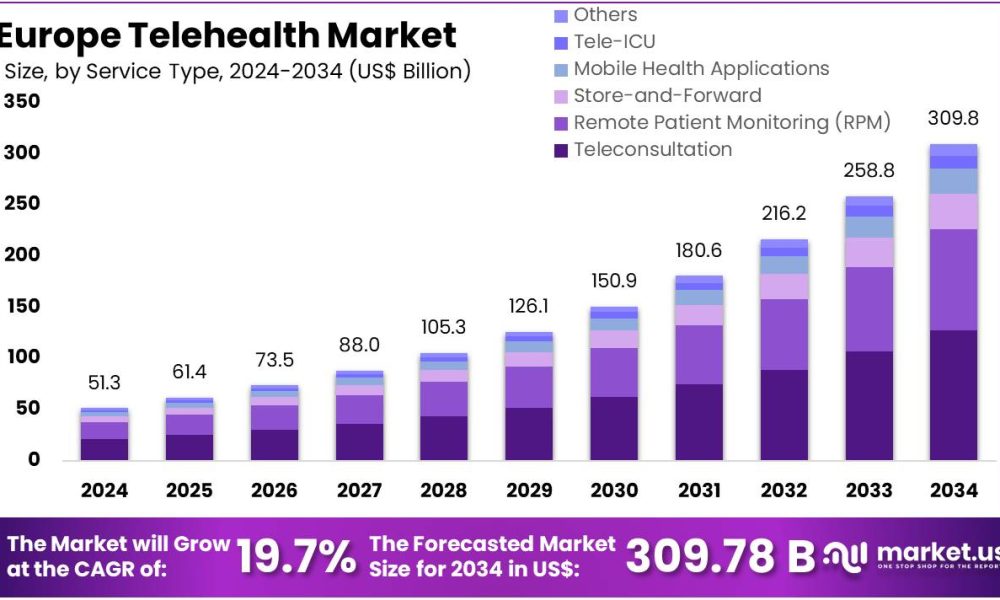
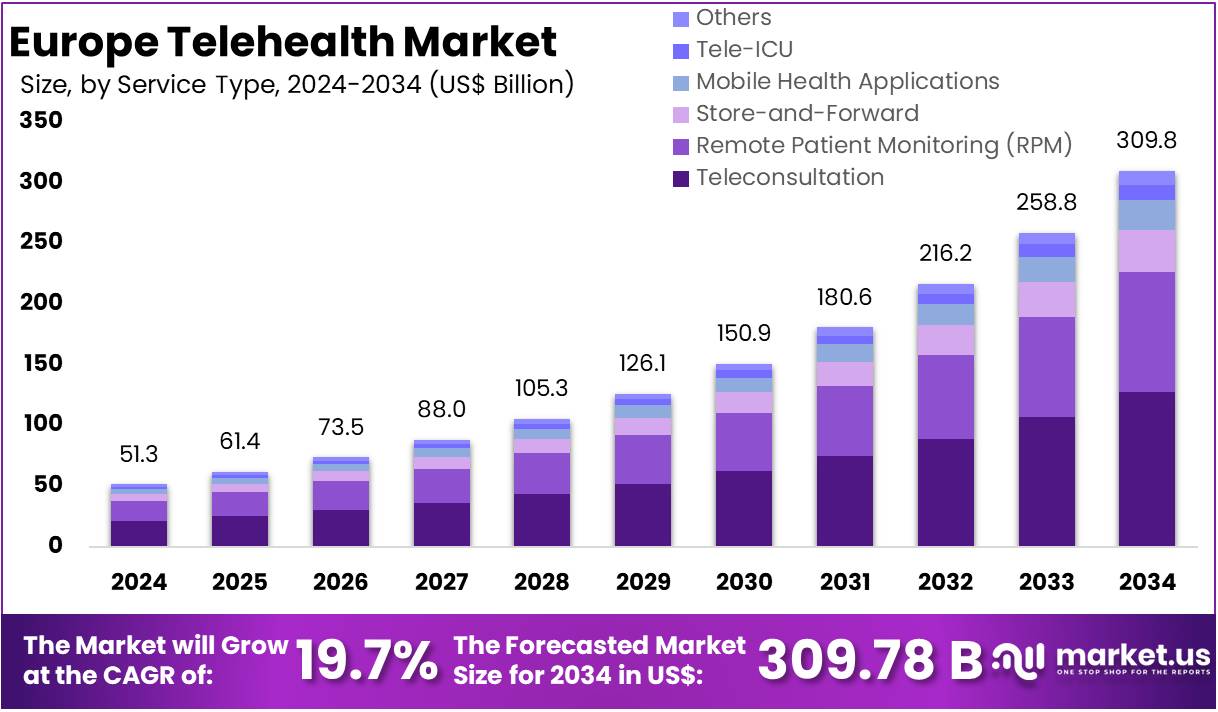
The Europe Telehealth market is witnessing robust growth and is projected to reach approximately USD 309.8 billion by 2034, up from USD 51.3 billion in 2024. This expansion reflects a strong compound annual growth rate (CAGR) of 19.7% during 2025 to 2034. The growth is primarily driven by rising demand for remote healthcare services. An aging population and the increasing need for chronic disease management further fuel the market. Telehealth enables flexible care delivery, making it essential for modern healthcare systems in Europe.
Remote consultations and patient support services hold the largest revenue share in the market. These are followed closely by telehealth software and connected devices like wearables and health sensors. Notably, mobile health (mHealth) applications contribute over one-third of total market revenue. This trend reflects growing public interest in digital tools for health tracking and chronic disease management. The convenience and ease of use offered by these tools are helping to drive broad adoption across all age groups.
Government-backed initiatives and favorable regulatory policies have accelerated telehealth adoption in Europe. Countries like the UK are leading in digital health transformation, supported by AI investments and improved healthcare infrastructure. These advancements are helping to improve patient access and treatment efficiency. They also support reduced hospital visits, which lowers the strain on traditional healthcare systems. Overall, this creates a more responsive and cost-effective care environment.
However, despite the promising growth trajectory, certain challenges persist. Key concerns include patient data privacy, complex regulatory compliance, and the uneven availability of digital infrastructure across regions. Ensuring secure data handling and standardizing legal frameworks are essential steps toward building public trust. Moreover, addressing these gaps is vital to ensure equitable access to telehealth services across both urban and rural populations in Europe.
The long-term outlook for the Europe telehealth market remains positive. The aging population, advances in healthcare technologies, and strong governmental support will continue to shape the market landscape. Ongoing investments in AI, cloud platforms, and wearable tech will enhance the capabilities of remote healthcare solutions. With strategic focus and innovation, telehealth is expected to transform healthcare delivery across Europe, offering better outcomes and broader access for patients in the coming decade.
Key Takeaways
- The Europe Telehealth Market is projected to grow from USD 51.3 billion in 2024 to USD 309.8 billion by 2034, expanding at 19.7% CAGR.
- Teleconsultation leads the service segment with a 40.8% share, driven by increased demand for remote doctor-patient interactions in general and specialized healthcare settings.
- Cloud-based deployment dominates with 65.9% market share, attributed to its scalability, remote accessibility, and secure storage supporting widespread telehealth service delivery.
- Telepsychiatry holds the top spot in distribution channels at 27.5%, propelled by growing mental health needs and limited psychiatric workforce post-COVID-19.
- Healthcare providers form the largest end-user group with a 46.2% market share, as hospitals and clinics heavily adopt telehealth to expand care access.
Get Sample: https://market.us/report/europe-telehealth-market/request-sample/
Segmentation Analysis
Teleconsultation is the leading service type in the European telehealth market, holding a 40.8% share. It allows patients to connect with healthcare providers through video, phone, or messaging platforms. Its popularity increased sharply during the COVID-19 pandemic due to restrictions on in-person visits. Teleconsultation is now widely used in primary care, mental health services, and urgent care. Growing patient preference for remote consultations, along with digital health innovations and expanded reimbursement policies across Europe, continues to support this segment’s growth. The EHDS Regulation, effective from March 2025, further boosts teleconsultation access and utility.
Cloud-based deployment dominates the European telehealth market, accounting for a 65.9% market share. This model provides scalable, flexible, and cost-effective access to telehealth services. Healthcare providers benefit from real-time access to patient records and easier integration with EHR systems. It supports remote monitoring, consultations, and secure data exchange. The cloud model also reduces hardware costs and simplifies IT needs. Philips’ February 2025 expansion of its HealthSuite Imaging platform in Europe, hosted on AWS, enhances radiology capabilities with AI features, increasing efficiency and diagnostic accuracy across several countries.
Telepsychiatry leads the application segment with a 27.5% market share in Europe’s telehealth sector. Mental health service demand has surged, especially since the pandemic. Telepsychiatry supports remote access to psychiatric care through video, phone, or messaging platforms. It helps reduce stigma and improves patient convenience. The shortage of mental health professionals, especially in rural regions, drives further adoption. Governments and insurers are increasing coverage for mental health services. Digital tools and AI-assisted diagnostics are being integrated into telepsychiatry workflows, enhancing treatment outcomes and enabling scalable mental health care delivery.
Healthcare providers are the dominant end users in Europe’s telehealth market, with a 46.2% share. Hospitals, clinics, and private practices increasingly use telehealth for virtual consultations and remote patient monitoring. These tools help providers manage patient loads, reduce unnecessary in-person visits, and maintain care continuity. Integration with EHR systems further streamlines operations. Governments are encouraging adoption through reimbursement support and incentives. The flexibility of telehealth platforms allows providers to expand their reach, especially in underserved areas. This results in cost-efficient service delivery while maintaining high-quality patient care standards.
By Service Type
- Teleconsultation
- Remote Patient Monitoring (RPM)
- Store-and-Forward
- Mobile Health Applications
- Tele-ICU
- Others
By Deployment Mode
- Cloud-Based
- On-Premises
By Application
- Telepsychiatry
- Teleradiology
- Teledermatology
- Teleneurology
- Teledermatology
- Others
By End User
- Healthcare Providers
- Patients
- Payers
- Others
Key Players Analysis
The Europe telehealth market is shaped by several prominent digital healthcare companies. Doctolib stands as one of the region’s largest platforms. It offers services like online appointment booking, teleconsultations, and digital health management. The company began by streamlining scheduling for both patients and providers. Kry, also known as Livi in the UK and France, is a Sweden-based provider delivering virtual consultations through its mobile app. Since its founding in 2014, Kry has expanded its services across multiple European countries, strengthening its presence in digital care.
Babylon Health, headquartered in the UK, is another key player. It integrates artificial intelligence with teleconsultation to offer AI-powered health assessments and doctor interactions. Zava provides cross-border telemedicine services throughout Europe, particularly in Germany and the UK. Ada Health uses an AI-based symptom checker to help users understand their symptoms before seeking care. Push Doctor, based in the UK, connects patients with NHS-trained doctors via video appointments. Each of these companies contributes to improving accessibility and efficiency in European healthcare.
Other important companies include HealthHero, offering virtual care for public and private sectors across the UK, Ireland, and Germany. Medbelle combines technology with clinical care coordination for surgical patients. TeleClinic provides digital consultations and e-prescriptions in Germany. Cureety supports oncology patients through digital follow-up tools. Medi24 delivers 24/7 remote medical support in Switzerland. Qare is a France-based platform offering virtual consultations and care continuity for families and individuals.
Also noteworthy are Bingli, known for its AI-assisted triage system, and Diagnose.me, which connects patients with international specialists. Immedicare supports care homes in the UK with remote clinical services. AccuRx offers secure communication between patients and healthcare professionals via SMS and video. Min Doktor, based in Sweden, focuses on digital primary care. Other players include Formel Skin, which provides dermatology care online, and Onera Health, developing home-based sleep diagnostics. These companies together reflect the strong digital transformation in Europe’s healthcare sector.
Buy Directly: https://market.us/purchase-report/?report_id=148017
Conclusion
In conclusion, the Europe telehealth market is set to play a key role in transforming healthcare delivery across the region. The growing need for remote care, supported by digital innovation and strong government backing, is helping telehealth become more accessible and efficient. Services like virtual consultations and mobile health tools are improving patient engagement and reducing the pressure on hospitals. While data privacy and infrastructure gaps still need attention, ongoing investment in cloud platforms, AI, and wearable devices is expected to drive future growth. With a strong focus on improving access, quality, and convenience, telehealth will continue to shape a smarter, more connected healthcare system across Europe.
Get in Touch with Us:
Market.us (Powered By Prudour Pvt. Ltd.)
Address: 420 Lexington Avenue, Suite 300, New York City, NY 10170, United States.
Contact No: +1 718 874 1545 (International), +91 78878 22626 (Asia).
Email: [email protected]
View More
Medical Document Management Systems Market
Healthcare Financial Analytics Market



