
Overview
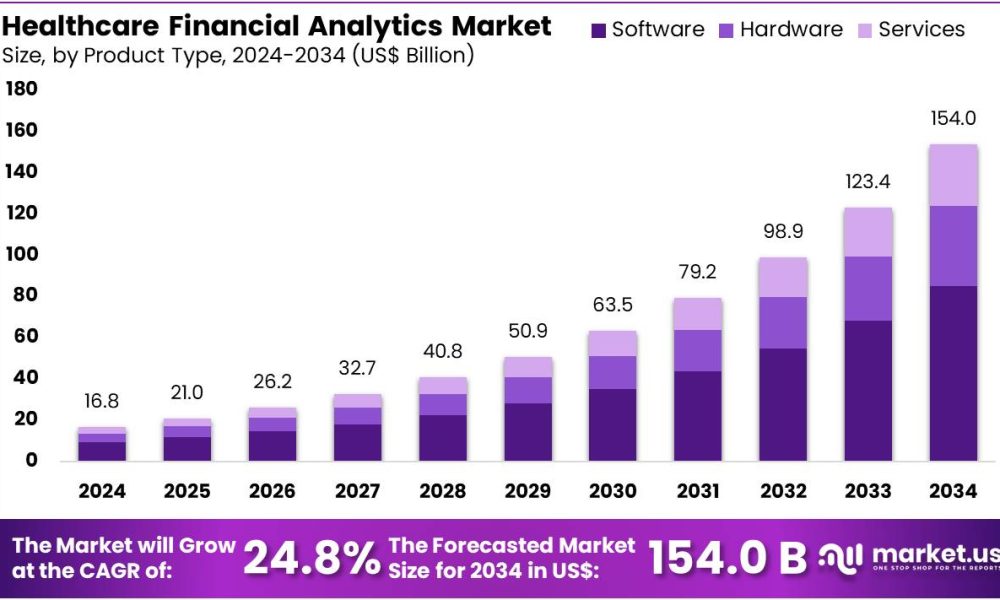
The Global Healthcare Financial Analytics Market is projected to reach approximately USD 154 billion by 2034. It will grow from USD 16.8 billion in 2024, registering a strong CAGR of 24.8% during the forecast period from 2025 to 2034. This growth is driven by the increasing demand for data-driven decision-making in the healthcare sector. Financial analytics supports healthcare institutions in enhancing transparency, identifying cost-saving opportunities, and improving their overall financial performance. It also helps in reducing inefficiencies across billing, budgeting, and revenue cycle processes.
Rising operational costs and growing regulatory complexities are encouraging healthcare providers to adopt financial analytics tools. These tools assist in optimizing spending, tracking revenues, and forecasting future financial scenarios. Hospitals, clinics, and payers are turning to analytics to improve financial health and streamline administrative functions. Additionally, financial analytics enhances the ability to identify reimbursement bottlenecks and areas of revenue leakage. This allows organizations to maintain profitability while delivering high-quality care in a value-driven environment.
Value-based care models are gaining momentum, further pushing the need for real-time financial insights. Under these models, healthcare providers must balance cost control with improved patient outcomes. Financial analytics helps measure key performance indicators, monitor expenditures, and allocate resources efficiently. As healthcare systems shift away from fee-for-service models, they rely more on predictive analytics to improve financial decision-making. This shift underscores the critical role of analytics in supporting new care delivery and payment models.
In August 2022, Syntellis Performance Solutions acquired Stratasan, a healthcare market intelligence firm. This acquisition strengthened Syntellis’ analytics portfolio by enhancing its capabilities in strategic planning and performance management. It enabled clients to leverage deeper insights into healthcare markets and patient demographics. Through this expansion, Syntellis offers more robust tools for financial and operational analysis. Such strategic developments indicate that leading companies are investing in advanced data solutions to better support healthcare organizations’ long-term planning.
Artificial intelligence and machine learning are becoming integral to modern financial analytics platforms. These technologies provide advanced forecasting and automation features. Predictive models help healthcare providers anticipate financial challenges and proactively manage risks. Machine learning algorithms can detect anomalies, streamline audits, and improve cash flow predictions. As these technologies mature, they are expected to further enhance the effectiveness of financial analytics tools. This trend presents major growth opportunities for vendors and signals a transformative future for healthcare financial analytics.

Key Takeaways
- In 2024, the healthcare financial analytics market reached US$ 16.8 billion, with a projected CAGR of 24.8% through 2034, hitting US$ 154 billion.
- Software dominated the product type segment in 2024, capturing a market share of 55.3% due to its scalability and integration with health systems.
- Cloud-based technology held the largest share in 2024 at 62.3%, reflecting strong adoption driven by accessibility, scalability, and reduced infrastructure costs.
- Financial planning led the application segment with a 42.7% share, as providers prioritized predictive budgeting and future cost control strategies.
- Healthcare providers were the top end-users in 2024, accounting for 51.5% of the market due to high operational data demands and revenue management needs.
- North America maintained dominance with a 43.4% market share in 2024, driven by advanced digital infrastructure and regulatory support for analytics adoption.
Get Sample: https://market.us/report/healthcare-financial-analytics-market/request-sample/
Segmentation Analysis
Product Type Analysis
In 2024, the software segment dominated the healthcare financial analytics market, accounting for 55.3% of total revenue. The demand is rising as healthcare institutions increasingly adopt software tools for real-time analytics, financial reporting, and predictive modeling. These tools help improve decision-making and enhance financial efficiency. As regulatory pressures grow, providers seek better visibility into financial operations. Moreover, the integration of artificial intelligence and machine learning into software is expected to support more accurate forecasting and better financial planning, driving sustained market growth.
Technology Analysis
Cloud-based technology captured a leading share of 62.3% in 2024, driven by its scalability and cost efficiency. Cloud platforms offer healthcare providers secure and flexible access to financial data. These tools support remote collaboration and easy integration with existing systems. As remote work increases and data accessibility becomes critical, cloud-based financial solutions are being prioritized. Healthcare organizations are adopting these platforms to improve financial workflows and reduce infrastructure costs. This shift is likely to continue, boosting demand across both large and mid-sized healthcare facilities.
Application Analysis
The financial planning segment achieved a revenue share of 42.7%, highlighting its growing importance. Rising healthcare costs and reimbursement complexities are pushing providers to adopt advanced financial planning tools. These solutions help forecast revenues, guide investments, and support long-term budgeting. With healthcare shifting toward value-based care, financial planning becomes vital for cost control and strategic growth. Providers use these tools to better allocate resources and prepare for economic uncertainties. The focus on financial sustainability is expected to strengthen demand in this segment.
End-User Analysis
Healthcare providers led the market with a 51.5% revenue share, driven by their need to manage financial operations more effectively. Hospitals, clinics, and physician groups are turning to analytics tools to improve billing, streamline revenue cycle management, and control costs. These solutions also help providers meet performance targets under value-based care models. The growing emphasis on data-driven decisions in healthcare is boosting adoption rates. As financial accountability becomes more critical, providers will increasingly rely on advanced analytics to maintain profitability and quality of care.
By Product Type
- Software
- Hardware
- Services
By Technology
- Cloud-based
- On-premises
- Hybrid
By Application
- Financial Planning
- Cost Management
- Revenue Cycle Management
- Budgeting
By End-user
- Health Insurance Companies
- Healthcare Providers
- Government Organizations
Key Players Analysis
Key players in the healthcare financial analytics market are adopting advanced technologies to drive business performance. They use data analytics, artificial intelligence (AI), and machine learning to develop tools that help healthcare organizations improve financial efficiency. These solutions assist in streamlining budgeting processes and enhancing decision-making. Companies are also focused on creating value-driven financial platforms that reduce costs and increase profitability. As the healthcare sector grows in complexity, the demand for analytical tools that provide real-time financial insights is rising steadily across hospitals, clinics, and insurance firms.
In addition to core analytics tools, market leaders offer customized solutions for specific healthcare segments. These tailored services meet the varied financial needs of hospitals, payers, and physician groups. Companies also invest in partnerships with healthcare providers and financial institutions. These collaborations help increase the adoption of their technologies. Expansion into emerging markets further supports growth. These regions are experiencing rising healthcare investments, presenting a favorable environment for analytics firms. As demand for transparency and cost control increases, personalized analytics tools gain popularity.
IBM Watson Health, based in Cambridge, Massachusetts, is a prominent name in this space. The company offers advanced healthcare financial analytics tools designed to optimize revenue cycles and improve financial planning. Its solutions use AI and cognitive computing to turn complex data into actionable insights. IBM Watson Health works closely with healthcare systems, government bodies, and insurers worldwide. Its strong global reach and commitment to innovation enable it to lead in transforming financial performance in healthcare. Strategic partnerships further support the company’s international expansion.
Conclusion
In conclusion, the healthcare financial analytics market is expanding rapidly as more providers focus on improving financial performance and reducing operational inefficiencies. The shift toward digital health and value-based care is driving the need for real-time insights and data-driven decision-making. Financial analytics tools help healthcare organizations manage costs, forecast budgets, and enhance overall financial planning. The growing use of cloud technology and artificial intelligence is further boosting adoption. As hospitals, clinics, and insurers seek smarter financial management, the demand for advanced analytics solutions is expected to rise. Continuous innovation and strategic partnerships will shape the future of this market and support its long-term growth.
Get in Touch with Us:
Market.us (Powered By Prudour Pvt. Ltd.)
Address: 420 Lexington Avenue, Suite 300, New York City, NY 10170, United States.
Contact No: +1 718 874 1545 (International), +91 78878 22626 (Asia).
Email: [email protected]
View More
Wireless Medical Devices Market
Practice Management System Market



