
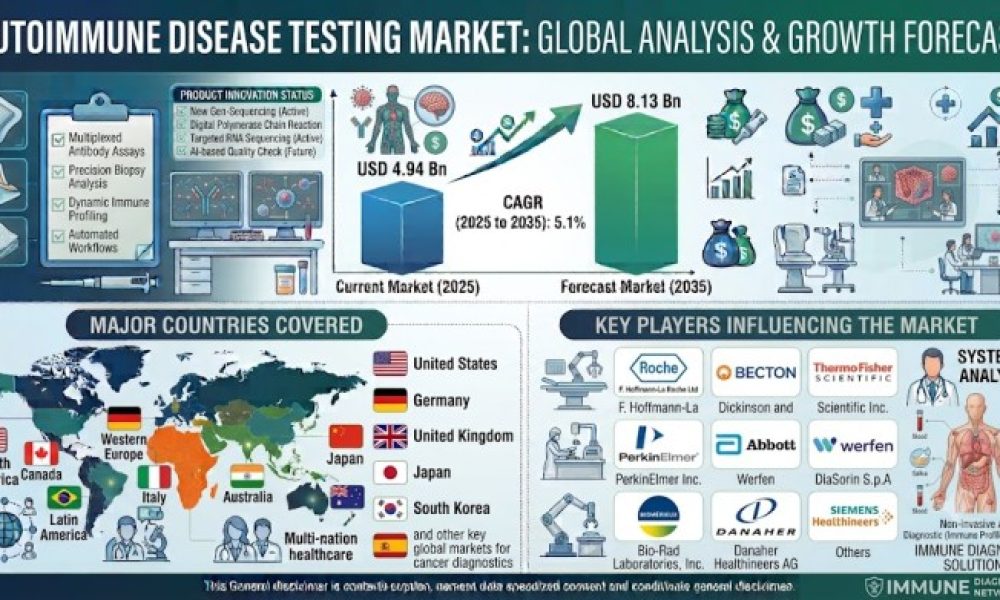
NEWARK, Del. — According to Future Market Insights, the global autoimmune disease testing market is projected to increase from USD 4.94 billion in 2025 to USD 8.13 billion by 2035, expanding at a 5.1% CAGR during the forecast period. Rising autoimmune disease incidence, greater emphasis on early diagnosis, and growing adoption of biomarker-based assays are supporting demand for testing across hospitals and diagnostic laboratories.
The market is shifting from symptom-led diagnosis toward earlier biomarker-based clinical assessment. Reagents and consumables are expected to remain the largest product category, while rheumatoid arthritis testing leads the indication segment. Automated testing platforms, point-of-care solutions, and advances in biomarker detection are creating additional opportunities for diagnostic manufacturers.
👉 Get Detailed Market Forecasts, Competitive Benchmarking, and Pricing Trends:
https://www.futuremarketinsights.com/reports/sample/rep-gb-16969
Key Market Highlights
- Market size, 2025: USD 4.94 billion.
- Market forecast, 2035: USD 8.13 billion.
- CAGR:1% from 2025 to 2035.
- Leading product segment: Reagents & consumables, with 3% share in 2025.
- Leading indication: Rheumatoid arthritis testing, with 9% share in 2025.
- Fastest-growing country: India, with a 2% CAGR.
- Second-fastest country: China, with a 8% CAGR.
- Trailing country among the profiled markets: Germany, with a 4% CAGR.
Global Segment Leaders
Reagents & Consumables — 43.3% Share:
Reagents and consumables are projected to account for 43.3% of the market in 2025. Their recurring use in ELISA, immunofluorescence and chemiluminescence assays supports demand from hospitals, diagnostic laboratories and research institutions. Automation-compatible reagent kits are also helping laboratories improve throughput and reduce manual errors.
Rheumatoid Arthritis Testing — 31.9% Share:
Rheumatoid arthritis testing leads the indication segment with a 31.9% share in 2025. Testing commonly includes rheumatoid factor, anti-cyclic citrullinated peptide antibodies and inflammatory markers such as ESR and CRP. Early identification is important because untreated disease can contribute to progressive joint damage.
Lab-Based Testing:
Laboratory testing continues to hold a central role because autoimmune disorders can require complex diagnostic panels, trained personnel and validated testing workflows. Point-of-care testing is nevertheless expanding as healthcare providers seek faster and more convenient diagnostic results.
Country-Level Performance
- India – 6.2% CAGR (2025–2035): Expanding healthcare access and diagnostic laboratory networks.
- China – 5.8% CAGR (2025–2035): Healthcare infrastructure investment, precision medicine and diagnostic modernization.
- South Korea – 5.2% CAGR (2025–2035): Growing adoption of advanced diagnostic technologies.
- United States – 3.7% CAGR (2025–2035): Rising autoimmune disease incidence and demand for advanced testing.
- Japan – 3.5% CAGR (2025–2035): Established diagnostic infrastructure and growing demand for advanced testing.
- Germany – 3.4% CAGR (2025–2035): Government-backed healthcare research and investment in diagnostic technologies.
India is projected to record the fastest country-level growth at 6.2% CAGR. FMI identifies the expansion of healthcare access and laboratory networks as important contributors to the country’s autoimmune disease testing opportunity. China follows at 5.8%, supported by healthcare infrastructure upgrades, precision medicine initiatives and wider access to advanced diagnostic technologies.
The United States is projected to expand at 3.7% CAGR. Increasing incidence of autoimmune conditions, an aging population and demand for earlier diagnosis are supporting opportunities for AI-driven diagnostics, biomarker panels and genetic testing.
Germany is expected to grow at 3.4% CAGR. Government investment in healthcare research, diagnostic technologies and precision medicine is supporting development and commercialization of improved autoimmune testing methods.
👉 Access the Complete Report in PDF Format:
https://www.futuremarketinsights.com/reports/brochure/rep-gb-16969
Market Drivers, Restraints and Opportunities
Biomarkers Strengthen Early Detection
Biomarker-based testing is becoming increasingly important in autoimmune disease diagnosis because molecular, genetic and protein markers can provide more targeted information about disease activity. Advances in genomics, proteomics and molecular biology are broadening the range of detectable biomarkers for conditions including rheumatoid arthritis, lupus and multiple sclerosis.
Point-of-Care and At-Home Testing Expand
Demand for faster and more convenient diagnostic solutions is supporting the development of point-of-care and at-home autoimmune testing. Compact platforms can provide results without relying entirely on traditional laboratory infrastructure. Integration with digital health technologies can also support data tracking and patient engagement.
Microfluidics Creates New Opportunities
Microfluidic and lab-on-a-chip platforms are emerging as an opportunity because they can miniaturize complex laboratory procedures, use smaller sample volumes and perform multiple assays on compact platforms. Combining microfluidics with biosensors and AI-based analysis could improve diagnostic precision while reducing turnaround times.
Test Variability Remains a Restraint
Variability in test sensitivity and specificity remains a major challenge. Autoimmune disorders can produce complex and overlapping symptoms, while false-positive or false-negative results can contribute to misdiagnosis or delayed diagnosis. Differences between test results can also increase the number of tests required and raise healthcare costs.
Competitive Landscape
The autoimmune disease testing market includes established diagnostic companies with broad assay portfolios, laboratory platforms and geographic reach. F. Hoffmann-La Roche Ltd, Becton, Dickinson and Company, Thermo Fisher Scientific Inc., PerkinElmer Inc., Abbott, Werfen, DiaSorin, BIOMÉRIEUX, Bio-Rad Laboratories, Danaher and Siemens Healthineers are among the key companies profiled by FMI.
Tier 1 companies collectively account for 46.8% of the global market. This group includes Roche, BD, Thermo Fisher Scientific, PerkinElmer and Abbott. Tier 2 companies account for 32.7%, with Werfen, DiaSorin, BIOMÉRIEUX and Bio-Rad among the identified players.
Recent Industry Developments
- February 2025: AliveDx received CE marking for its MosaiQ AiPlex CTDplus multiplex assay for the diagnosis and management of systemic autoimmune rheumatic diseases.
- January 2025: Exagen’s AVISE CTD platform received approval from the New York State Department of Health for biomarker assays targeting systemic lupus erythematosus and rheumatoid arthritis.
- January 2025: OMNY Health and Scipher Medicine entered a partnership focused on advancing precision medicine for autoimmune disease treatment.
Analyst Perspective
“The autoimmune disease testing market is likely to favor diagnostic companies able to improve test sensitivity across high-volume clinical panels. Reagents suppliers and assay platform developers are expected to gain advantage as laboratories seek faster turnaround and stronger result consistency.”
— Anurag Sharma, Principal Consultant for Healthcare at Future Market Insights.
Access the full report: https://www.futuremarketinsights.com/reports/autoimmune-disease-testing-market
Frequently Asked Questions
- What is the size of the autoimmune disease testing market in 2025?
The global autoimmune disease testing market is valued at USD 4.94 billion in 2025. - What will the autoimmune disease testing market be worth in 2035?
The market is projected to reach USD 8.13 billion by 2035. - What is the CAGR of the autoimmune disease testing market?
The market is expected to expand at a 1% CAGR between 2025 and 2035. - Which product segment leads the market?
Reagents and consumables lead with a 3% share in 2025. - Which autoimmune disease indication holds the largest share?
Rheumatoid arthritis testing leads with a 9% share in 2025. - Which country is growing fastest?
India is projected to record the highest CAGR at 2% from 2025 to 2035, followed by China at 5.8%.
Market Scope
- Market Size (2025): USD 4.94 billion
- Market Forecast (2035): USD 8.13 billion
- CAGR: 5.1%
- Historical Period: 2020–2024
- Forecast Period: 2025–2035
- Product Types: Instruments, Assay Kits, Reagents & Consumables
- Testing Modes: Lab-Based Testing, Point-of-Care Testing
- Indications: Rheumatoid Arthritis, Type 1 Diabetes, IBD, Multiple Sclerosis, Celiac Disease, Graves’ Disease, Hashimoto’s Thyroiditis, Psoriasis, SLE, Others
- End Users: Hospitals, Diagnostic Laboratories, Reference Laboratories, Specialized Clinics, Academic & Research Institutes, Home Care Settings, Point-of-Care Testing Centers
- Regions: North America, Latin America, Western Europe, Eastern Europe, East Asia, South Asia & Pacific, Middle East & Africa
- Countries: United States, Canada, Brazil, Mexico, Germany, UK, France, Italy, Spain, China, Japan, South Korea, India, Australia, UAE, Saudi Arabia, South Africa
- Key Companies: Roche, BD, Thermo Fisher Scientific, PerkinElmer, Abbott, Werfen, DiaSorin, BIOMÉRIEUX, Bio-Rad, Danaher, Siemens Healthineers
About Future Market Insights
Future Market Insights, Inc. (FMI) is an ESOMAR-certified market research and consulting firm headquartered in Delaware, USA, with offices in the United Kingdom, the United Arab Emirates and India. FMI delivers syndicated and custom research across food and beverage, healthcare, chemicals, technology, packaging, consumer goods and industrial sectors.
Media Contact
Future Market Insights, Inc.
Phone: +1-347-918-3531



