
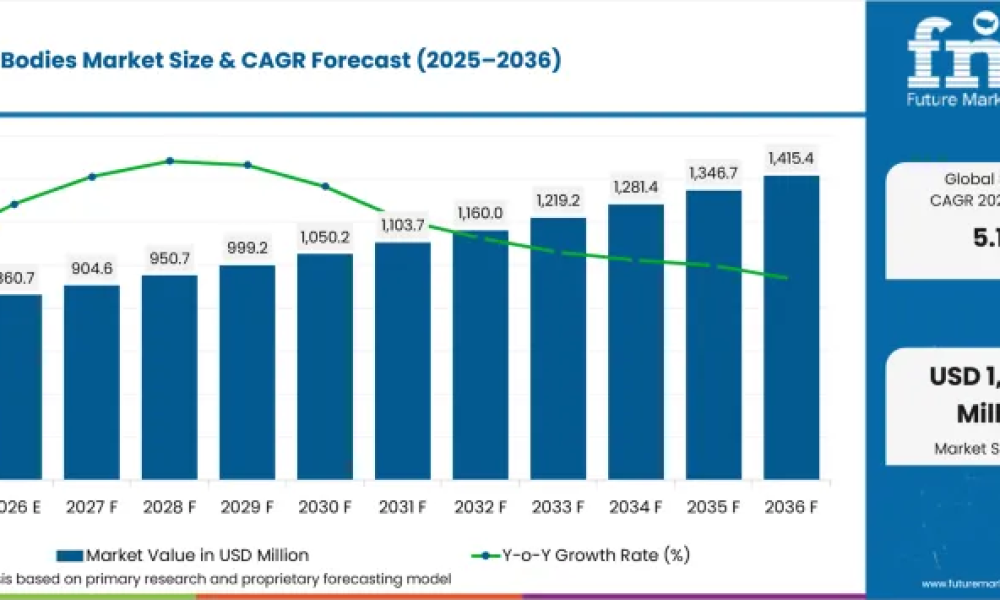
The global drop-side bodies market is projected to expand from USD 860.7 million in 2026 to USD 1,415.4 million by 2036, advancing at a 5.1% CAGR from 2026 to 2036. Demand is supported by commercial vehicle replacement cycles as fleet operators evaluate body upgrades while extending vehicle service life or refurbishing existing assets.
The aging commercial vehicle parc is creating opportunities for body replacement and retrofit activity where operators seek lower vehicle weight, improved cargo access, corrosion resistance, or faster side-loading capability. ACEA reported in February 2025 that more than 30 million vans were in operation, with an average age of 12.5 years. This aging fleet provides a substantial installed base for body upgrades where improved utilization can delay the need for complete vehicle replacement.
Fleet utilization also influences replacement timing. Great Britain recorded 58.8 billion van miles in 2025, according to the Department for Transport, representing a 10.0% increase over 2019. Fleet management systems can provide operators with utilization and repair histories, helping identify vehicles where body refurbishment or replacement can deliver measurable operational value.
What Are the Key Segments in the Drop-Side Bodies Market?
- Aluminum Drop-Side Bodies — 32.0% share: Aluminum bodies lead the body-type segment in 2026 because lower structural mass can help preserve payload while corrosion resistance supports demanding commercial applications.
- Light Commercial Vehicles — 37.0% share: Light commercial vehicles represent the leading vehicle class as compact chassis support frequent stop-and-load operations across construction, logistics, utilities, and service fleets.
- Two-Side Drop — 27.0% share: Two-side configurations provide broad cargo access without requiring the additional hardware associated with full three-way tipping systems.
- Body Builders and Dealer Upfitters: Specialized bodybuilders and upfitters remain important because mounting geometry and chassis compatibility must be validated before completed vehicles enter fleet service.
- Construction and Logistics: These applications generate demand where operators require repeated cargo access, flexible loading, and durable body structures.
Get detailed market forecasts, competitive benchmarking, and pricing trends:
https://www.futuremarketinsights.com/reports/sample/rep-gb-35049
Which Countries Are Showing the Strongest Growth in the Drop-Side Bodies Market?
The United Kingdom is projected to record the highest CAGR among the profiled countries at 5.8% through 2036. Strong commercial van utilization and an aging vehicle parc support demand for body refurbishment and replacement. High vehicle usage can encourage operators to improve cargo access and loading efficiency without replacing the complete chassis.
South Africa is expected to expand at a 5.4% CAGR, supported by commercial vehicle applications across construction, agriculture, logistics, and utility operations. Demand for durable body structures is influenced by operating conditions and the need to maintain productive vehicle utilization.
Australia is projected to register a 5.2% CAGR. Commercial vehicles serving construction, agriculture, landscaping, and utility applications can benefit from body configurations that provide flexible side access while maintaining useful payload capacity.
Italy is expected to grow at a 4.9% CAGR. The market benefits from established commercial vehicle applications and demand for practical cargo-loading configurations. Body replacement opportunities are influenced by fleet age, operating intensity, and the condition of existing equipment.
Germany is projected to expand at a 4.7% CAGR, supported by its established commercial vehicle manufacturing and logistics ecosystem. Fleet operators continue to evaluate body configurations according to payload, durability, loading efficiency, and chassis integration requirements.
The United States is expected to record a 4.4% CAGR. Construction, landscaping, utilities, and other work-truck applications provide demand for flexible cargo bodies. Replacement activity is closely connected to fleet utilization and the economics of upgrading existing vehicles.
Japan is projected to record the lowest CAGR among the profiled countries at 3.7%. Its mature commercial vehicle fleet supports a continuing replacement market, although demand growth is influenced by established vehicle platforms and differing fleet utilization patterns.
How Is Regional Demand Shaping the Drop-Side Bodies Market?
Drop-side body demand depends on more than commercial vehicle population because operators use vehicles at different intensities and for different tasks. High-mileage fleets can reach refurbishment decisions sooner when body wear begins to affect loading efficiency, payload management, or vehicle availability.
The United Kingdom combines a large van population with high utilization, while Australia and South Africa provide opportunities across construction, agricultural, utility, and logistics applications. In Germany, Italy, the United States, and Japan, established commercial vehicle fleets create additional opportunities for replacement and retrofit suppliers.
What Is Changing the Competitive Landscape?
The competitive landscape includes Humbaur, MEILLER, Kögel, Ifor Williams, Knapheide, Edbro, Bevan Group, and Thompsons UK. These companies compete through body construction, chassis integration, payload optimization, side-access configurations, and customized fleet solutions.
Aluminum construction is an important area of differentiation because lower body mass can preserve payload capacity while corrosion resistance can support longer service life. Steel remains relevant where operators prioritize structural durability and specific heavy-duty applications.
Customization also plays a major role in commercial vehicle body procurement. Fleet operators may require specific mounting arrangements, side configurations, dimensions, or equipment integration depending on the chassis and end use. This makes pre-engineered solutions valuable for repeat fleet orders.
Approval and mounting requirements can influence conversion timelines. Bodybuilders that maintain validated mounting geometry and documentation for common chassis families can reduce the engineering work required when fleets order multiple vehicles with similar specifications.
What Does the Analyst Say About the Drop-Side Bodies Market?
“Drop-side bodies pay back fastest where side access cuts handling time without surrendering payload to heavier structures. Repeat orders favor bodybuilders that pre-engineer mounting geometry and approval records for the same chassis families.”
— Nikhil Kaitwade, Principal Consultant, Future Market Insights
What Is Driving Demand for Drop-Side Bodies?
Aging Commercial Vehicle Fleets
Older commercial vehicles create opportunities for body replacement because operators may refurbish a chassis rather than purchase an entirely new vehicle. Body upgrades can extend useful operating life when the chassis and powertrain remain economically viable.
Faster Side Loading
Direct side access can reduce repeated handling during daily operations. Construction, landscaping, utility, and logistics fleets can benefit when workers can access cargo from the side rather than repositioning the vehicle for every loading or unloading task.
Payload Optimization
Lower-weight aluminum bodies can help operators preserve available payload capacity. This becomes increasingly important when vehicles carry tools, equipment, materials, and other loads while remaining within applicable weight limits.
Fleet Utilization and Data
Fleet management systems can provide mileage, utilization, maintenance, and repair histories that help operators identify vehicles approaching body replacement thresholds. Data-driven maintenance decisions can make refurbishment more closely tied to actual operating requirements.
What Are the Key Market Restraints?
Bespoke mounting requirements can slow conversion when completed vehicles require additional engineering, approval documentation, or payload validation. Differences in chassis dimensions and equipment layouts can also limit the interchangeability of body systems.
The economics of replacement can become challenging when the underlying vehicle is approaching the end of its service life. Fleet operators must compare body refurbishment costs with complete vehicle replacement, particularly when powertrain or chassis repairs are also required.
Drive Your Business Growth Strategy: Checkout the Report for Key Insights!
https://www.futuremarketinsights.com/checkout/35049
What Opportunities Exist for Drop-Side Body Manufacturers?
Pre-engineered body systems for high-volume commercial vehicle chassis represent an important opportunity. Standardized mounting solutions can reduce installation time and make repeat fleet orders easier to manage.
Manufacturers can also expand lightweight solutions that combine aluminum structures with durable mounting systems. Providing modular side configurations, removable sections, and application-specific equipment integration can broaden the addressable market across construction, agriculture, logistics, and municipal fleets.
How Is the Drop-Side Bodies Market Segmented?
The market is segmented by body type, vehicle class, side configuration, sales channel, and end use.
By Body Type
Aluminum drop-side, steel drop-side, tipping drop-side, removable side, modular systems, and custom bodies represent key product categories.
By Vehicle Class
Light, medium, and heavy commercial vehicles form the major vehicle classes.
By Side Configuration
One-side, two-side, three-side, drop, and removable-side configurations address different cargo-access requirements.
By Sales Channel
Body builders, dealer upfitters, fleet and OEM contracts, and aftermarket installers represent the major sales routes.
By End Use
Construction, agriculture, logistics, municipal services, landscaping, and utilities represent major application areas.
What Are the Drivers, Restraints and Opportunities in the Drop-Side Bodies Market?
Drop-side body demand is being shaped by aging commercial vehicle fleets, the need for faster cargo access, and efforts to preserve payload while extending vehicle service life.
- Driver: Fleet refurbishment creates demand for body upgrades without complete vehicle replacement.
- Restraint: Custom mounting and approval requirements can increase conversion time and engineering costs.
- Opportunity: Pre-engineered lightweight bodies for common chassis families can reduce installation complexity and support repeat fleet orders.
What Is the Drop-Side Bodies Market Demand Outlook?
The market is expected to benefit from aging commercial vehicle fleets and the continued need to maintain vehicle productivity. Operators are increasingly evaluating body replacement according to utilization, repair history, payload requirements, and loading efficiency rather than relying solely on vehicle age.
Light commercial vehicles remain an important demand base, while construction, agriculture, logistics, municipal services, landscaping, and utilities provide diverse end-use opportunities. Suppliers that combine lightweight construction with validated chassis integration can strengthen their position in fleet refurbishment programs.
Which Countries Are Growing Fastest in the Drop-Side Bodies Market?
The United Kingdom leads the profiled countries with a 5.8% CAGR, followed by South Africa at 5.4%, Australia at 5.2%, Italy at 4.9%, Germany at 4.7%, the United States at 4.4%, and Japan at 3.7% through 2036. The country outlook reflects differences in commercial vehicle utilization, fleet age, construction and logistics activity, and the economics of upgrading existing vehicle assets.
About Future Market Insights
Future Market Insights (FMI) is a leading provider of market research and consulting services, offering syndicated and customized research across automotive, commercial vehicles, mobility, energy, industrial, and related industries. FMI provides market forecasts, competitive intelligence, strategic analysis, and data-driven insights to support business and investment decisions across global markets.



