
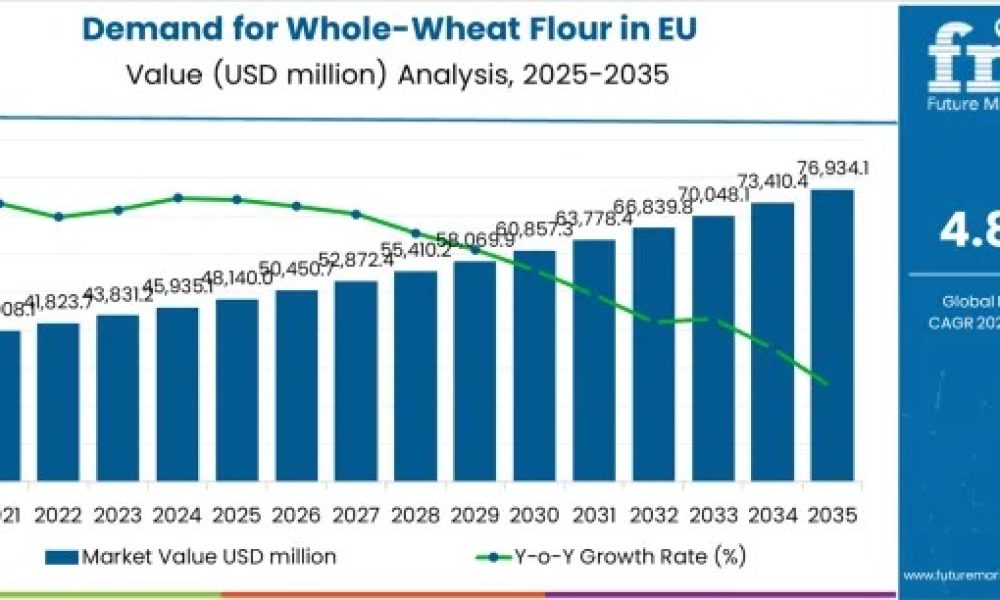
The European Union whole-wheat flour market is entering a decade of steady, nutrition-led growth, supported by structural shifts in consumer diets, bakery innovation, and milling technologies. Sales are projected to rise from USD 48,140.0 million in 2025 to approximately USD 76,934.1 million by 2035, representing an absolute increase of USD 28,513.0 million. This equates to total growth of 59.2%, with demand expanding at a compound annual growth rate (CAGR) of 4.8% over the forecast period.
According to Future Market Insights (FMI), the EU whole-wheat flour industry is expected to grow by nearly 1.6X between 2025 and 2035, driven by accelerating health consciousness, rising preference for whole-grain foods with documented nutritional benefits, and expanding use across artisan bakeries, industrial bread manufacturing, specialty baked goods, and home baking. Whole-wheat flour is increasingly positioned as a foundational ingredient supporting fiber intake, cardiovascular health, and balanced nutrition across European diets.
Explore trends before investing – request a sample report today!
Market Trajectory Highlights and Near-Term Momentum
Between 2025 and 2030, EU whole-wheat flour demand is forecast to climb from USD 48,140.0 million to USD 60,760.3 million, generating USD 12,620.3 million in new value, or 44.3% of total decade growth. This phase reflects mainstream adoption of whole-grain diets, broader retail availability of whole-wheat flour varieties, and rising acceptance of whole-wheat products in bakeries, supermarkets, and foodservice channels.
From 2030 to 2035, sales are expected to accelerate further, expanding from USD 60,760.3 million to USD 76,653.0 million and contributing 55.7% of overall forecast growth. Premium artisan bread, advanced milling technologies that preserve nutritional integrity, and specialty whole-wheat flour products targeting professional bakers and health-focused consumers will shape this phase. Preventive nutrition and willingness to invest in nutritionally superior ingredients remain central demand drivers.
Health Awareness Anchors Long-Term Demand
Demand growth is fundamentally underpinned by rising awareness of whole-grain benefits, including improved digestive health, better blood sugar management, and reduced cardiovascular risk. Whole-wheat flour has become essential for modern bakeries and home bakers producing health-positioned bread, premium artisan loaves, and nutritionally enhanced baked goods aligned with dietary guidelines recommending increased whole-grain consumption.
Regulatory clarity around whole-grain labeling, nutritional claims, and quality standards is strengthening consumer trust, while scientific research continues to validate the functional and health advantages of whole-wheat flour. This has increased demand for specialized milling methods that retain bran and germ, optimize particle size, and ensure consistent baking performance across applications.
Segmental Insights Reflect Bread’s Enduring Role
Bread flour remains the dominant product type, accounting for 55.0% of EU whole-wheat flour sales in 2025, supported by bread’s role as a dietary staple and whole-wheat bread’s positioning as a healthier alternative. While its share is expected to ease slightly to 53.0% by 2035 due to diversification into specialty flours, absolute demand continues to rise.
By application, bread production represents 32.0% of total demand in 2025, reflecting strong reliance on whole-wheat flour for sandwich bread, artisan loaves, and rustic breads. Modern bread manufacturers increasingly require flour optimized for commercial equipment, predictable dough behavior, and balanced taste profiles.
From a channel perspective, B2B and direct sales dominate with 66.0% share in 2025, highlighting the professional nature of flour procurement and the importance of technical partnerships between millers and commercial bakeries. Conventional whole-wheat flour accounts for 88.0% of sales, driven by price accessibility, supply reliability, and scalability for industrial operations.
Technology, Transparency, and Grain Diversity Shape Trends
Advanced milling technologies are transforming whole-wheat flour quality by improving taste, texture, and baking functionality without compromising whole-grain integrity. Precision milling, temperature-controlled processing, and selective bran grinding are enabling broader mainstream adoption.
At the same time, integration of ancient grains and specialty wheat varieties such as spelt and einkorn is supporting premium positioning, while growing emphasis on transparency and traceability—including origin labeling and farmer partnerships—is strengthening consumer confidence and brand differentiation across Europe.
Country-Level Growth Led by France and the Netherlands
Growth varies across EU markets, reflecting differences in bakery culture and health awareness:
- France: CAGR 5.2%, driven by preventive nutrition awareness and organic food expansion
- Netherlands: CAGR 5.0%, supported by strong health consciousness and organic consumption
- Spain: CAGR 5.1%, fueled by wellness trends and modernizing bakeries
- Italy: CAGR 4.8%, blending traditional applications with modern health preferences
- Germany: CAGR 4.5%, anchored by Europe’s strongest bakery heritage and whole-grain acceptance
Germany holds the largest market share at 27.6% in 2025, while France and the Netherlands demonstrate the fastest growth trajectories through 2035.
Subscribe for Year-Round Insights → Stay ahead with quarterly and annual data updates!
Competitive Landscape Remains Moderately Fragmented
The EU whole-wheat flour market features competition among large integrated millers, regional producers, and organic specialists. GoodMills Group, Groupe Soufflet / InVivo, and ADM Milling collectively anchor the market through scale, technical expertise, and strong bakery relationships, while numerous regional and specialty players differentiate through organic certification, local sourcing, and heritage wheat offerings.
Key Players
- GoodMills Group
- Groupe Soufflet / InVivo
- ADM Milling (EU operations)
- General Mills (Gold Medal)
- Ardent Mills (EU partnerships)
- Bob’s Red Mill Natural Foods
- Stone Ground
- Georgia Organics
- Heartland Mill Inc
- Wheat Montana Anson Mills
- Siemer Milling Company
- Hodgson Mills
- Lindsey Mills
About Future Market Insights (FMI)
Future Market Insights, Inc. (FMI) is an ESOMAR-certified, ISO 9001:2015 market research and consulting organization trusted by Fortune 500 companies and global enterprises. With delivery centers in the U.S., UK, India, and Dubai, FMI provides data-backed insights and strategic intelligence across 30+ industries and 1,200+ markets worldwide, enabling clients to make confident, forward-looking decisions.



