
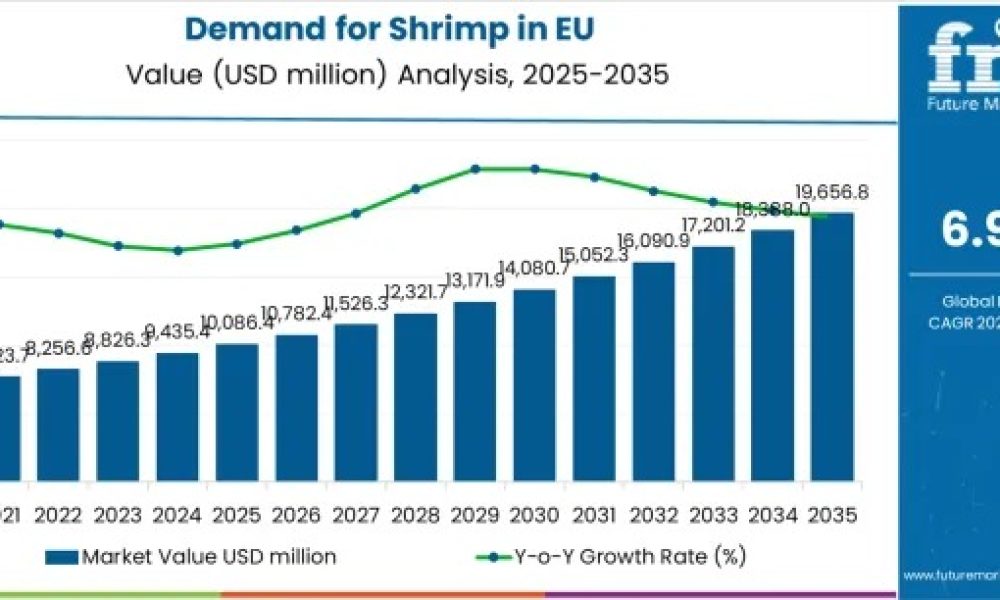
The European Union shrimp market is entering a decade of sustained expansion, underpinned by changing dietary habits, premiumization of seafood, and stronger retail and foodservice penetration. EU shrimp sales are projected to grow from USD 10,086.4 million in 2025 to approximately USD 19,656.8 million by 2035, registering an absolute increase of USD 9,534.8 million. This reflects total growth of 94.5% and a compound annual growth rate (CAGR) of 6.9% between 2025 and 2035.
According to Future Market Insights (FMI), the EU shrimp industry is expected to expand by nearly 1.9X over the forecast period, supported by rising consumption of high-protein seafood, increasing awareness of shrimp’s nutritional profile, and expanding availability across modern retail, foodservice, and e-commerce channels throughout Europe. Shrimp continues to benefit from its positioning as a lean, versatile protein aligned with health-conscious and convenience-driven lifestyles.
Explore trends before investing – request a sample report today!
Market Snapshot: EU Shrimp Industry
- Market Value (2025): USD 10,086.4 million
- Forecast Value (2035): USD 19,656.8 million
- Forecast CAGR (2025–2035): 6.9%
- Leading Product Type: Canned shrimp (80% share)
- Top Application: Food (85% share)
- Key Growth Countries: France, Italy, Spain, Netherlands
Growth Phases Highlight Structural Momentum
Between 2025 and 2030, EU shrimp demand is forecast to rise to USD 14,048.2 million, generating USD 3,961.8 million in new value and accounting for 41.5% of total decade growth. This phase is shaped by stronger adoption of convenient seafood formats, expansion of ready-to-eat and ready-to-cook shrimp products, and wider acceptance of shrimp as a daily protein source across households and restaurants.
From 2030 to 2035, growth accelerates further, with sales increasing to nearly USD 19.6 billion, adding USD 5.57 billion or 58.5% of total forecast expansion. This period is expected to be driven by premiumization, wider availability of organic and sustainably certified shrimp, and advanced processing technologies that enhance taste, texture, and shelf stability.
Why EU Shrimp Demand Continues to Rise
Shrimp demand across Europe is closely linked to rising health consciousness. Consumers increasingly prioritize lean protein, omega-3 fatty acids, and low-calorie nutrition, positioning shrimp as a preferred option for balanced diets. Its culinary versatility across salads, pasta, appetizers, and ethnic cuisines further strengthens everyday consumption.
At the same time, sustainability awareness is reshaping purchasing decisions. Demand is shifting toward shrimp sourced from certified and traceable aquaculture systems, supported by clearer labeling regulations and improved transparency across the seafood value chain. Responsible sourcing and quality assurance are now critical differentiators for brands and retailers.
Product, Application, and Channel Insights
Canned shrimp dominates the EU market, accounting for 80% of sales in 2025, supported by ambient storage, long shelf life, and established consumption habits—particularly in Southern Europe. While frozen shrimp continues to gain traction, canned formats are expected to retain a strong 75% share by 2035.
Food applications represent the backbone of the market, contributing 85% of total demand. Shrimp remains a core ingredient for home cooking, restaurants, and prepared meals, benefiting from its premium perception and adaptability across cuisines.
In distribution, modern trade channels account for roughly 30% of sales, led by large supermarket and hypermarket chains. However, e-commerce is emerging as a high-growth channel, reshaping how frozen and premium shrimp products reach consumers.
Sustainability and Innovation Reshape the Industry
Sustainable aquaculture is transforming shrimp from a commodity into a premium, responsibly sourced protein. Certifications such as ASC, BAP, and organic standards are gaining importance as consumers show greater willingness to pay for verified environmental credentials.
At the same time, processors are investing in value-added formats, including marinated, pre-seasoned, and ready-to-cook shrimp. These innovations address time-constrained consumers seeking restaurant-quality meals at home, strengthening category relevance across urban households.
Country-Level Growth Outlook
France, Italy, Spain, and the Netherlands are projected to record 7.7% CAGR through 2035, driven by Mediterranean dietary traditions, strong seafood culture, and premium retail expansion. Germany remains the largest market by volume, holding 36.2% share in 2025, but grows at a more moderate 5.3% CAGR due to market maturity and price sensitivity.
Subscribe for Year-Round Insights → Stay ahead with quarterly and annual data updates
Competitive Landscape
The EU shrimp market remains highly fragmented, with global aquaculture leaders and European processors competing alongside private-label suppliers. Key players include Pescanova S.A., Thai Union Frozen Products PLC, Charoen Pokphand Food PCL, Nippon Suisan Kaisha Ltd., and Gulf Shrimp Company, alongside Royal Greenland, Maruha Nichiro, Sirena Group, and Lyons Seafoods. Competitive differentiation increasingly centers on sustainability certifications, traceability, and value-added product innovation.
Key Players
- Pescanova S.A.
- Thai Union Frozen Products PLC
- Charoen Pokphand Food PCL
- Nippon Suisan Kaisha Ltd.
- Gulf Shrimp Company
- Royal Greenland A/S
- Maruha Nichiro Corporation
- Sirena Group
- Lyons Seafoods Ltd.
- Findus Group
- Others
About Future Market Insights (FMI)
Future Market Insights, Inc. (FMI) is an ESOMAR-certified, ISO 9001:2015 market research and consulting organization trusted by Fortune 500 companies and global enterprises. With operations in the U.S., UK, India, and Dubai, FMI delivers data-backed insights and strategic intelligence across 30+ industries and 1,200+ markets worldwide, empowering clients to navigate growth opportunities with confidence.



