
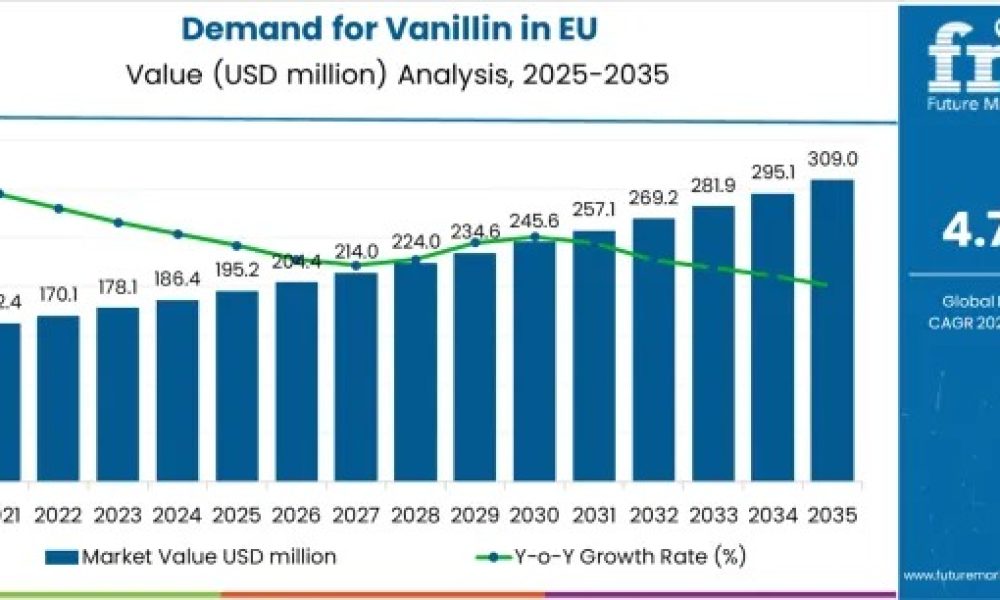
The European Union vanillin market is entering a phase of steady, structurally supported growth, driven by its indispensable role across food manufacturing, pharmaceuticals, and personal care applications. According to Future Market Insights (FMI), EU vanillin sales are projected to rise from USD 195.2 million in 2025 to approximately USD 309.0 million by 2035, reflecting an absolute increase of USD 112.4 million over the forecast period. This expansion represents total growth of 57.6%, with demand advancing at a CAGR of 4.7% between 2025 and 2035, enabling the overall market to grow by nearly 1.6X.
Growth is underpinned by sustained utilization of vanillin as a cost-effective flavoring agent, increasing pharmaceutical formulation requirements, rising preference for natural and clean-label ingredients, and expanding use in fragrance and personal care products across major European economies.
Explore trends before investing – request a sample report today!
Quick Stats: EU Vanillin Market
- Market Value (2025): USD 195.2 million
- Forecast Value (2035): USD 309.0 million
- Forecast CAGR (2025–2035): 4.7%
- Leading Product Type: Synthetic vanillin (64.5% share in 2025)
- Top Application: Food (60% share)
- Key Growth Countries: Netherlands, Spain, France
Decade-Long Growth Anchored in Food and Pharmaceutical Demand
Between 2025 and 2030, EU vanillin demand is expected to increase from USD 195.2 million to USD 245.2 million, accounting for USD 50 million, or 44.5% of total decade growth. This phase is shaped by sustained food and beverage production, expanding pharmaceutical formulations requiring taste masking, and early-stage acceleration in natural vanillin adoption.
From 2030 to 2035, sales are forecast to rise further to USD 307.6 million, adding USD 62.4 million and contributing 55.5% of overall growth. This later phase reflects intensifying clean-label reformulation, stronger regulatory scrutiny of synthetic additives, and technological progress in biotechnology-based natural vanillin production.
Historically, the market demonstrated resilience, growing from USD 155.5 million in 2020 to USD 195.2 million in 2025 at a CAGR of 4.7%, supported by mature supply chains and reliable synthetic production.
Why Vanillin Remains Critical for EU Manufacturers
Vanillin’s long-standing role as an economical and multifunctional ingredient continues to reinforce demand. Food processors rely on it not only for vanilla flavor delivery but also for its ability to enhance sweetness perception, mask undesirable notes, and remain stable under baking, freezing, and acidic conditions. Its crystalline form simplifies industrial handling and enables precise dosing at low inclusion rates.
In pharmaceuticals, vanillin is increasingly used as a palatability-enhancing excipient in pediatric and geriatric medicines, directly improving patient compliance and treatment outcomes.
Segmental Insights: Synthetic Dominance with Natural Shift
By product type, synthetic vanillin accounts for 64.5% of EU sales in 2025, supported by cost efficiency, batch-to-batch consistency, and large-scale production capacity. While its share is expected to moderate to around 60% by 2035, synthetic vanillin will remain dominant in cost-sensitive, high-volume applications.
Key advantages include:
- Significant cost benefits versus natural vanilla derivatives
- Consistent quality and purity
- Reliable supply for industrial-scale demand
Natural vanillin, meanwhile, is gaining traction in premium and clean-label products, supported by advances in fermentation and bio-based production methods.
Food Applications Lead, Pharma Grows Faster
Food remains the largest application segment, accounting for 60% of total demand in 2025, driven by chocolate, confectionery, baked goods, dairy, and cereals. Although its share is projected to decline slightly to 55% by 2035, this reflects faster growth in pharmaceuticals rather than reduced food usage.
Pharmaceutical applications are set to expand from 15% share in 2025 to 20% by 2035, as manufacturers prioritize taste masking, patient-centric formulations, and regulatory-compliant excipients. Pharmaceutical-grade vanillin commands premium pricing due to stringent quality and documentation requirements.
Country-Level Growth Reflects Industrial Strength
Growth remains broad-based across the EU:
- Netherlands (5.0% CAGR) benefits from its role as an ingredient distribution hub and pharmaceutical manufacturing center.
- Spain (4.9%) sees strong expansion through food processing modernization.
- France (4.8%) leverages premium food manufacturing and natural ingredient preference.
- Italy (4.5%) sustains growth through confectionery, bakery, and pharma applications.
- Germany (4.4%) maintains leadership, with sales projected to reach USD 88.6 million by 2035, supported by Europe’s largest food and pharmaceutical manufacturing base.
Subscribe for Year-Round Insights → Stay ahead with quarterly and annual data updates!
Competitive Landscape and Innovation Focus
The EU vanillin market features competition among chemical producers, bio-based ingredient specialists, and distributors. Leading players such as Solvay SA, Borregaard, Camlin Fine Sciences, Merck Group, and Prinova Group compete on cost efficiency, quality consistency, sustainability credentials, and technical support. Biotechnology-based natural vanillin production is emerging as a key differentiator, with potential to reshape pricing and adoption dynamics.
As clean-label expectations rise and pharmaceutical formulation requirements expand, vanillin’s role as a versatile, high-value ingredient is set to strengthen further, ensuring stable growth across the European Union through 2035.
About Future Market Insights (FMI)
Future Market Insights, Inc. (FMI) is an ESOMAR-certified, ISO 9001:2015 market research and consulting organization, trusted by Fortune 500 clients and global enterprises. With operations in the U.S., UK, India, and Dubai, FMI delivers data-backed insights and strategic intelligence across more than 30 industries and 1,200 markets worldwide.



