
Email remains one of the most essential communication tools in the modern digital ecosystem. Despite the rise of instant messaging, collaboration platforms, and social media, email continues to serve as the backbone of both personal and enterprise communication. The Email Application Market reflects this enduring relevance, evolving rapidly to meet new demands around security, mobility, and productivity.
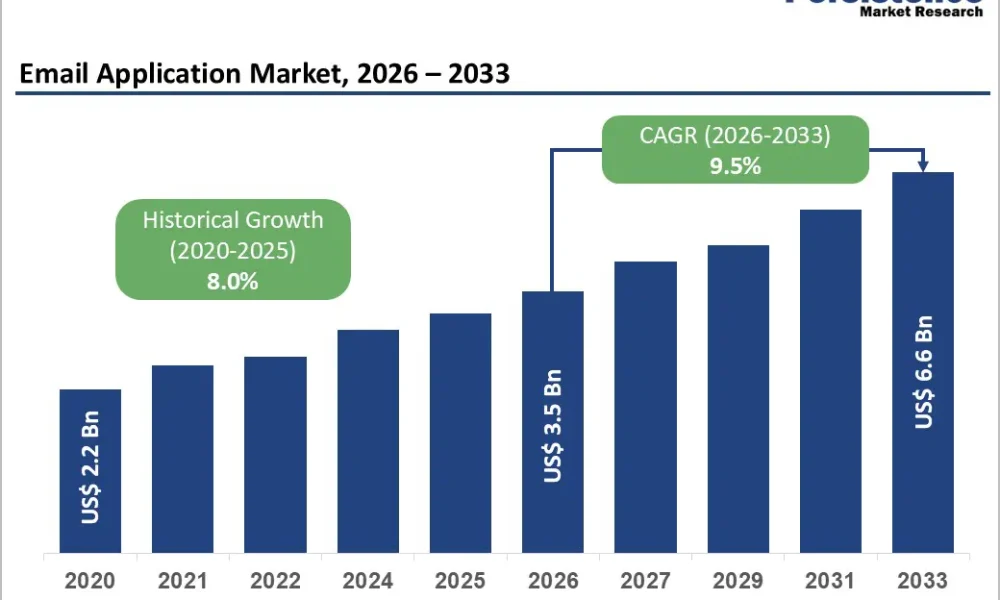
Valued at US$ 3.5 billion in 2026, the global Email Application Market is projected to reach US$ 6.6 billion by 2033, expanding at a CAGR of 9.5%. This growth is fueled by structural shifts such as hybrid work adoption, widespread cloud migration, and rising cybersecurity threats.
At the same time, the global email user base is expected to grow from 4.5 billion users in 2024 to nearly 5 billion by 2027–2028, creating a massive addressable market for innovative email platforms across both consumer and enterprise segments.
Key Market Highlights
The Email Application Market demonstrates strong regional and segment-based dynamics:
- North America leads with a 35.3% market share, driven by advanced cloud adoption and enterprise IT investments
- East Asia is the fastest-growing region, holding 20% share and benefiting from mobile-first usage
- Free email services dominate with 55.2% share, supported by massive global adoption
- Enterprise email solutions are the fastest-growing segment due to rising demand for security and compliance
- Web-based platforms lead deployment with 50.7% share, offering accessibility and ease of use
- Mobile-based applications are expanding rapidly due to changing workforce preferences
Market Dynamics
Growth Drivers
- AI and Machine Learning Transform Email Security
Artificial intelligence has revolutionized email applications, particularly in cybersecurity. Traditional spam filters are being replaced by advanced machine learning systems capable of detecting sophisticated phishing attacks and malware.
Modern platforms can now:
- Block over 99.9% of spam and malicious emails
- Process billions of messages daily
- Reduce false positives significantly
AI also enhances user experience through:
- Smart reply suggestions
- Predictive text
- Automated email categorization
- Workflow automation
Industries such as banking, healthcare, and government are increasingly investing in AI-driven email systems to ensure both productivity and compliance.
- Cloud Migration Accelerates Market Expansion
Cloud-based email solutions are rapidly replacing traditional on-premises systems. Organizations are shifting toward cloud platforms due to:
- Lower infrastructure costs
- Easier scalability
- Simplified maintenance
- Enhanced security integration
Today, nearly 70% of enterprises are transitioning to cloud-native email security systems. These solutions integrate seamlessly with productivity suites and eliminate the need for complex email routing.
Cloud adoption also aligns with regulatory requirements, making compliance easier while improving operational efficiency.
- Regulatory Compliance Driving Investments
Global regulations such as:
- GDPR (Europe)
- CCPA (California)
- HIPAA (Healthcare)
are forcing organizations to upgrade their email infrastructure. Compliance requirements now demand:
- Data encryption
- Authentication protocols (SPF, DKIM, DMARC)
- Audit trails and monitoring
As a result, email applications are no longer just communication tools—they are critical components of enterprise risk management strategies.
Market Restraints
Data Privacy Complexity
Managing data privacy across multiple regions presents a major challenge. Organizations operating globally must comply with diverse regulations, increasing operational complexity and cost.
For smaller businesses, these compliance requirements can slow adoption of advanced email solutions.
Emerging Threat of Quantum Computing
Quantum computing poses a long-term risk to current encryption technologies used in email systems. While still in early stages, this threat is pushing vendors to invest heavily in quantum-resistant cryptography.
This transition may increase development costs and create uncertainty in the market.
Key Opportunities
- Rise of Unified Cloud Security Platforms
Enterprises are increasingly consolidating their IT infrastructure into unified platforms. Instead of using separate tools for email, endpoint, and identity security, organizations now prefer integrated solutions.
Benefits include:
- Reduced operational complexity
- Faster threat detection
- Streamlined incident response
This trend creates significant opportunities for vendors offering comprehensive, cloud-native security ecosystems.
- Mobile-First Email Experience
Mobile devices now account for over 55% of email opens globally, signaling a major shift in user behavior.
Key trends include:
- Increased use of smartphones for professional communication
- Demand for real-time synchronization across devices
- Preference for intuitive, mobile-friendly interfaces
Younger workforces, especially Gen Z and Millennials, are driving this change. Companies that prioritize mobile optimization will gain a competitive advantage.
Category-wise Analysis
Free Email Services: Market Dominance
Free email platforms dominate the market due to their massive user base and accessibility. These services are widely used for:
- Personal communication
- Account registrations
- Digital identity management
Their success is driven by:
- Ecosystem integration
- Advertising-based revenue models
- Continuous feature innovation
Strong network effects make it difficult for new entrants to compete in this segment.
Enterprise Email Solutions: Fastest Growth
Enterprise email solutions are witnessing rapid growth due to increasing demand for:
- Advanced security features
- Regulatory compliance tools
- Collaboration capabilities
- Integration with business applications
Organizations are willing to pay premium prices for solutions that ensure secure and efficient communication.
Web-Based Deployment: Market Leadership
Web-based email applications hold the largest share due to:
- Cross-platform accessibility
- No installation requirements
- Automatic updates
- Lower IT maintenance
These platforms are ideal for organizations adopting remote or hybrid work models.
Mobile-Based Deployment: Emerging Growth
Mobile-based email applications are growing quickly as users shift toward smartphones for communication.
Key advantages include:
- On-the-go access
- Push notifications
- Seamless synchronization
- Enhanced productivity for field workers
This segment is expected to gain significant traction in the coming years.
Elevate your business strategy with comprehensive market data. Request a sample report now: https://www.persistencemarketresearch.com/samples/17098
Regional Insights
North America: Market Leader
North America dominates the Email Application Market due to:
- High enterprise IT spending
- Early adoption of cloud technologies
- Strong regulatory frameworks
Organizations in this region prioritize advanced security and compliance, driving demand for premium email solutions.
East Asia: Fastest-Growing Market
East Asia is experiencing rapid growth driven by:
- Mobile-first user behavior
- Expanding digital infrastructure
- Government-led digital initiatives
Countries like China, Japan, and South Korea are leading innovation in localized email ecosystems.
Europe: Regulation-Driven Growth
Europe holds a significant share of the market, driven by strict data protection regulations.
Organizations in this region focus on:
- Data privacy
- Secure communication
- Compliance with evolving laws
This creates strong demand for advanced email solutions with robust governance features.
Competitive Landscape
The Email Application Market is dominated by a few major players, making it largely oligopolistic. However, niche providers continue to innovate and capture specialized segments.
Key Players Include:
- Microsoft Corporation
- Google Inc.
- IBM Corporation
- Amazon.com
- NEC Corporation
- Fujitsu
Leading Platforms:
- Microsoft Outlook
- Gmail
- Apple Mail
- Yahoo Mail
- Zoho Mail
- ProtonMail
Competition is driven by:
- AI innovation
- Security enhancements
- Cross-platform compatibility
- Integration with productivity ecosystems
Key Industry Developments
Recent innovations highlight the rapid evolution of email applications:
- Google Inc. introduced advanced AI features in Gmail, including smart replies, email summarization, and writing assistance
- Microsoft Corporation launched a new version of Outlook with improved UI, AI-powered suggestions, and seamless integration with cloud services
These developments are transforming email into a proactive productivity tool, rather than just a communication platform.
Future Outlook
The future of the Email Application Market will be shaped by three major trends:
- AI-Driven Personalization
Email platforms will become more intelligent, offering personalized recommendations, automated workflows, and predictive communication tools.
- Enhanced Security Frameworks
As cyber threats evolve, email security will become more advanced, incorporating:
- Behavioral analytics
- Zero-trust architecture
- Quantum-resistant encryption
- Integration with Digital Ecosystems
Email will increasingly integrate with:
- Collaboration tools
- CRM systems
- Project management platforms
This will transform email into a central hub for digital workflows.
Conclusion
The Email Application Market is undergoing a significant transformation, driven by advancements in AI, cloud computing, and cybersecurity. While free email services continue to dominate in terms of user base, enterprise solutions are emerging as the key revenue drivers.
As organizations adapt to hybrid work environments and increasing cyber threats, email applications are evolving into intelligent, secure, and integrated communication platforms. Vendors that can successfully combine security, usability, and innovation will be best positioned to capture future growth opportunities.
With strong momentum across regions and segments, the market is set to play a critical role in shaping the future of digital communication worldwide.
Related Reports:




