
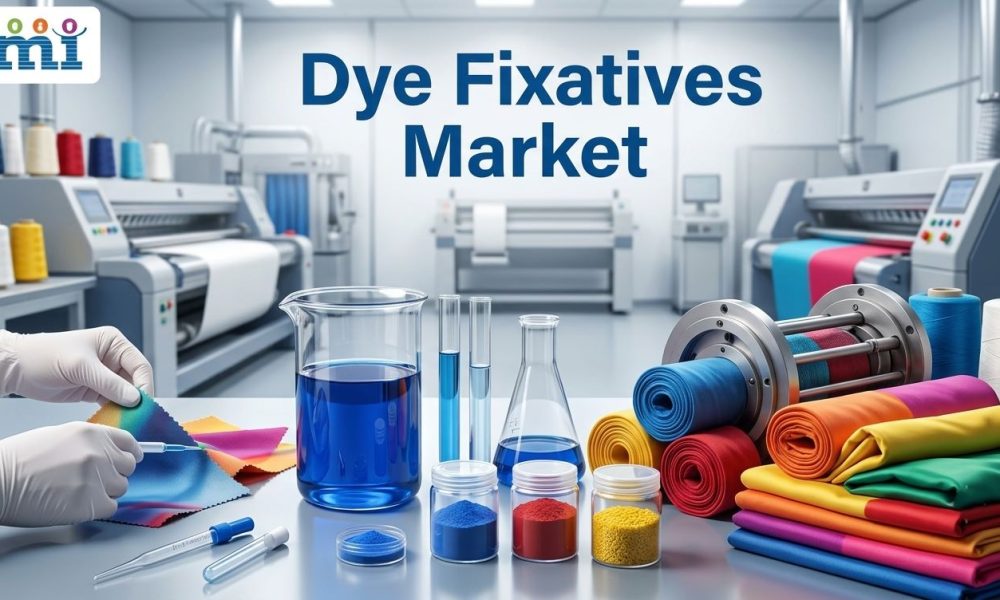
The global dye fixatives market is projected to grow from USD 1.3 billion in 2026 to USD 2.1 billion by 2036, advancing at a 5.9% CAGR during the forecast period. Market demand is being supported by the growing need for colorfast, durable textiles across apparel, home furnishings, technical textiles, and other fabric applications.
Dye fixatives improve the adhesion and permanence of dyes on textile fibers, helping reduce fading, bleeding, and color loss during washing and use. Increasing textile production, rising quality requirements, and growing interest in sustainable processing are encouraging manufacturers to adopt more efficient and environmentally compatible fixation solutions.
Dye Fixatives Market: Key Growth Drivers
Textile wet processing represents the largest demand center because dye fixatives are widely used during dyeing and finishing to improve color retention and resistance to washing, light, and friction. The market is also influenced by the growing use of advanced dyeing technologies and the need to maintain consistent coloration across different fibers and fabric blends.
Textile wet processing is expected to account for 66% of end-use demand in 2026, while direct sales to mills or dyehouses are projected to represent 48% of sales channel demand, reflecting the importance of direct technical and supply relationships in textile processing.
Get detailed market forecasts, competitive benchmarking, and pricing trends: https://www.futuremarketinsights.com/reports/sample/rep-gb-30865
Textile Wet Processing Leads End-use Demand
By end use, textile wet processing is estimated to hold a 66% share of the market. Dye fixatives are essential during textile dyeing and finishing because they improve colorfastness and help fabrics retain their appearance through washing, friction, and prolonged use.
By sales channel, direct to mills or dyehouses accounts for 48% of demand. Direct supply enables fixative manufacturers to work closely with textile processors, customize formulations, manage quality requirements, and maintain consistent supply for continuous production.
Sustainability Creates New Opportunities
The shift toward sustainable textile manufacturing is creating opportunities for suppliers developing dye fixatives with lower environmental impact. Manufacturers are increasingly seeking formulations that support reduced water consumption, lower chemical loads, and improved wastewater profiles without compromising colorfastness.
Digital textile printing, technical textiles, sportswear, medical textiles, and home furnishings are also expanding opportunities for specialized fixation technologies.
Country Markets Show Different Growth Patterns
Country-level demand reflects differences in textile production, export activity, manufacturing investment, and sustainability requirements.
India is projected to record the highest CAGR among the profiled countries at 8.1%, followed by Vietnam at 7.6%, Indonesia at 7.0%, Turkiye at 6.4%, and Mexico at 5.2% through 2036.
India’s large textile manufacturing base and expanding export activity are supporting demand for durable and high-quality color fixation. Vietnam’s growing textile and garment industry is increasing demand for advanced dyeing solutions, while Indonesia’s expanding apparel manufacturing sector is supporting continued adoption of dye fixatives.
Access the Complete Report in PDF Format: https://www.futuremarketinsights.com/reports/brochure/rep-gb-30865
Competitive Landscape
The competitive landscape includes Archroma, DyStar, Huntsman (Textile Effects), Pulcra Chemicals, Rudolf Group, Tanatex Chemicals, Zschimmer & Schwarz, NICCA Chemical, Bozzetto Group, and Jaysynth Dyestuff.
Competition centers on colorfastness performance, formulation compatibility, sustainability, water efficiency, and technical support. Archroma provides dye fixation solutions focused on color retention and sustainable textile processing, while DyStar develops fixatives designed to support stable coloration and fabric performance.
Huntsman (Textile Effects) competes through textile chemical technologies focused on fixation and environmental performance. Pulcra Chemicals emphasizes solutions supporting color fixation and reduced resource consumption, while Rudolf Group and Tanatex Chemicals offer specialized products for durable and high-quality textile finishing.
“Dye fixative selection is increasingly tied to colorfastness requirements, fiber composition, processing conditions, and environmental targets. Suppliers that can deliver consistent fixation while reducing water and chemical burdens can support textile manufacturers as sustainability and product-quality requirements continue to converge.”
— Nikhil Kaitwade, Principal Consultant, Future Market Insights
Dye Fixatives Market: Report Scope
The report covers the market by end use and sales channel, including textile wet processing, garment washing units, home textiles, and other applications, as well as direct sales to mills or dyehouses, distributors, formulators or blenders, and other channels.
The forecast period extends from 2026 to 2036, with market values presented in USD billion. The study examines demand for dye fixatives across textile and related processing applications, with emphasis on colorfastness, sustainable formulations, processing efficiency, and evolving textile manufacturing requirements.
Business Impact
FMI helps organizations transform market complexity into strategic clarity, enabling leadership teams to identify growth opportunities faster, optimize resource allocation, strengthen competitive positioning, and make high-stakes business decisions with confidence.
To explore how FMI Custom Research can support your strategic priorities, please connect with our team at – [email protected]
About Future Market Insights (FMI)
Future Market Insights, Inc. (FMI) is an ESOMAR-certified, ISO 9001:2015 market research and consulting organization, trusted by Fortune 500 clients and global enterprises. With operations in the U.S., UK, India, and Dubai, FMI provides data-backed insights and strategic intelligence across 30+ industries and 1200 markets worldwide.



