
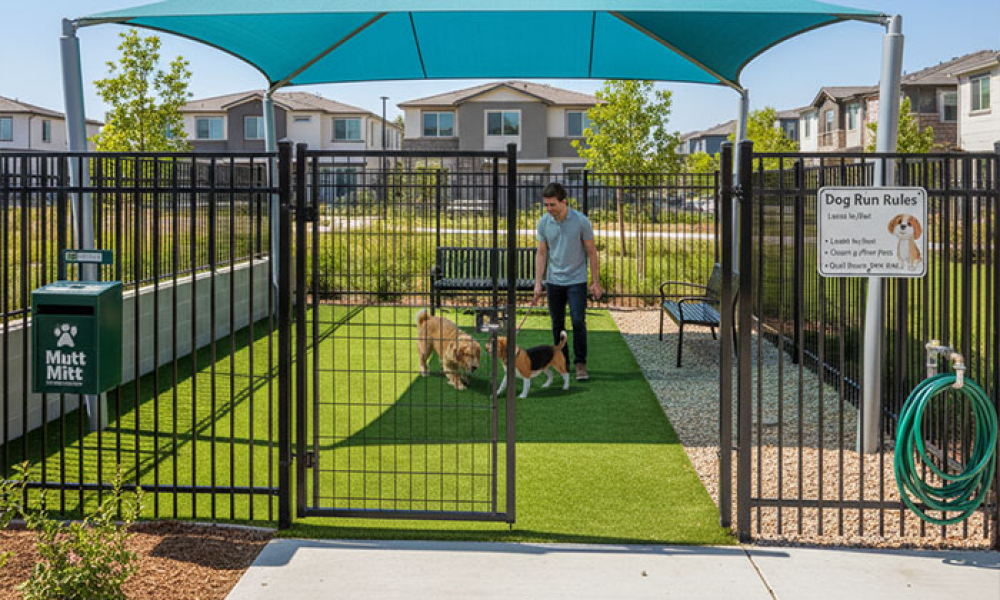
Dog park equipment HOA residential communities install is increasingly recognized as one of the most effective community amenities for attracting and retaining residents who own pets — and pet ownership rates consistently above sixty percent in most American markets mean that’s a substantial majority of most residential communities’ target demographic. But a community dog park that’s poorly planned, inadequately equipped, or built with products that don’t hold up under public use conditions quickly becomes a liability rather than an asset — creating maintenance headaches, safety concerns, and resident dissatisfaction that’s harder to reverse than it would have been to avoid with better upfront planning.
Why HOA Dog Parks Are Different From Other Park Amenities
Dog park equipment HOA residential communities install faces a use profile that differs from most other community amenities in ways that make product selection and space planning particularly consequential. Unlike a tennis court or playground that serves residents at predictable times and with relatively predictable use patterns, a community dog park is used continuously throughout the day by an unpredictable number of dogs of varying sizes, temperaments, and energy levels — with no professional supervision and no ability to manage which dogs use which equipment at any given time.
That use profile means equipment that works well in supervised commercial settings may not be appropriate for unsupervised community park use, and equipment that performs adequately for occasional residential backyard use will deteriorate rapidly under the volume and frequency of an HOA dog park. The selection criteria that should drive equipment decisions — unsupervised safety, durability under continuous outdoor use, ease of maintenance — are different from the criteria that drive residential or commercial facility equipment selection.
Planning the Space Before Selecting Equipment
The most consistent mistake HOA boards and property management companies make in dog park development is selecting equipment before the space itself has been properly planned. Equipment placement decisions that don’t account for traffic flow, supervision sight lines, drainage patterns, and the separation between small and large dog areas create problems that the best equipment can’t compensate for.
Effective space planning for a community dog park starts with the physical constraints of the available area — its dimensions, topography, existing drainage, and relationship to surrounding residential units — and works outward from there to determine how much space is available for active play, what separation between dog size groups is feasible, where entry and exit points should be located, and what sight lines the surrounding residences provide for informal supervision. Equipment placement follows from that spatial plan rather than driving it.
Dog park equipment that’s modular and reconfigurable is particularly valuable in HOA settings because it allows the initial configuration to be adjusted as the community learns how the space actually gets used rather than locking in a fixed layout that proves problematic after installation.
Size Separation and Why It’s Non-Negotiable
One of the most important infrastructure decisions in any community dog park is whether and how to separate the space by dog size. Mixed-size parks where small dogs and large dogs share the same equipment and play area create conditions that lead to the most serious incidents that HOA dog parks generate — not because large dogs are aggressive, but because the size differential creates inherent risk when large dogs play in ways that are normal for their size but dangerous for small breeds.
Purpose-designed equipment scaled for small dogs — appropriate jump heights, tunnel dimensions, platform sizes — gives small breed dogs structures they can actually use confidently and safely. The Mini Series provides exactly this kind of size-appropriate equipment for the small dog section of a community park, which is consistently the section that gets more use per square foot than the large dog area in most residential communities simply because small breed ownership is so prevalent.
Double-gate airlock entry systems at each section’s entrance — where a dog passes through an outer gate that closes before the inner gate opens — prevent escape incidents that are among the most common and most serious safety events at community dog parks without this infrastructure.
Durability Standards for HOA Investment
The financial case for investing in genuinely commercial-grade durable dog play accessories for an HOA dog park is straightforward when total cost of ownership is evaluated rather than just upfront installation cost. Equipment built for sustained outdoor public use with UV-stabilized materials, powder-coated steel frames, and non-porous surfaces that resist moisture infiltration maintains its appearance and structural integrity through years of continuous use and seasonal weather cycles.
Consumer or light commercial equipment installed in a community dog park typically shows significant deterioration within one to two seasons — which means the HOA faces the cost and disruption of replacement far sooner than the initial purchase suggested it would. The premium for properly specified outdoor commercial equipment pays for itself through avoided replacement costs before the end of the standard warranty period for quality commercial products.
Ongoing Maintenance as Part of the Plan
Community dog park equipment for HOA residential communities delivers the best long-term value when ongoing maintenance responsibilities are defined before installation rather than addressed reactively after problems develop. Establishing inspection schedules, identifying who is responsible for routine maintenance, and ensuring parts availability for repairs rather than full replacement when individual components wear — all of these planning elements determine whether a community dog park remains an asset or gradually deteriorates into a liability.
Dog exercise equipment manufacturers who provide clear maintenance documentation and support parts availability for the life of the installation make the ongoing management of an HOA dog park significantly more straightforward than those whose products require full replacement when individual components fail.




