
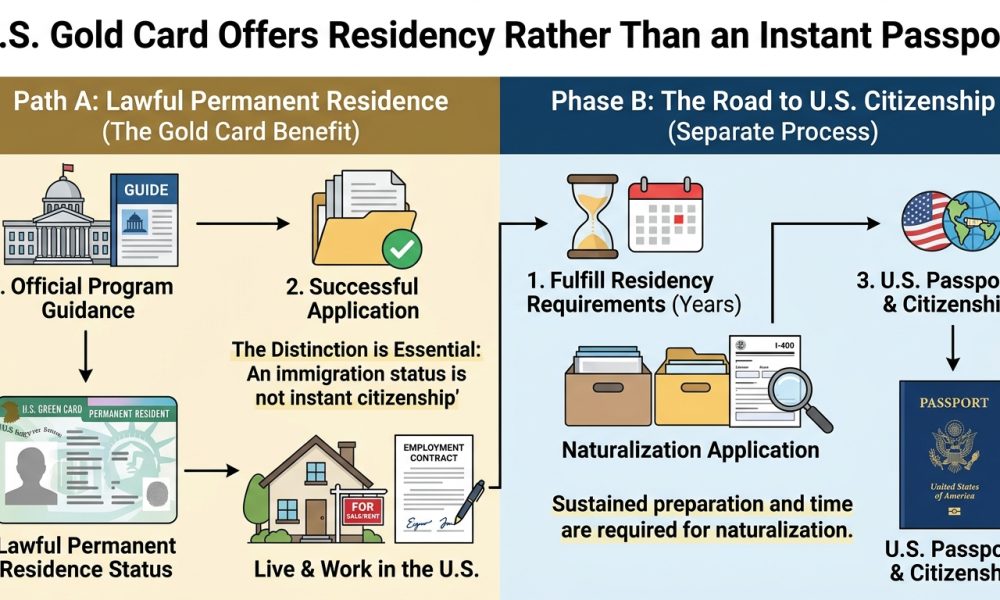
The Trump Gold Card program offers qualifying foreign nationals a government-administered pathway to lawful permanent residence in the United States through substantial financial contributions, but permanent residency, eventual naturalization, and possession of an American passport remain legally distinct stages.
WASHINGTON, DC, November 5, 2026 — The United States Gold Card program is attracting attention from wealthy foreign nationals seeking American residence, but its official framework establishes an immigration pathway rather than an immediate grant of United States citizenship or a passport.
Under the administration’s published rules, qualifying individuals may seek permanent resident status through existing employment-based immigrant classifications after paying processing charges, completing government screening, and providing a substantial financial contribution to the United States.
The distinction matters for investors and their families because lawful permanent residence can authorize settlement and employment. At the same time, citizenship requires separate statutory qualifications, further government review, and completion of naturalization procedures.
The Gold Card Program Is Built Around Permanent Residence
The program was established through an executive order signed by President Donald Trump on September 19, 2025, and subsequently opened for applications in December, creating an expedited process connected to existing employment-based immigration classifications.
Rather than issuing an American passport in exchange for payment, the program directs participating federal agencies to consider qualifying financial contributions as evidence supporting eligibility for particular immigrant visa classifications under existing immigration legislation.
The official framework identifies EB-1 and EB-2 classifications as the relevant pathways, meaning successful applicants obtain lawful permanent resident status when they meet the applicable legal requirements, obtain government approvals, and secure an available immigrant visa number.
Official Guidance Identifies the Financial Requirements
According to the U.S. government’s official Gold Card program guidance, an individual applicant must pay a nonrefundable $15,000 Department of Homeland Security processing fee before completing further vetting and making a $1 million contribution following the required government review.
The website describes the contribution as evidence that the applicant will substantially benefit the United States, while emphasizing that eligibility for permanent residence, admissibility, and an available immigrant visa remain necessary for approval.
The published process also involves Form I-140G, supporting evidence, government instructions, and potentially additional State Department expenses, demonstrating that a substantial payment does not independently establish immigration status or guarantee a successful application.
Corporate Sponsorship Follows a Different Financial Structure
The administration also offers a corporate Gold Card arrangement under which an eligible business sponsor may support a foreign employee through a $2 million contribution, alongside the applicable processing fee and government screening.
Official guidance describes arrangements that allow certain corporate sponsors to transfer sponsorship to another qualifying employee. However, the program’s published conditions may require additional maintenance, transfer, and background-check charges.
These provisions distinguish the corporate route from ordinary individual applications, particularly where an employer seeks to retain international talent while complying with immigration classification requirements, sponsorship procedures, and federal government review.
Recent Reporting Shows That Approval Is Not Automatic
In an April 23, 2026, Reuters report on the Gold Card program’s initial approvals, Commerce Secretary Howard Lutnick said only one applicant had received approval while hundreds of others remained under consideration.
Lutnick’s remarks highlighted the difference between substantial preliminary interest and completed immigration approvals, particularly as the government established administrative procedures and screened applicants seeking residence through the new framework.
Those reported figures describe the program’s position in April rather than its verified approval total in November, so they should not be interpreted as a current count or proof of any particular applicant’s likely outcome.
A Financial Contribution Does Not Replace Background Screening
Applicants must satisfy government vetting requirements involving identity, admissibility, and national security considerations, meaning substantial personal wealth cannot independently overcome statutory grounds of ineligibility or create an exemption from ordinary immigration safeguards.
The Gold Card application process requires truthful information and supporting evidence. At the same time, federal authorities retain responsibility for evaluating immigration petitions and determining whether an individual meets the requirements of the relevant immigrant visa classification.
Prospective applicants should therefore question commercial assurances suggesting guaranteed approval or special exemptions from screening, because official program materials expressly condition permanent residence on successful review and the availability of an appropriate visa.
EB-1 and EB-2 Categories Remain Important
The executive order connects the contribution-based process to existing employment-based immigrant visa classifications, including categories traditionally associated with extraordinary ability, exceptional ability, and certain national interest considerations under federal law.
The administration’s approach treats qualifying financial contributions as evidence of substantial benefit to the United States. Still, it remains subject to the applicable statutory framework and the immigration decisions of authorized federal agencies.
That distinction matters because the Gold Card does not establish an unlimited new citizenship category, and applicants should understand how existing visa allocations, eligibility assessments, and immigration procedures affect the advertised pathway.
Immigrant Visa Availability Can Affect Processing Times
The official program website acknowledges that immigrant visa availability remains relevant and that applicants from certain countries may face waits of a year or longer despite the accelerated processing described in promotional materials.
Employment-based immigration classifications operate within statutory numerical limits, meaning faster petition review does not necessarily eliminate every delay associated with obtaining an immigrant visa or completing permanent residence procedures.
Investors should distinguish processing targets from guaranteed arrival dates, particularly when planning international moves involving property purchases, business commitments, dependent children, or relocation arrangements that cannot easily be reversed.
Legal Challenges Introduce Another Area of Uncertainty
A lawsuit filed in February 2026 by the American Association of University Professors and other plaintiffs challenged the program’s legal basis, arguing that the administration improperly altered established employment-based immigration priorities.
The plaintiffs contend that federal law does not authorize the government to treat large financial gifts as a substitute for statutory eligibility requirements. At the same time, the administration’s executive order directs implementation within existing legal authorities.
As of the latest publicly reviewed case information, the litigation remained ongoing without an identified final merits judgment, making it important to distinguish the program’s operation from unresolved judicial questions concerning its legality.
Family Members Carry Additional Financial Obligations
The official Gold Card guidance permits qualifying spouses and unmarried children under twenty-one to participate in the application process. However, it sets separate financial requirements for accompanying relatives rather than a single household contribution.
Under the published terms, each participating family member faces an additional $15,000 processing fee and a $1 million contribution, creating potentially substantial differences between an individual applicant’s costs and those of a larger household.
Applicants should verify each relative’s eligibility and financial requirements before proceeding, particularly when adult children, elderly parents, or other dependents fall outside the family categories described in the program’s official materials.
Permanent Residents Can Live and Work in America
A successful applicant who obtains lawful permanent resident status generally gains authorization to establish residence and work in the United States, subject to the legal responsibilities and restrictions associated with that immigration classification.
Permanent residence can support long-term housing, employment, business development, and family planning. Still, it does not automatically grant voting rights, an American passport, or every privilege reserved under law for United States citizens.
Applicants should therefore evaluate the Gold Card principally as an immigration and residence opportunity, rather than assuming that the substantial contribution produces citizenship immediately upon completion of government screening.
Naturalization Requires a Separate Legal Process
Under the ordinary naturalization framework, many lawful permanent residents must complete at least five years of qualifying residence before applying for American citizenship. However, particular circumstances can create different statutory requirements.
Applicants generally must also satisfy continuous residence, physical presence, good moral character, and applicable English-language and civics requirements before taking the oath that completes naturalization following approval by United States Citizenship and Immigration Services.
Payment under the Gold Card program does not automatically waive those requirements, so the time between obtaining permanent residence and receiving an American passport can extend well beyond the program’s advertised processing period.
Extended Absences Can Affect Future Citizenship Eligibility
Permanent residents who eventually intend to naturalize should carefully consider their international travel patterns, because prolonged absences may raise questions about maintaining residence and meeting the physical presence requirements established by federal immigration law.
The ordinary five-year naturalization pathway generally requires thirty months of physical presence during the relevant qualifying period, alongside separate continuous residence requirements that may be affected by lengthy trips abroad.
A wealthy applicant who maintains homes and businesses across several countries should therefore seek qualified advice before assuming that holding permanent residence while spending most of the year overseas will preserve every future citizenship opportunity.
Permanent Residence Also Carries Financial Responsibilities
The government’s Gold Card materials explain that successful permanent residents may become subject to United States taxation, including rules concerning income earned outside America, which can materially affect applicants with international investments and businesses.
A financial contribution should therefore be evaluated alongside potential tax residence, asset ownership, reporting responsibilities, estate planning, and cross-border business arrangements rather than being treated as a self-contained immigration expense.
Prospective applicants may need coordinated legal and financial advice before relocating, particularly where foreign corporations, trusts, property holdings, or investment accounts create obligations that continue after American permanent residence begins.
The Gold Card Differs From Citizenship by Investment
Some countries operate programs that can grant nationality following approved investments or contributions, but the United States Gold Card instead provides a route to permanent residence under existing immigration classifications.
This distinction affects family planning, international travel, and future naturalization because applicants with U.S. residence rights remain foreign nationals until they independently meet the legal requirements to obtain U.S. citizenship.
Investors comparing international programs should examine whether the advertised benefit is temporary residence, permanent residence, or citizenship itself, rather than relying on commercial terminology that presents all expensive immigration opportunities as equivalent.
The Gold Card Is Also Different From EB-5 Investment Immigration
The existing EB-5 immigrant investor program generally requires a qualifying investment in a commercial enterprise and compliance with applicable job-creation requirements. In contrast, the Gold Card framework centers on a substantial financial gift.
These different structures carry different financial and legal implications, particularly because an unrestricted government contribution should not be confused with an investment that may involve ownership interests, operating risks, or potential financial returns.
Applicants should compare the statutory foundation, government screening, financial commitments, and visa availability of each route before assuming that the newer contribution-based arrangement necessarily offers greater certainty or a more suitable outcome.
Passport Verification Cannot Establish Immigration Approval.
Modern biometric passports incorporate electronic security features that help compatible systems assess stored identity information. Still, successful technical authentication does not establish permanent resident status, confirm immigrant visa approval, or prove American citizenship.
Amicus International Consulting explains these distinctions in its guide on scanning a passport’s NFC chip and understanding the results, emphasizing the difference between document authentication and legal decisions made by immigration authorities.
A foreign passport may remain entirely authentic while its holder applies for American residency, showing why nationality documents, government immigration approvals, and future naturalization must be evaluated as separate legal matters.
Gold Card Applicants Must Distinguish Residency From Citizenship
The United States Gold Card represents a substantial financial commitment within a government-administered immigration framework. Still, its advertised benefit is lawful permanent residence, not the immediate acquisition of an American passport.
For prospective applicants, realistic planning requires attention to official approval, admissibility, family expenses, visa availability, taxation, and the separate residence and naturalization requirements that may eventually lead to United States citizenship.
Ultimately, the Gold Card offers a potential pathway to living and working permanently in America. At the same time, American citizenship remains a separate legal achievement that the program’s contribution requirements cannot buy instantly.




