
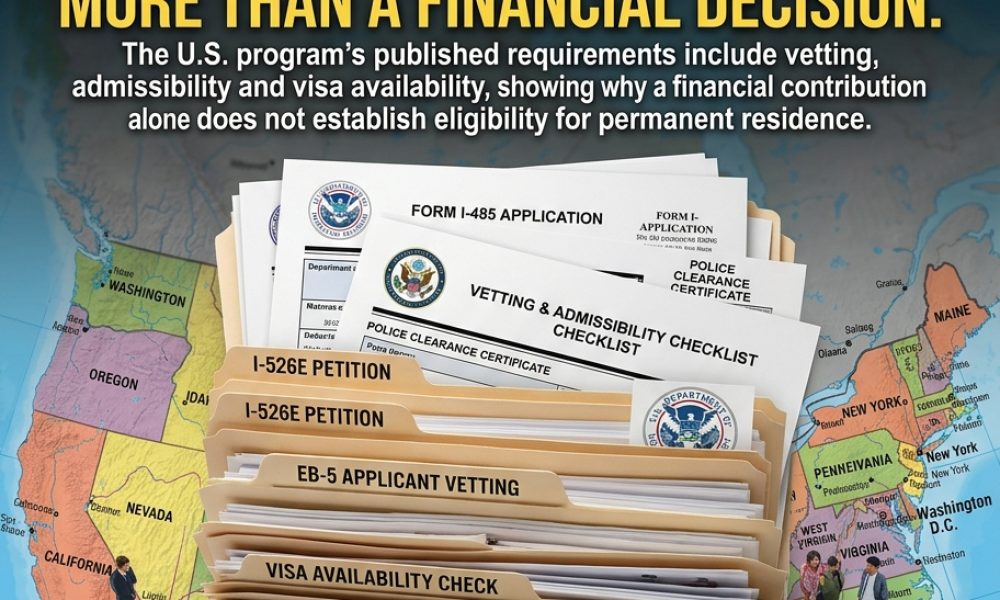
The American Gold Card offers a contribution-based route toward permanent residence. Still, government vetting, statutory admissibility, visa availability, additional family costs, and unresolved legal questions distinguish a substantial payment from an approved immigration application.
WASHINGTON, DC, November 5, 2026 — Foreign nationals exploring the United States Gold Card face a fundamental distinction between the financial contribution advertised by the administration and the separate immigration requirements that determine whether an applicant can obtain lawful permanent residence.
The program’s published terms require government screening, admissibility, and an available immigrant visa, making it inaccurate to describe the million-dollar contribution as an automatic purchase of citizenship or an unconditional right to enter the United States.
For investors coordinating business interests, international assets, and accompanying relatives, understanding these conditions is essential before making nonrefundable payments or committing to housing, employment transitions, and other arrangements that depend on a favorable immigration decision.
The Gold Card Is an Immigration Program, Not Instant Citizenship
Established by executive order in September 2025 and opened for applications in December, the Gold Card directs federal agencies to consider substantial gifts in connection with existing employment-based immigrant visa categories rather than grant American nationality immediately.
Successful applicants may ultimately become lawful permanent residents, permitting residence and employment subject to applicable rules. Still, American citizenship requires a separate naturalization process with statutory residence, physical presence, character, and other qualifications.
This distinction matters when commercial descriptions emphasize an American passport, because a permanent resident’s immigration document is not a United States passport and does not confer the voting or nationality rights reserved for citizens.
Official Eligibility Extends Beyond the Contribution
The official United States Gold Card program guidance expressly states that applicants must qualify for lawful permanent resident status, be admissible to the United States, and have an immigrant visa available before receiving the advertised benefit.
Those requirements remain relevant even after a substantial gift, since the federal government retains authority over background checks, identity assessment, visa classification, and the final adjudication of each individual’s immigration application under the published federal immigration framework and applicable administrative procedures.
Prospective applicants should therefore evaluate eligibility with qualified immigration counsel before treating the program as a guaranteed transaction, particularly when existing immigration complications or family circumstances might prevent the expected result under the published federal immigration framework and applicable administrative procedures.
The Advertised Financial Threshold Is Only One Stage
Current government materials describe a nonrefundable Department of Homeland Security processing fee of $15,000 for an individual, followed by vetting and a $1 million contribution after completion of the relevant screening process.
Additional State Department charges may apply, while professional advice, document preparation, travel, and any separate family applications can increase the overall cost beyond the two principal amounts highlighted in promotional materials under the published federal immigration framework and applicable administrative procedures.
A nonrefundable filing payment should not be interpreted as a reservation of permanent residence, because application review may identify legal obstacles that the applicant cannot overcome simply by demonstrating the financial capacity to contribute.
Early Approval Figures Exposed the Screening Gap
An April 23, 2026, Reuters report on Gold Card approvals quoted Commerce Secretary Howard Lutnick as saying only one applicant had been approved, while hundreds of other submissions remained under review under the published federal immigration framework and applicable administrative procedures.
Those figures described the program at that particular point in April, not its confirmed approval count in November. Still, they illustrated the substantial difference between initial registrations, paid applications, vetting, and completed approvals.
Subsequent public discussion of applicant numbers has also underscored the importance of distinguishing expressions of interest from actual fee payments and favorable decisions, rather than treating the largest reported enrollment figure as evidence of successful residency grants.
Admissibility Is a Separate Statutory Test
United States immigration law includes grounds of inadmissibility related to criminal conduct, security concerns, immigration violations, health-related issues, and material misrepresentation, and each rule depends on the individual facts.
Significant financial resources do not automatically remove these restrictions, and applicants should disclose relevant history accurately rather than assuming a prestigious program or an expensive contribution eliminates ordinary legal review under the published federal immigration framework and applicable administrative procedures.
Where a potential issue exists, a qualified lawyer can assess whether a specific rule applies and whether any legally available exception or waiver is relevant, without promising approval under the published federal immigration framework and applicable administrative procedures.
Vetting Can Extend Into Personal and Financial Records
Government review may involve identity documents, prior immigration history, professional activities, travel information, and other records relevant to assessing eligibility, and requests for additional evidence may lengthen the application process under the published federal immigration framework and applicable administrative procedures.
Applicants should preserve accurate supporting documents and maintain consistency across government forms, because conflicting names, undisclosed prior applications, or unsupported statements can raise concerns independent of the applicant’s ability to contribute.
Prudent preparation means resolving legitimate documentary discrepancies through appropriate official procedures, rather than paying intermediaries who offer to create a replacement personal history or conceal facts relevant to adjudication under the published federal immigration framework and applicable administrative procedures.
Visa Availability Can Create Waiting Periods
The program’s own guidance warns that applicants from a small number of countries may encounter waits of a year or longer based on immigrant visa availability, even when expedited petition processing is otherwise offered.
This reflects the underlying structure of employment-based immigration, where statutory allocations and nationality-related demand can affect when an approved applicant can complete the final stages of obtaining permanent residence under the published federal immigration framework and applicable administrative procedures.
An advertised processing advantage should therefore be separated from an unconditional arrival deadline, especially when families intend to terminate employment, sell property, or enroll children in American schools on a fixed schedule under the published federal immigration framework and applicable administrative procedures.
EB-1 and EB-2 Categories Shape the Legal Framework
The September 2025 executive order directs federal officials to consider qualifying gifts as evidence relevant to specified EB-1 and EB-2 classifications, including exceptional ability and national-interest considerations identified in existing immigration legislation under the published federal immigration framework and applicable administrative procedures.
That instruction does not eliminate statutory visa limits or other legal obligations, and the order expressly requires implementation consistent with applicable law and the responsibilities of the participating federal departments under the published federal immigration framework and applicable administrative procedures.
For applicants, this means that the Gold Card should be understood as an administrative approach operating through immigration categories, not as an independent promise that money supersedes every requirement of those categories under the published federal immigration framework and applicable administrative procedures.
Legal Challenges Add Uncertainty to Planning
The program has faced litigation questioning whether the executive branch has authority to use financial gifts as contemplated under existing employment-based immigration statutes, creating a legal issue separate from individual applicant screening.
Supporters of the administration’s framework point to the executive order’s requirement that implementation remain consistent with law. At the same time, challengers argue that the program improperly changes eligibility priorities without congressional authorization under the published federal immigration framework and applicable administrative procedures.
Applicants should monitor material court developments and obtain current professional advice before making irreversible financial commitments, without treating allegations in ongoing litigation as either a final judgment invalidating the program or definitive confirmation of its legality.
Family Members Generate Their Own Requirements
The official program describes potential inclusion of a spouse and unmarried children younger than twenty-one. Still, each qualifying family member is subject to an additional $15,000 processing fee and $1 million contribution.
Consequently, a household’s financial commitment can be several times the individual headline price. At the same time, older children and other relatives may require entirely different immigration pathways if they fall outside the permitted accompanying categories.
Families should establish every person’s eligibility before paying, because the principal applicant’s willingness to contribute cannot automatically convert an adult relative or dependent parent into an eligible beneficiary under the published scheme.
Residency Brings Continuing Responsibilities
Lawful permanent residence creates opportunities to live and work in the United States. Still, residents must also comply with immigration rules governing status maintenance, travel, and circumstances that could lead to removal.
Long overseas absences may raise questions about whether residence has been abandoned, a consideration especially important for wealthy applicants maintaining multiple homes, substantial foreign businesses, or frequent international commitments after approval under the published federal immigration framework and applicable administrative procedures.
Financial planning can also change materially because United States tax residence generally involves broad reporting and taxation obligations, making qualified cross-border advice important before restructuring investments or transferring substantial family assets under the published federal immigration framework and applicable administrative procedures.
Citizenship Requires a Later, Separate Application
For many permanent residents, naturalization ordinarily becomes possible only after satisfying a qualifying residence period, commonly five years, together with statutory physical presence, continuous residence, good moral character, and other requirements under the published federal immigration framework and applicable administrative procedures.
An approved Gold Card does not immediately deliver a United States passport, and applicants who expect to spend most of their time abroad should evaluate how their travel patterns may affect eventual naturalization eligibility.
The distinction also matters for children and spouses, whose immigration and eventual citizenship circumstances may differ from those of the original contributor even when the entire household relocates to America under the published federal immigration framework and applicable administrative procedures.
Gold Card and EB-5 Are Not Interchangeable
The established EB-5 investor route generally involves qualifying capital investment and job creation under a statutory immigrant investor framework. In contrast, the Gold Card focuses on a large gift considered within specified employment-based categories.
Those structures create different financial exposures, evidentiary demands, and policy questions, so describing both merely as expensive green cards obscures meaningful differences in the legal basis and potential economic outcomes under the published federal immigration framework and applicable administrative procedures.
Applicants comparing them should examine capital recoverability, job-creation obligations, investment risk, government review, and current visa availability rather than assume one is automatically quicker or more reliable than the other under the published federal immigration framework and applicable administrative procedures.
Document Authenticity Does Not Establish Immigration Status
Modern biometric passports include electronic data and cryptographic protections that compatible readers can evaluate. Still, a successful technical inspection cannot independently establish an approved immigrant petition or a valid grant of American permanent residence.
Amicus International Consulting discusses these distinctions in its guide on scanning a passport’s NFC chip and understanding the results, separating document authentication from the underlying citizenship and immigration decisions made by government authorities.
A valid foreign passport can support Identification during the Gold Card process. Yet, the booklet remains evidence of the issuing country’s nationality rather than proof that the United States has approved the holder for permanent settlement.
Families Need a Complete Relocation Budget
Beyond government contributions and filing fees, a move to America can require housing deposits, private insurance, school arrangements, transportation, professional licensing, and accessible funds during the transition between countries of residence under the published federal immigration framework and applicable administrative procedures.
Applicants should also account for tax advice, document translation, legal representation, and the financial impact of any processing delay, particularly if a business transfer or property purchase depends on a specific approval date.
A realistic budget preserves resources for family stability after immigration approval, rather than directing every available asset toward the advertised contribution before the family’s legal and practical needs have been assessed under the published federal immigration framework and applicable administrative procedures.
Court Proceedings and Policy Changes Affect Risk
Applicants should recognize that executive actions, administrative regulations, and pending litigation can change the operating environment after an initial expression of interest, so review official developments immediately before submitting fees or committing to an international relocation.
A professionally prepared application may still encounter delays or changed instructions, so contractual arrangements and financial reserves should allow for uncertainty without assuming that a previously advertised schedule will remain unchanged throughout the government’s examination.
Transparent Advice Matters Before Payment
Commercial advisers can help coordinate document preparation and explain program requirements. Still, no private representative can lawfully guarantee a favorable federal immigration decision or waive applicable statutory screening requirements through personal connections under the published federal immigration framework and applicable administrative procedures.
Prospective clients should require written fee schedules, clear descriptions of professional responsibilities, and an explanation of what happens if processing is delayed or the application is refused after nonrefundable charges have been paid.
Independent legal review is particularly valuable where the program’s implementation or legal basis is disputed, because the scale of the financial commitment makes unsupported assurances of certainty especially consequential for families under the published federal immigration framework and applicable administrative procedures.
Approval Depends on Law as Well as Money
The Gold Card offers a contribution-based pathway toward American permanent residence. Still, eligibility depends on formal government review, admissibility, visa availability, and compliance with existing immigration law, not wealth alone, under the published federal immigration framework and applicable administrative procedures.
For investors considering the program, the soundest approach is to separate the advertised financial contribution from the legal criteria, potential delays, family costs, and continuing obligations that accompany a successful immigration decision under the published federal immigration framework and applicable administrative procedures.
Ultimately, Gold Card applicants face more than a financial decision because a substantial payment may support a petition. At the same time, only the appropriate government authorities can determine whether an individual qualifies to become a lawful permanent resident.




