
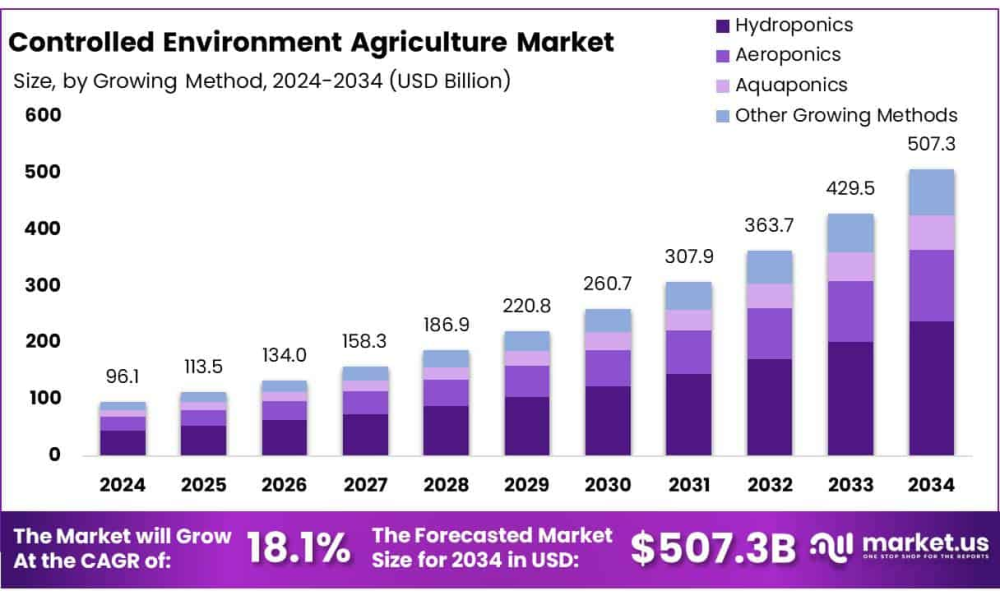
New York, NY – July 02, 2025 – The Controlled Environment Agriculture Market is growing fast due to rising demand for fresh, high-quality food and the need for sustainable farming. In 2024, the market was valued at USD 96.1 billion, but it is expected to reach USD 507.3 billion by 2034, growing at a strong 18.1% CAGR from 2025 to 2034.
The USDA supports initiatives to minimize the environmental footprint of conventional farming while boosting food production. According to the USDA, the vertical farming market could reach $12.77 billion by 2026, underscoring the growth potential of the controlled environment agriculture market. Urban agriculture and food self-sufficiency are gaining traction globally, prompting government action.
For instance, Singapore aims to produce 30% of its nutritional needs through local, sustainable farming by 2030, leveraging advanced technologies like vertical farming and hydroponics to meet food demands while conserving resources. However, establishing a vertical farm is capital-intensive, with costs ranging from $100,000 to $300,000 per acre, depending on system complexity and location, according to the United Nations Food and Agriculture Organization (FAO).
High energy costs for lighting and climate control systems further challenge farmers, particularly in developing regions with elevated electricity prices. Urban farming can significantly enhance food security, potentially supplying up to 15% of a city’s food by 2030, as per an FAO report. Growing food close to consumers reduces transportation costs, minimizes waste, and improves supply chain efficiency. The integration of AI and automation in vertical farms has increased yield efficiency by up to 30%, according to the FAO, positioning these technologies as key drivers of growth in the sector.
Important Revelation
- Controlled Environment Agriculture Market size is expected to be worth around USD 507.3 billion by 2034 from USD 96.1 billion in 2024, growing at a CAGR of 18.1%.
- Hydroponics held a dominant market position, capturing more than a 46.10% share.
- Lighting Systems held a dominant market position, capturing more than a 37.10% share of the controlled environment agriculture market.
- Greenhouses held a dominant market position, capturing more than a 38.10% share.
- Vegetables held a dominant market position, capturing more than a 41.20% share of the controlled environment agriculture market.
- Commercial Growers held a dominant market position, capturing more than a 53.10% share.
- Europe’s contribution is estimated to reach approximately 34.20%, equivalent to USD 32.8 billion.
➤ Download Exclusive Sample Of This Premium Report (Including Full TOC, Table & Figures): https://market.us/report/controlled-environment-agriculture-market/request-sample/
Report Segmentation
By Growing Method Analysis
- In 2024, Hydroponics emerged as the leading growing method in the controlled environment agriculture market, accounting for over 46.10% of the total market share. Its dominance is primarily driven by its efficient use of water and independence from soil, allowing crop production in diverse environments, including urban and water-scarce regions.
- The method supports consistent, high-yield cultivation in closed systems, aligning well with the rising focus on sustainable controlled environment agriculture market. The trend toward locally grown, fresh produce is further supporting its adoption. In 2025, Hydroponics is projected to witness a slight increase in market share, supported by technological innovations such as automated monitoring and nutrient optimization systems.
By Components Analysis
- Lighting Systems represented the largest component segment in the controlled environment agriculture market in 2024, holding a market share of more than 37.10%. Their essential role in enabling photosynthesis, especially in indoor or low-light farming settings, underpins their market leadership.
- The demand for energy-efficient, year-round crop production has led to increased reliance on LED and smart lighting technologies, which reduce energy consumption while improving plant growth outcomes. By 2025, further advancements in intelligent lighting systems and cost-saving innovations are expected to bolster this segment’s dominance, making lighting systems integral to operational efficiency and yield improvement.
By Farming Type Analysis
- Greenhouses maintained their leading position in 2024, capturing over 38.10% of the market share in the farming type segment. Their ability to provide a stable and protected environment for diverse crops throughout the year contributes significantly to their widespread adoption. Greenhouses offer scalability and adaptability, suitable for both commercial and small-scale growers. The rising need for weather-resilient farming solutions and improved crop quality is expected to sustain greenhouse usage in 2025.
By Crop Type Analysis
- Vegetables dominated the crop type segment in 2024, accounting for more than 41.20% of the controlled environment agriculture market. This leadership can be attributed to the strong consumer demand for clean, pesticide-free, and locally sourced produce. Vegetables are ideally suited to controlled environments due to their short growth cycles and high nutritional value. The growing health awareness among consumers and the increasing adoption of sustainable farming methods are expected to support further growth in this segment in 2025. The integration of advanced cultivation techniques such as hydroponics and vertical farming is likely to enhance productivity and reinforce vegetables’ leading market share.
By End-User Analysis
- Commercial Growers held the largest share in the controlled environment agriculture market in 2024, contributing over 53.10% of total revenue. Their preference for controlled systems stems from the need for consistent output, scalability, and quality assurance across large volumes. The ability to control environmental variables allows commercial operations to achieve higher efficiency and reduce dependency on seasonal factors. As demand for year-round, high-quality produce continues to rise, the commercial segment is expected to expand further in 2025. Investments in automation, environmental control, and resource-efficient technologies are likely to enhance the competitiveness of commercial growers in this space.
Market Key Segmentation
Based on Growing Method
- Hydroponics
- Aeroponics
- Aquaponics
- Other Growing Methods
Based on Components
- Lighting Systems
- Climate Control Systems
- Sensors and Monitoring Systems
- Growing Media
- Other Components
Farming Type
- Greenhouses
- Smart
- Traditional
- Vertical Farms
- Indoor Farming
- Container Farms
- Other Farming Types
Based on Crop Types
- Vegetables
- Fruits
- Flowers and Ornamentals
- Herbs
- Other Crop Types
End-User
- Commercial Growers
- Research Institutes and Academies
- Residential Users
Factors Affecting the Growth of the Controlled Environment Agriculture Market
1. Climate Control and Environmental Parameters: Temperature, humidity, CO₂ levels, lighting, and ventilation must be finely balanced in CEA systems. These factors directly affect plant growth, yield, and quality. Advanced sensors and monitoring tools help maintain stable conditions. Failure to stabilize any of these may result in reduced crop output and inefficiencies, so investment in control systems is essential.
2. Energy Consumption and Costs: CEA operations require substantial energy for lighting, heating, and cooling. Energy costs constitute a major portion of operational expenses. Adoption of energy-efficient technologies like LEDs, solar power, and heat pumps can lower costs and emissions. Efficient energy management is a critical factor in making CEA economically sustainable.
3. Initial Capital and Operational Investments: High upfront costs for infrastructure—greenhouses, vertical racks, sensors, and automation—create significant financial barriers. In addition, costs for skilled labor and ongoing maintenance add to the expense. Strong financial planning, access to funding, and estimating return on investment are key to managing these high entry and operational costs.
4. Technological Advancements and Digital Integration: Integration of IoT devices, AI-driven systems, and automation tools allows real-time monitoring and precise control of growing conditions. These technologies improve yield, reduce waste, and optimize resource usage. As digital solutions become more affordable and widespread, they enhance operational efficiency and drive broader adoption of CEA.
5. Water and Nutrient Management: CEA systems rely heavily on recycled water and nutrient solutions, demanding precise control of pH, electrical conductivity, and water quality. Effective management reduces water consumption and nutrient loss, leading to sustainable operations. Poor control may lead to nutrient imbalances, affecting crop health and increasing costs.
Competitive Landscape
- Sky Greens
- Heliospectra AB
- Signify N.V.
- Philips Lighting
- Urban Crop Solutions
- GrowGroup IFS
- EVERLIGHT ELECTRONICS CO., LTD
- AGRIFY CORP
- Plenty Unlimited, Inc.
- Intelligent Growth Solutions Limited
- Freight Farms
- Gavita International B.V.
- AeroFarms
- BrightFarms
- Greenlux Lighting Solutions
- Valoya, Inc.
- AGronomic IQ
- Urban Crop Solutions
- Bowery Farming
- AmHydro
- CubicFarm Systems
- Other Key Players
Get in Touch with Us:
Market.us (Powered By Prudour Pvt. Ltd.)
Address: 420 Lexington Avenue, Suite 300, New York City, NY 10170, United States
Send Email: [email protected]
Refer More Related Reports:
Dumplings Market
Battery Recycling Market
Biobased Polyurethane Market



