
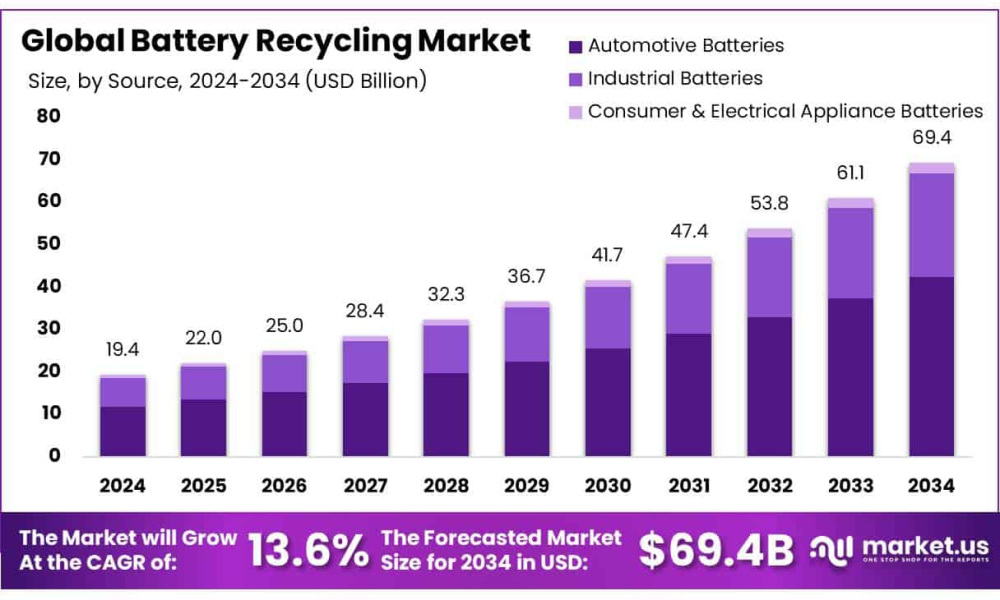
New York, NY – June 27, 2025 – The Global Battery Recycling Market is experiencing significant growth, driven by rising demand for sustainable solutions and the increasing popularity of electric vehicles (EVs) and consumer electronics. Valued at USD 19.4 billion in 2024, the market is projected to reach USD 69.4 billion by 2034, growing at a robust CAGR of 13.6% from 2025 to 2034.
This expansion is fueled by key growth factors, including stringent environmental regulations promoting responsible battery disposal and the need to recover valuable materials like lithium, cobalt, and nickel to reduce reliance on mining. The market is gaining popularity due to heightened awareness of environmental concerns and the push for a circular economy. Opportunities abound in advancing recycling technologies, such as hydrometallurgy and pyrometallurgy, which enhance material recovery efficiency.
Consumer electronics (CE) accounts for 50% of the global lithium-ion battery market and use 39% of all cobalt in LIBs, driving the need for sustainable recycling to recover valuable materials and reduce environmental impact.
According to European Electric vehicles (EVs) are rapidly growing in popularity, with over 30 million expected on European roads by 2020. As this number rises, so will the volume of end-of-life batteries. According to the International Energy Agency (IEA), the demand for sustainable lithium-ion batteries (SLIBs) is projected to grow significantly, from 400 GWh in 2035 to 1300 GWh by 2040. This surge in demand is expected to boost the global battery recycling market.
Recycling lithium-ion batteries (LIBs) reduces energy consumption and environmental impact by 5-30%, consuming nine times less energy than producing new batteries. It also lowers fine particulate matter by 17% and reduces mineral resource scarcity by 25%, supporting sustainable development. Battery recycling led to a 17% decrease in EVs’ fine particulate matter formation, improving air quality by reducing waste incineration and landfills.
In 2023, the EU introduced new Battery Regulations covering the entire lifecycle of batteries, requiring manufacturers to recover 50% of lithium from old batteries by 2027 and 80% by 2031. Companies must also track carbon footprints, meet recycling content targets by 2025, and implement a digital battery passport for improved transparency by 2027.
Important Revelation
- The global battery recycling market was valued at USD 19.4 billion in 2024.
- The global battery recycling market is projected to grow at a CAGR of 13.6 % and is estimated to reach USD 69.4 billion by 2034.
- Among sources, automotive batteries accounted for the largest market share of 61.2%.
- Among battery chemistries, lead-acid accounted for the majority of the market share at 72.1%.
- By technology, pyrometallurgy accounted for the largest market share of 56.2%.
- By end-use, material extraction accounted for the majority of the market share at 48.2%.
- Asia-Pacific is estimated as the largest market for battery recycling with a share of 39.4% of the market share.
➤ Download Exclusive Sample Of This Premium Report (Including Full TOC, Table & Figures): https://market.us/report/global-battery-recycling-market/request-sample/
Report Segmentation
Source Analysis
- The Automotive Batteries Segment dominates the battery recycling market, driven by rising electric vehicle (EV) adoption and stricter recycling regulations. In 2024, this segment accounted for 61.2% of market revenue, fueled by the increasing volume of end-of-life EV batteries and stringent government policies promoting sustainable practices. The recovery of critical materials like lithium, cobalt, and nickel further boosts recycling efforts in the automotive sector. This trend is expected to persist as the global EV fleet grows and recycling technologies advance.
Battery Chemistry Analysis
- Lead-acid batteries lead the market, holding a 72.1% share in 2024, due to their widespread use in internal combustion engine (ICE) vehicles, cost-effectiveness, and well-established recycling infrastructure. Despite the emergence of newer battery technologies, lead-acid batteries maintain dominance in the recycling sector, supported by their long-standing use in automotive and backup power applications.
Technology Analysis
- Pyrometallurgy leads the market with a 56.2% share in 2024, favored for its efficiency in recovering valuable metals like nickel, cobalt, and copper from various battery chemistries. Its scalability, high throughput, and ability to process diverse battery types make it the preferred method for large-scale recycling operations.
End-Use Analysis
- Material extraction dominates the market, capturing a 48.2% share in 2024, driven by the high demand for critical raw materials such as lithium, cobalt, and nickel for new battery production. Efficient recycling processes support material recovery, while the focus on reducing reliance on mined resources and promoting a circular economy further strengthens this segment.
Market Key Segmentation
By Source
- Automotive Batteries
- Passenger Cars
- Light & Heavy Commercial
- Others (2 & 3 Wheelers)
- Industrial Batteries
- Consumer & Electrical Appliance Batteries
By Battery Chemistry
- Lithium-ion
- Lithium Cobalt Oxide (LCO)
- Lithium Manganese Oxide (LMO)
- Lithium Nickel Manganese Cobalt Oxide (NMC)
- Lithium Nickel Cobalt Aluminum Oxide (NCA)
- Lithium Iron Phosphate (LFP)
- Others
- Lead-acid
- Nickel based
- Flow Batteries
- Others
By Technology
- Pyrometallurgy
- Hydrometallurgy
- Mechanical Separation
By End-Use
- Material Extraction
- Disposal
- Reuse, Repackaging & Second Life
Geopolitical Impact Analysis
Impact of U.S. Tariffs on the Global Battery Recycling Market
U.S. tariffs on Chinese-made batteries, combined with escalating trade restrictions and geopolitical tensions, are reshaping the global battery recycling market. The tariffs, set to reach 82% by January 2026, include a 34% increase on top of existing measures (a 20% tariff, two 10% increments, a 3.4% global tariff on lithium-ion batteries, and a Section 301 tariff rising from 7.5% to 25% in 2026).
These measures significantly raise the cost of imported batteries, potentially doubling prices. Higher battery costs may reduce demand for replacements, leading to fewer used batteries available for recycling. Additionally, increased raw material costs make recycling less economically viable, while supply chain disruptions further hinder the efficiency and growth of the recycling industry.
Factors Affecting the Growth of the Battery Recycling Market
- Rising Electric Vehicle Adoption: The surge in electric vehicle sales increases the volume of end-of-life batteries, boosting the need for recycling. As more EVs hit the roads, recycling programs expand to handle used batteries, recover valuable materials, and support sustainable transportation.
- Stricter Recycling Regulations: Governments worldwide enforce tough rules to ensure safe battery disposal and promote recycling. These regulations push companies to adopt sustainable practices, meet recycling targets, and reduce environmental harm, driving growth in the recycling market.
- Raw Material Costs: High costs of critical materials like lithium, cobalt, and nickel make recycling more appealing. Recovering these materials from used batteries reduces reliance on expensive mining, lowers production costs, and supports a cost-effective supply chain.
- Supply Chain Disruptions: Global trade issues, labor shortages, and logistical challenges disrupt battery recycling processes. These disruptions raise costs and delay operations, making it harder for recycling facilities to scale and meet growing demand efficiently.
- Technological Advancements: New recycling methods, like hydrometallurgy and direct recycling, improve material recovery rates and reduce energy use. These innovations make recycling more efficient, cost-effective, and environmentally friendly, encouraging wider adoption in the industry.
Competitive Landscape
- BASF SE
- Accurec Recycling GmbH
- Fortum
- Glencore
- Umicore
- Exide Industries Ltd
- Gravita India Ltd
- Li-Cycle
- RecycLiCo Battery Materials
- Tata Chemicals Ltd.
- American Battery Technology Company
- Cirba Solutions
- Gopher Resource LLC
- East Penn Manufacturing
- Aqua Metals
- Eco-Bat Technologies
- Ganfeng Lithium Group Co., Ltd.
- Lithion Recycling Inc.
- EnerSys
- Redwood Materials, Inc.
- Element Resources LLC
- Contemporary Amperex Technology Co. Limited
- Stena Recycling
- REDUX Recycling GmbH
- Other Key Players
Get in Touch with Us:
Market.us (Powered By Prudour Pvt. Ltd.)
Address: 420 Lexington Avenue, Suite 300, New York City, NY 10170, United States
Send Email: [email protected]
Refer More Related Reports:



