
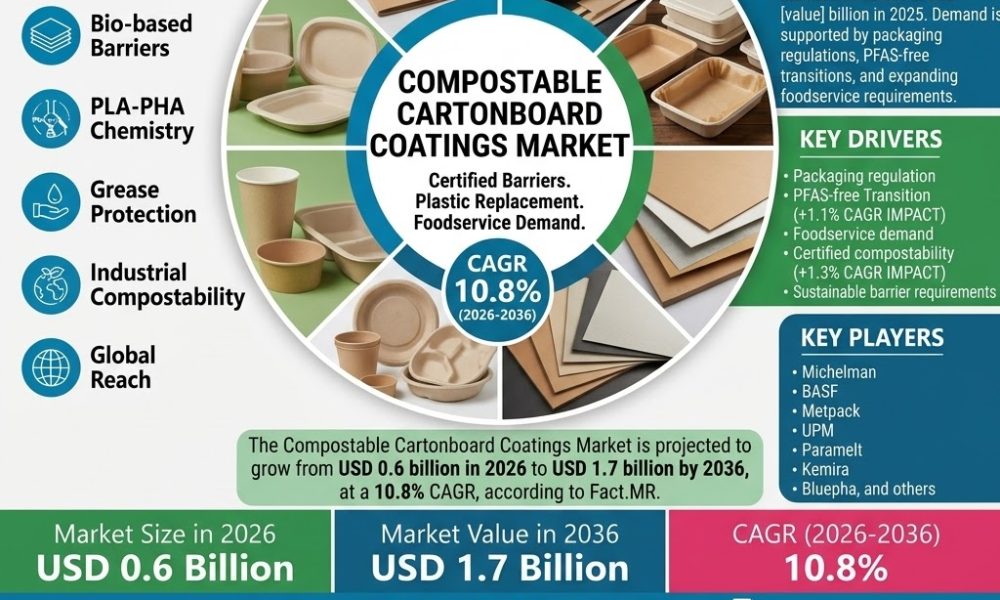
Market rises from USD 0.6 billion in 2026 to USD 1.7 billion by 2036 at a 10.8% CAGR as converters qualify certified barriers.
September 22, 2026 — The global Compostable Cartonboard Coatings Market is projected to reach USD 1.7 billion by 2036, rising from USD 0.6 billion in 2026 at a 10.8% CAGR, according to Fact.MR. The market crossed USD 0.5 billion in 2025 as board mills expanded plastic-replacement trials. The forecast reflects demand for certified coating systems that can perform on established converting lines while meeting documented end-of-life requirements.
The market has a USD 1.1 billion absolute opportunity through 2036. Foodservice applications, PLA-PHA chemistry, and industrially compostable systems are central to this expansion. Why now? Packaging regulation, foodservice barrier requirements, and converter interest in familiar application methods are increasing the need for validated alternatives to conventional plastic barriers.
Get detailed market forecasts, competitive benchmarking, and pricing trends: https://www.factmr.com/connectus/sample?flag=S&rep_id=15817
Fact.MR is a market research and consulting company that provides syndicated and customized research across industries and evaluates market size, segments, competitive activity, and country-level trends.
Certification and line performance shape adoption
Commercial adoption depends on more than coating chemistry. Board mills need plastic-replacement coatings that preserve carton stiffness and production speed, while foodservice packaging producers require grease protection that withstands hot contents and handling.
Shambhu Nath Jha, Principal Consultant at Fact.MR, said, “Commercial adoption depends on proving each coated structure under actual converting conditions before customer approval.”
He added that demand is expected to favor formulators connecting barrier chemistry with certification and local processor acceptance, with documented line performance and an accepted end-of-life route remaining central to commercial value.
The market’s segment data highlights this qualification focus. PLA-PHA is projected to hold 34.0% share in 2026, supported by established processing routes and recognized compostability pathways. Industrially compostable coatings are projected to account for 66.0%, while grease and oil resistance is forecast to represent 38.0% of demand.
Foodservice represents another major application. The segment is estimated to hold 40.0% share in 2026, reflecting recurring takeaway use and frequent contact with food residue. Folding boxboard is anticipated to account for 38.0%, supported by established printing, scoring, and carton-conversion workflows.
Commercial activity reflects the market’s direction
Recent company activity provides a practical view of how coating suppliers are addressing packaging requirements. In April 2026, Michelman announced Nuvita® Life 4002 and Nuvita® Life 4605, described as bio-based, plastic-free barrier coatings for fiber-based retail food packaging.
BASF expanded its ecovio grades for paper barrier coatings in April 2026. In May 2025, Metpack and BASF announced work involving certified home-compostable coated paper for food packaging.
UPM and Paramelt introduced a bio-based food packaging concept in March 2026, while Kemira and Bluepha announced an exclusive APAC partnership for fully biobased barrier coatings in June 2025.
These developments are relevant because converters must validate coating performance under commercial conditions. High-speed coating can expose failures that laboratory testing does not reveal, making line trials and finished-package certification important before wider customer approval.
Regional growth varies across major markets
India is projected to record the fastest stated growth among the highlighted countries, at a 13.4% CAGR, supported by certified substitution programs. China follows at 12.4%, driven by fiber packaging demand.
The United Kingdom is forecast to advance at 11.1%, while Germany is projected at 10.5% and Brazil at 10.4%.
England’s March 2026 recycling reforms require separate paper and card collection across household waste systems nationwide. Germany’s August 2025 minimum standard strengthens recyclability assessment for packaging intended for established fiber recovery routes. In Brazil, Anvisa’s September 2024 framework defines registration and notification requirements covering food and packaging.
These country conditions matter because certification alone does not guarantee an available disposal route. Fact.MR notes that collection acceptance mismatch remains a restraint, with different municipal systems potentially directing certified packages through incompatible treatment pathways.
Regulation creates opportunities while disposal routes remain critical
Packaging regulation and PFAS replacement are identified as a +0.9% impact on CAGR, with relevance across Europe and global markets. Foodservice barrier performance carries a +0.7% impact, while established equipment compatibility carries +0.6%.
The report also identifies dual-pathway structures as a +0.5% opportunity impact on CAGR. PLA and PHA barrier packages contribute a further +0.4%, while closed-loop foodservice programs contribute +0.3%.
At the same time, collection acceptance mismatch carries a -0.6% impact, followed by applied coating cost at -0.5%. Production scale-up risk accounts for -0.4%.
For converters and brand owners, the practical issue is clear: compostability claims require more than material selection. Finished-package certification and written processor acceptance can determine whether a coated carton can move from trial to commercial use.
Fact.MR research scope
The Compostable Cartonboard Coatings Market analysis covers 120+ sources, 35+ company portfolios, 25+ countries, and more than 20 industry interviews. The study evaluates PLA-PHA, starch-based, cellulose-based, and other biopolymer chemistries across industrially compostable and home-compostable certification categories.
The research also covers grease and oil resistance, moisture-water, oxygen-aroma, and heat-seal barriers across foodservice, food packaging, personal care, and industrial applications.
For the complete Compostable Cartonboard Coatings Market report, visit Fact.MR. Additional market context is available through the European Union packaging and packaging waste regulation.
Top Reports :
About Fact.MR
Fact.MR is a market research and consulting company providing syndicated and customized research across global industries. Its research combines primary interviews, desk research, market sizing, forecasting, company analysis, regulatory review, and data validation to assess market development and commercial opportunities.



