
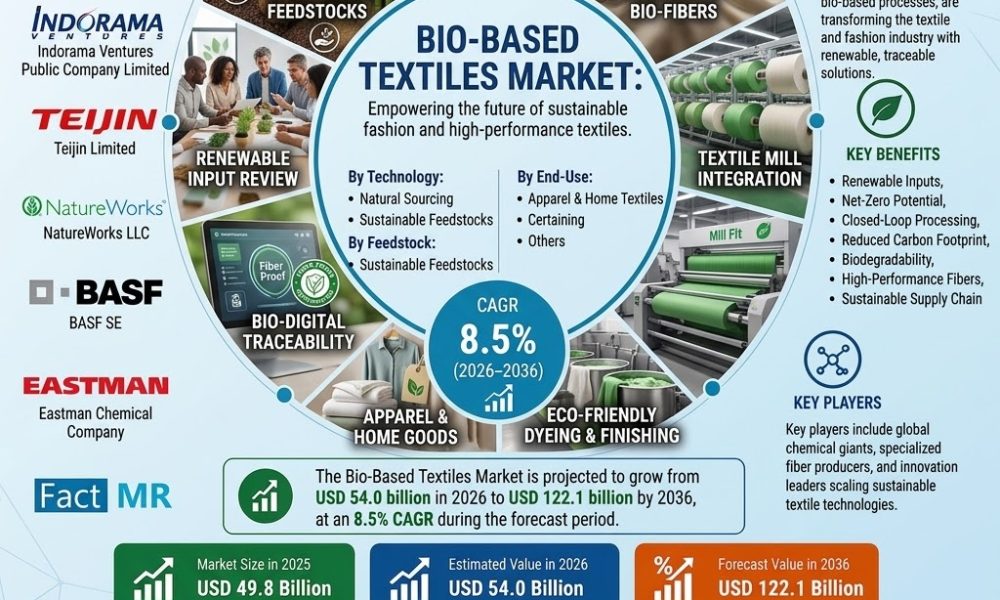
The Bio Based Textiles Market is projected to reach USD 122.1 billion by 2036, rising from USD 54.0 billion in 2026 at an 8.5% CAGR, according to Fact.MR. The market reached USD 49.8 billion in 2025 as brands and textile processors reviewed renewable inputs for broader use.
The market is expected to create a USD 68.1 billion absolute opportunity through 2036. Adoption is being shaped by fiber verification, mill-level processing fit, material origin, and the ability of renewable fibers to meet established fabric requirements.
Get detailed market forecasts, competitive benchmarking, and pricing trends
Natural fibers and apparel shape early demand
Natural Bio-based Fibers are projected to account for 39.6% of the market in 2026, making the segment the leading fiber type. Apparel is expected to hold 34.0% share during the same year, reflecting the role of comfort, material origin, and fiber documentation in seasonal purchasing decisions.
Plant-based sources are anticipated to capture 44.3% share in 2026. Cotton and hemp benefit from familiar processing routes, while flax provides another option for durable fabric programs.
Fashion & Apparel is estimated to represent 33.9% share, as public-facing brands face direct customer review of material claims. Direct Sales are forecast to hold 39.0% share, reflecting account-level sourcing decisions and the technical discussions often required before textile orders are converted.
Fact.MR is a market research and consulting company that provides market intelligence, industry analysis, and strategic research across global markets.
The immediate question for textile companies is how renewable fibers can fit existing production requirements. The supplied market analysis points to fiber proof and mill-level fit as central factors, particularly when companies evaluate spinning, dyeing, comfort, and wear performance.
Shambhu Nath Jha, Sr. Consultant at Fact.MR, said, “Bio based textiles must prove that renewable origin does not weaken comfort or repeat supply. Acceptance is expected to depend on verified fiber claims and mill-level fit.”
Regional growth varies across major textile markets
The USA is projected to record an 11.1% CAGR from 2026 to 2036, the highest listed country growth rate in the supplied comparison. Germany follows at 10.0%, while the UK is forecast at 9.0%.
France is estimated to grow at 8.0%, followed by Japan at 7.0%. Canada is projected to record a 6.0% CAGR.
The country differences reflect varying levels of channel support, fiber development, compliance requirements, and material verification. In the USA, brand substitution programs and fiber development activity are identified as growth factors. Germany’s demand is linked to material proof and compliance-led sourcing.
UK growth is expected to come through selective apparel renewal programs. France is associated with fashion customer interest in material provenance and fabric quality, while Japan’s market development places greater emphasis on quality consistency and processing control.
Fiber qualification remains central to adoption
Natural bio-based fiber substitution is identified as a driver with a +2.4% impact on CAGR, with Canada, Germany, and the USA identified as relevant markets over the short term.
Apparel material qualification carries a +2.0% impact, particularly across Germany, France, and the UK. Plant-based source familiarity contributes a further +1.6% impact, with Canada, the USA, and Japan identified for medium-term relevance.
For textile producers, known spinning and dyeing behavior can simplify customer approval. Bio-based specific yarn programs are identified as a medium-term opportunity, while verified apparel renewal collections could support limited launches before wider seasonal adoption.
Raw-material cost movement remains a constraint, carrying a -1.2% impact on CAGR in the supplied analysis. Mill process-change risk follows at -1.0%, while weak claim documentation carries a -0.8% impact.
These factors can delay conversion when renewable fibers carry higher costs without a corresponding garment value. New blends may also require trials before mills accept dyeing behavior and defect responsibility.
Competitive landscape includes major fiber and material companies
The competitive landscape includes Lenzing AG, Toray Industries, Inc., Indorama Ventures Public Company Limited, Teijin Limited, NatureWorks LLC, BASF SE, and Eastman Chemical Company.
Lenzing AG contributes regenerated cellulosic fiber portfolios used in apparel and home textiles. Eastman Chemical Company provides cellulosic textile materials, while NatureWorks LLC adds polylactic acid fiber capabilities for bio-based synthetic applications.
Toray Industries, Inc. and Teijin Limited participate through advanced textile materials. Indorama Ventures Public Company Limited and BASF SE extend the competitive field through polymer, fiber, and material technologies.
The report’s analysis draws on 120+ sources, 35+ company portfolios, 25+ countries, and more than 20 industry interviews. Primary research includes manufacturers, distributors, procurement teams, end users, technology developers, and subject-matter experts.
Market outlook through 2036
The Bio Based Textiles Market covers renewable fiber inputs used across apparel, home textiles, industrial textiles, and medical textiles when bio-based content influences purchasing decisions.
The market is segmented by Fiber Type, Application, Source, End Use, Distribution Channel, and Region. Natural Bio-based Fibers, Apparel, Plant-based sources, Fashion & Apparel, and Direct Sales are the leading 2026 categories identified in the supplied analysis.
The full study covers North America, Latin America, Europe, East Asia, South Asia and Oceania, and the Middle East and Africa. The forecast period extends from 2026 through 2036.
Fact.MR’s analysis indicates that future adoption will depend on whether renewable fibers can satisfy material-origin requirements while maintaining familiar processing behavior, documented claims, and commercial supply consistency.
To View Top Reports
About Fact.MR
Fact.MR is a global market research and consulting firm providing syndicated and customized research reports, strategic consulting, and competitive intelligence across industries. Its research supports businesses in understanding market trends, demand patterns, competitive environments, and growth opportunities.



