
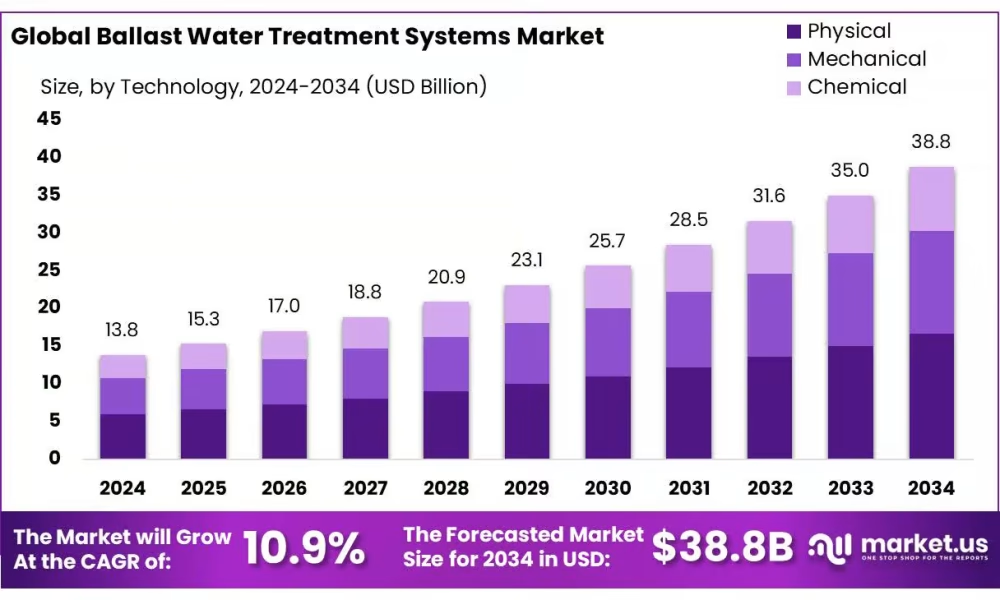
According to market.us, the global Ballast Water Treatment Systems (BWTS) market is expected to be worth around USD 38.8 billion by 2034, rising from USD 13.8 billion in 2024, registering a strong CAGR of 10.9% during the forecast period from 2025 to 2034.
This significant growth is driven by tightening international regulations on marine environmental protection, particularly concerning the discharge of untreated ballast water that poses ecological threats through the spread of invasive aquatic species. The International Maritime Organization (IMO) and various national authorities have mandated the installation of treatment systems on vessels to ensure compliance, prompting widespread adoption across the global shipping industry. The rise in global maritime trade, fleet modernization, and retrofitting activities in older vessels are contributing further to the demand for effective ballast water treatment technologies.
Technological advancements have enabled the development of compact, energy-efficient, and cost-effective treatment systems that utilize UV radiation, electrochlorination, and filtration methods to eliminate harmful organisms. Shipowners are increasingly focusing on systems with low maintenance requirements and high operational reliability.
Additionally, growing environmental awareness and the shift toward sustainable shipping practices are expected to reinforce market growth in the coming years. Overall, the ballast water treatment systems market is set to expand robustly as maritime stakeholders align with evolving compliance frameworks and environmental standards.
Key Takeaways
- Ballast Water Treatment Systems Market size is expected to be worth around USD 38.8 Bn by 2034, from USD 13.8 Bn in 2024, growing at a CAGR of 10.9%.
- Physical treatment technology held a dominant market position in the ballast water treatment systems market, capturing more than a 43.30% share.
- 1500-5000m³ capacity range held a dominant market position, capturing more than a 48.60% share of the ballast water treatment systems market.
- Tankers/Carriers held a dominant market position, capturing more than a 26.20% share of the ballast water treatment systems market.
- New Built held a dominant market position, capturing more than a 82.10% share.
- Europe held a dominant position in the global ballast water treatment systems (BWTS) market, capturing 38.90% of the market share, valued at approximately $5.3 billion.
Access a Complimentary Sample of This Premium Report: https://market.us/report/global-ballast-water-treatment-systems-market/request-sample/
Factors Affecting the Growth of the Ballast Water Treatment Systems Market
Stringent Environmental Regulations: Global maritime authorities, particularly the International Maritime Organization (IMO), have enforced mandatory compliance with ballast water discharge standards. These regulations are compelling shipowners to install treatment systems, significantly influencing market demand.
Expansion of Global Maritime Trade: The steady rise in international trade has led to an increase in the number of commercial vessels, driving the need for efficient ballast water management solutions to ensure environmental safety during port-to-port transitions.
Fleet Modernization and Retrofitting Needs: Older vessels are undergoing retrofitting to meet current compliance standards. Simultaneously, new builds are being equipped with integrated treatment systems, boosting installation activities across both segments of the industry.
Technological Advancements in Treatment Systems: Innovations in treatment technologies—such as UV irradiation, electro-chlorination, and advanced filtration—are enhancing system efficiency, reducing operational complexity, and increasing adoption among shipowners seeking reliable and cost-effective solutions.
Rising Focus on Environmental Sustainability: The maritime sector’s shift toward greener practices has elevated the importance of ballast water management as part of broader decarbonization and ecological preservation strategies. This cultural and regulatory momentum is accelerating the uptake of compliant treatment systems.
Key Market Segmentation
By Technology Analysis
In 2024, physical treatment technology dominated the ballast water treatment systems market with a market share exceeding 43.30%, driven by the effectiveness of methods like filtration and sedimentation in removing larger particles and organisms. Ultraviolet (UV) light technology also gained substantial traction, offering a chemical-free and eco-friendly solution by neutralizing microorganisms, and is projected to play a major role in future market expansion.
While technologies such as heat treatment, deoxygenation, and cavitation/ultrasonic remain less adopted, they are expected to see gradual growth as improvements in efficiency and cost-effectiveness emerge. Chemical treatments, including oxidizing and non-oxidizing biocides, continue to be widely utilized for their broad-spectrum effectiveness. However, environmental concerns and the industry’s shift toward greener alternatives may temper their long-term growth.
By Capacity Analysis
In 2024, the 1500–5000m³ capacity segment led the ballast water treatment systems market with a dominant 48.60% share, driven by the prevalence of medium-sized commercial vessels such as bulk carriers, tankers, and container ships, which commonly fall within this range. The <1500m³ segment also held a notable share, supported by growing adoption among smaller vessels, such as fishing boats and cargo ships, particularly in regions that enforce strict environmental regulations.
The >5000m³ segment, while accounting for a smaller share in terms of unit volume, is expected to grow steadily due to increasing demand from large vessels such as LNG carriers and large tankers. These ships require high-capacity and scalable treatment systems, contributing significantly to revenue despite their smaller numbers.
By Ship Type Analysis
In 2024, tankers and carriers dominated the ballast water treatment systems market with a 26.20% share, driven by their global presence and the need to comply with IMO regulations for transporting oil, gas, chemicals, and bulk goods. Offshore Support Vessels also represented a significant portion of the market, supported by the growth in offshore oil and gas projects and associated regulatory requirements.
Barges and cargo vessels held a notable share due to their high volume in global commercial fleets, especially in regulated coastal and inland waterways. Other vessel types—including tugboats, defense vessels, ferries, yachts, and cruise ships—contributed smaller but important shares, with growing adoption of treatment systems driven by regulatory compliance and environmental sustainability demands.
By End-use Analysis
In 2024, the New Build segment dominated the ballast water treatment systems market, accounting for over 82.10% of the total share. This dominance is attributed to the increasing number of newly constructed ships being equipped with integrated treatment systems to comply with stringent environmental regulations, particularly the IMO Ballast Water Management Convention.
In contrast, the Retrofit segment held a smaller market share but remains significant. As many older vessels require upgrades to meet current standards, retrofitting continues to drive steady growth, although it lags behind new builds in overall market volume.
Key Market Segments
By Technology
- Physical
- Ultraviolet Light
- Heat Treatment
- Deoxygenation
- Cavitation/Ultrasonic
- Mechanical
- Filtration
- Cyclonic Separation
- Electromechanical Separation
- Chemical
- Oxidizing Biocides
- Non-oxidizing Biocides
By Capacity
- <1500m3
- 1500-5000m3
- >5000m3
By Ship Type
- Offshore Support Vessels
- Tankers/Carriers
- Barges/Cargo Vessels
- Tugboats
- Defense Vessels
- Ferries
- Yachts
- Cruise Ships
- Others
By End-use
- New Built
- Retrofit
Regional Analysis
In 2024, Europe led the global ballast water treatment systems (BWTS) market with a 38.90% share, valued at approximately USD 5.3 billion. This dominance is driven by strict IMO and EU regulatory frameworks mandating effective ballast water management for both new and existing vessels. North America followed with a notable share, supported by regulatory enforcement in the U.S. and Canada and a sizable commercial fleet, though still trailing Europe.
Asia Pacific emerged as a key growth region, with rising demand in China, Japan, and South Korea fueled by expanding maritime trade and tightening environmental regulations. Meanwhile, the Middle East & Africa and Latin America held smaller shares but are projected to grow steadily as shipping activity increases and environmental standards become more stringent.
Top Key Players
- Wärtsilä
- Alfa Laval AB
- Xylem
- Atlantium Technologies Ltd.
- BIO-UV Group
- Industrie De Nora S.p.A.
- Mitsubishi Kakoki Kaisha, Ltd.
- Ecochlor Inc.
- DESMI A/S
- ERMA FIRST
- GEA Group AG
- Headway Technology Group (Qingdao) Co., Ltd
- Optimarin AS
- PANASIA CO,LTD
- Other Key Players
Get in Touch with Us:
Market.us (Powered By Prudour Pvt. Ltd.)
Address: 420 Lexington Avenue, Suite 300 New York City, NY 10170, United States
Send Email: [email protected]
Refer to More Related Reports:



