
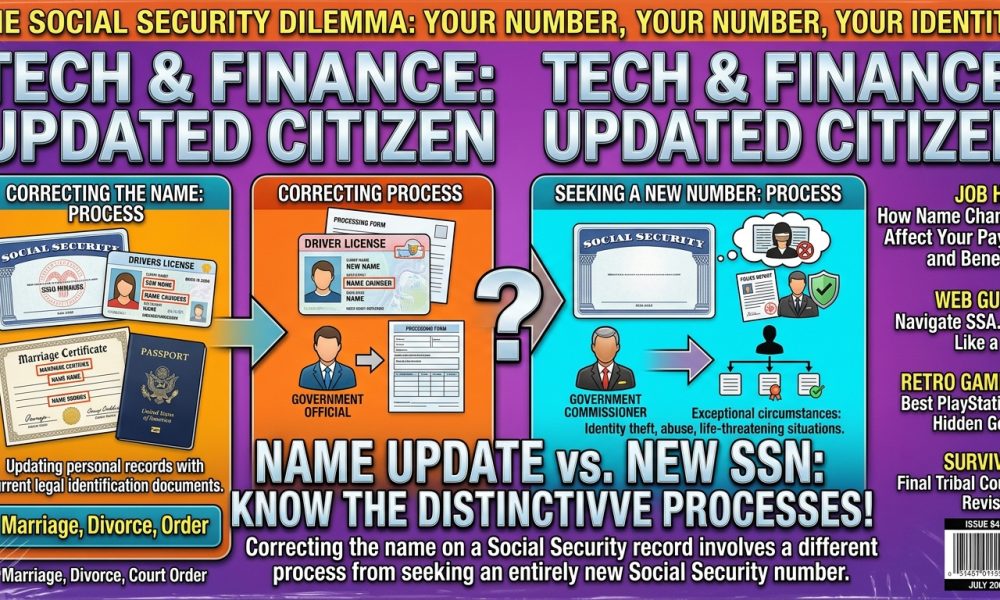
Correcting the name on a Social Security record follows a different process than requesting an entirely new Social Security number.
Washington, DC, October 20, 2026 — Updating a name with the Social Security Administration generally changes the identifying Information attached to an existing number, while obtaining a different number requires a separate assessment under limited circumstances recognized by the federal agency.
The distinction matters for people changing their names after marriage, divorce, or a court proceeding, because a replacement Social Security card ordinarily provides corrected documentation rather than a new number or an unrelated government record.
It also matters for individuals experiencing identity theft, harassment, or domestic violence, whose concerns may require consideration beyond an ordinary name update but do not automatically establish eligibility for a different number without supporting evidence and agency review.
Understanding which request addresses the actual problem can help applicants prepare the right documents, avoid unnecessary administrative steps, and recognize that a legal name change does not erase earlier earnings, financial obligations, or the history associated with their existing records.
A Name Update Preserves the Existing Number
A routine name update lets Social Security record a person’s current legal name while keeping the number already assigned to that individual, preserving continuity between earlier Information and records created after the change takes effect.
The replacement card reflects the updated name, but its issuance should not be confused with approval of a separate request for a different number, even when an applicant informally describes the document as a new Social Security card.
That language can create confusion during appointments or conversations with employers, so it helps to specify whether the task involves correcting a spelling error, recording a legal name change, or asking the agency to consider assigning another number.
Applicants who need only a name update should clearly identify that purpose at the start of the process, allowing the agency to direct them to the appropriate service without creating an unnecessary request that requires a different explanation and supporting evidence.
Documents Must Establish the Requested Change
Social Security’s name correction guidance requires evidence appropriate to the request, including identity and, when applicable, the new legal name and the event supporting the change, with citizenship or lawful noncitizen status evidence sometimes also necessary.
A marriage record, divorce decree, or court order may support a name change. Still, applicants should check the agency’s requirements for their circumstances rather than assuming one document resolves every question about identity and eligibility.
Correcting an existing error can involve a different evidentiary question from recording a later legal change, since the agency must determine whether the record was inaccurate or whether the person’s legally recognized name changed after the record was established.
Reviewing the instructions before submitting documents can reduce avoidable delays, especially when an applicant has older Identification, several previous names, or records whose differences require explanation before the agency can confidently connect the evidence to the correct person.
Application Routes Depend on the Circumstances
Social Security provides an online starting point for name changes, but whether you can complete a request electronically depends on your situation, and some people must schedule an appointment to finish the process with the required documentation.
Applicants should therefore follow the eligibility questions presented through the official service rather than relying on another person’s experience, because a route available for one request may not be available for a different name change or documentary situation.
The agency currently describes replacement card delivery as the period after it completes a request, so it’s important to distinguish mailing expectations from the additional time needed to review evidence or resolve discrepancies.
Keeping a record of submissions and outstanding requirements can make follow-up more effective, particularly when another organization is waiting for the Social Security update before correcting payroll Information, issuing Identification, or completing a separate administrative transaction.
Different Numbers Are Reserved for Limited Situations
The Social Security Administration’s guidance on requesting a new number describes eligibility as unusual. It identifies specific circumstances for consideration, including continuing identity theft problems, certain numbering conflicts, threats to personal safety, and qualifying religious or cultural objections.
Examples include family members with similar numbers that cause problems, situations where more than one person uses the same number, and identity theft that continues to disadvantage the victim despite attempts to address the underlying misuse.
Religious or cultural objections to particular digits require supporting documentation under the agency’s guidance, showing that a personal preference for a different number is not equivalent to a request based on an identified reason for consideration.
People seeking a different number must arrange an appointment and provide evidence relevant to their circumstances, allowing a representative to assess eligibility and explain potential advantages and disadvantages before the applicant assumes the requested change will be approved.
Identity Theft Requires Attention to the Actual Harm
Exposing a Social Security number and continuing to misuse it are related. Still, different problems, so someone responding to a breach should determine what happened and which accounts or records need attention before requesting an exceptional replacement.
Social Security explains that a lost or stolen card without evidence of number misuse does not qualify someone for a different number. At the same time, if problems continue after you try to resolve identity theft, the agency may consider further action.
The Federal Trade Commission recommends reporting identity theft and following a recovery plan, including contacting affected businesses, reviewing credit reports, and considering credit freezes to address risks created by the misuse of personal Information.
Keeping correspondence, dispute outcomes, and records of ongoing harm can help a victim explain the situation accurately, while avoiding the assumption that changing a name alone prevents someone from continuing to misuse already compromised Information.
Survivor Safety Can Justify a Separate Assessment
Social Security recognizes that harassment, abuse, domestic violence, and life endangerment can support consideration of a new number. Still, its guidance emphasizes evidence of the circumstances rather than treating every privacy concern as sufficient for approval.
For survivors who also expect to change their names, the agency’s domestic violence publication advises completing the name change before applying for a different number, helping align the evidence presented during the subsequent Application and identity review.
A survivor considering that process can discuss document requirements and communication concerns with the agency, while seeking assistance from a qualified advocate or lawyer when gathering records or receiving correspondence could create difficulties connected to personal safety.
A new number may be part of a broader safety plan. Still, you must weigh its potential value against the practical effects on employment, financial services, and other systems that still hold Information under the earlier number.
Identity Theft Cases Show Why Accuracy Matters
The consequences of unreliable identity matching extend beyond inconvenient paperwork, especially when an institution accepts a fraudulent record as authoritative, and the genuine individual then struggles to prove ownership of their name, accounts, or personal history.
In April 2024, Associated Press reporting on WilliamWoods’’ stolen identity described how the victim was wrongly jailed after attempting to challenge financial activity conducted under his name, while the man who had assumed his identity later pleaded guilty to federal charges.
The case illustrates the importance of carefully examining conflicting evidence, rather than assuming that familiar identifying details alone prove the person presenting them is the individual legally associated with the underlying records and transactions.
For applicants seeking assistance, a clear explanation of what Information is wrong and how the discrepancy affects them can help focus the review, especially when the issue involves impersonation rather than a straightforward change to a legal name.
A New Number Does Not Erase Earlier Records
Social Security’s handbook states that when it assigns a different number, it keeps the old and new numbers linked in its records so it can credit earnings properly, preserving administrative continuity for the individual whose number has changed.
That internal connection should not be confused with unrestricted public access to Social Security Information. Still, an approved number change cannot be described as removing every official connection to the person’s earlier record.
The agency also warns that other government bodies and private businesses retain records under the previous number, so applicants must coordinate separately when updating accounts or explaining why current Information differs from an older document.
A different number can create problems if applicants don’t link legitimate credit history to the updated Information, showing why they should discuss practical consequences before assuming a change will simplify every transaction or eliminate all existing problems.
Credit Repair Promises Require Careful Scrutiny
The Federal Trade Commission warns that offers to create a new credit identity or conceal an accurate credit history can be scams, especially when promoters encourage false Information, misuse another person’s number, or submit deceptive applications for alternative identifiers.
An ordinary Social Security name update does not remove accurate credit Information, and a legitimate request for a different number should not be presented as a service that cancels debt or guarantees access to previously unavailable borrowing.
Social Security expressly excludes requests intended to avoid bankruptcy consequences, the law, or legal responsibility, drawing a clear line between an administrative remedy for qualifying circumstances and an attempt to escape obligations through altered identifying Information.
Consumers evaluating assistance should ask what work is actually being performed and which agency decides the outcome, because a promise of guaranteed approval or a completely disconnected financial history goes beyond what a legitimate representative can establish.
Employers and Other Organizations Still Need Updates
After Social Security processes a name change, applicants should identify which employers, financial institutions, and other organizations require separate notification, since an updated federal record does not mean every organization maintaining personal Information has completed its own amendment.
Payroll deserves particular attention because an employee may have separate records for workplace communications, compensation, and benefits, so it helps to confirm that the appropriate administrative systems reflect the updated name, not just an internal directory.
Applicants should also distinguish a correction to identifying Information from a change in account ownership, beneficiary instructions, or service eligibility, since those requests may require additional documentation and should not be assumed to accompany a routine name update.
When a different number has actually been assigned, following the agency’s instructions and checking requirements with affected institutions can help preserve access to legitimate records without relying on assumptions about how independently maintained systems exchange or update Information.
Family Documentation Raises Additional Questions
Parents assisting children with Social Security records must establish the circumstances relevant to each child’s request, rather than assuming that a parent’s approved name change or eligibility for a different number automatically produces the same result for dependents.
Social Security’s guidance for domestic violence situations identifies custody and child identity documentation among the evidence relevant to requests involving children, reinforcing the need to prepare records addressing the child’s circumstances as well as the adult’s concerns.
The broader importance of family Identification is reflected in Amicus International Consulting’s article on Mexico’s children’s passports and parental photographs, a related documentation subject that remains distinct from the evidence and eligibility requirements governing American Social Security records.
Families managing several updates can benefit from keeping each person’s documents and outstanding requests clearly organized, especially when parental names, custody records, and existing Identification differ, and the receiving organization needs a clear explanation of those differences.
The Correct Request Begins With a Clear Objective
Someone whose legal name has changed generally needs the correct name on their existing Social Security record, while someone experiencing a qualifying problem with the number itself may need a separate discussion about whether another number is appropriate.
Before contacting the agency, identifying the specific problem and reviewing the corresponding official instructions can help an applicant prepare relevant evidence, ask focused questions, and avoid submitting a request that does not address the difficulty they are experiencing.
After completing a request, review the resulting card and coordinate necessary updates elsewhere to prevent small discrepancies from carrying into later transactions, and securely retain appropriate evidence explaining the relationship between earlier records and current identifying Information.
The central distinction remains both practical and legal: correcting a name keeps an accurate record for an existing number, whereas assigning a different number requires exceptional justification and preserves important connections to the same individual’s history.




