
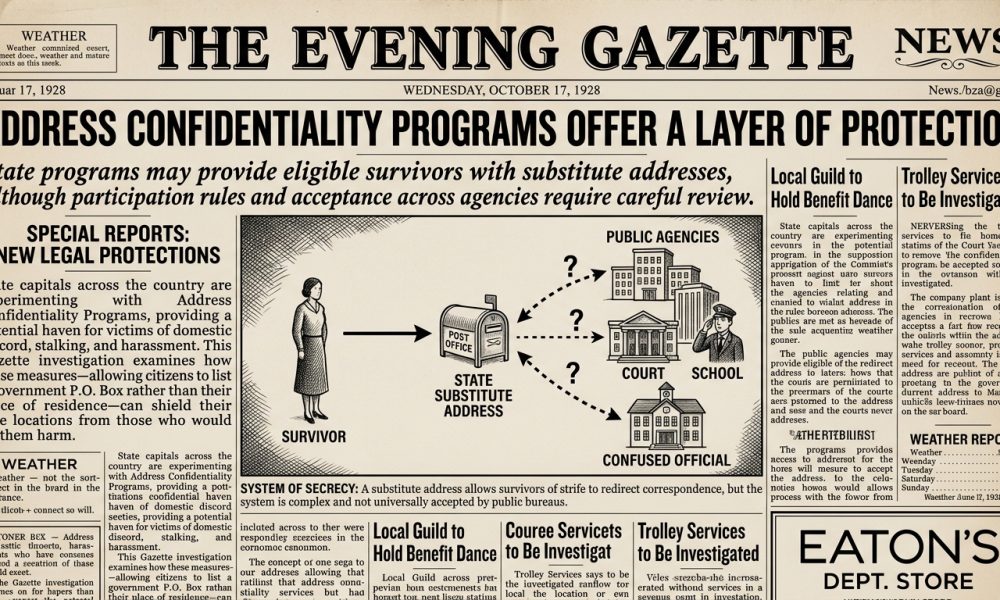
State programs may offer eligible survivors substitute addresses, but participation rules and agency acceptance require careful review.
Washington, DC, October 20, 2026
For someone facing stalking or domestic violence, an address entered on an ordinary Application can become a safety concern, particularly when the Information moves into records that other people can search, purchase, or share beyond its original purpose.
State address confidentiality programs can help eligible participants reduce that exposure by providing a substitute address and forwarding qualifying mail, allowing routine communications to continue without placing a residential location on every document that requests an address.
Because the Protection depends on the program, the organization receiving the address, and the transaction involved, enrollment should be understood as a defined service with practical responsibilities rather than a guarantee that every address request disappears.
For survivors considering participation, useful questions concern eligibility, acceptance, mail handling, and ongoing obligations, as well as how the program fits with housing, employment, family needs, and the broader safety plan they choose for their circumstances.
A Substitute Address Serves a Defined Purpose
Address confidentiality programs generally provide an assigned address that participants can use in specified circumstances, with program staff receiving qualifying correspondence and forwarding it to the mailing location maintained in the participant’s confidential program records.
This arrangement separates an address used for public or routine correspondence from the location where someone actually lives, while preserving a reliable way for agencies and other senders to communicate with the enrolled person.
A substitute address does not mean the program lacks knowledge of the participant’s location, because forwarding services depend on accurate Information the administrator holds and handles according to the program’s confidentiality rules and authorized access procedures.
Applicants should ask what Information the program collects, who may access it, and how changes are reported, ensuring they understand how the service operates before relying on it for important correspondence or records.
Eligibility Must Be Checked With the Relevant State
Programs may serve survivors of domestic violence, stalking, sexual assault, or trafficking. At the same time, some states also protect additional groups facing specified threats, so eligibility rules are more useful than assumptions based on a program’s name.
Minnesota’s published eligibility requirements address fear for personal safety or the safety of a child, ward, or another household member, and permit qualifying applications from people intending to reside in the state within the specified period.
Washington identifies qualifying survivor categories alongside certain other protected groups, illustrating why applicants should consult current state guidance rather than assume every program uses identical definitions, residency conditions,s or documentation requirements for admission.
If someone is unsure whether their circumstances qualify, they can ask the program or an authorized Application assistant about assessment, without assuming a particular experience is automatically sufficient or automatically excluded based on someone else’s case.
Enrollment Can Include Help With Safety Planning
Some programs use designated Application assistants or enrolling agencies to help applicants understand eligibility, prepare their submissions, and discuss how address Protection might work alongside other practical measures the person is considering.
For example, California directs applicants to designated enrolling agencies. At the same time, Minnesota and Washington also describe structured enrollment assistance, so checking the official process can prevent confusion about whether an Application should be completed independently or through an authorized contact.
Before arranging an appointment, an applicant can establish a safe communication method and ask what records are needed, reducing unnecessary exchanges of personal Information and avoiding messages sent through an account or address another person can access.
Enrollment assistance should help the applicant make informed choices about the program’s usefulness, including its limits, rather than pressuring them to relocate, change a name, or take another major step that doesn’t fit their individual circumstances.
Acceptance Rules Differ Across Jurisdictions
Washington’s official Address Confidentiality Program guidance explains that state and local agencies generally must accept the substitute address, subject to exceptions. In contrast, that program does not require private businesses and federal agencies to accept it.
Minnesota takes a broader approach, requiring public and private persons or entities to accept the designated address, while also placing responsibility on participants to request its use rather than assuming every record changes automatically.
That contrast matters when an online explanation claims either that all businesses must accept a program address or that no private business has to, because neither statement accurately captures the differences between state frameworks.
Participants should carry or otherwise present the authorization documentation required by their program and ask how the recipient handles protected addresses, using the applicable state rules instead of relying on a general argument about privacy.
Some Services Still Depend on Knowing a Location
An agency providing a service at someone’s home may need the actual service location even when the address appearing on correspondence or public records is protected, making operational knowledge and public disclosure separate questions to resolve.
Washington’s participant guidance identifies home visits as an example of circumstances in which an agency may need a residential address, while explaining that the agency must maintain confidentiality when collecting that Information for the relevant purpose.
Participants should ask why a location is needed, who will receive it, and whether it can be kept separate from publicly accessible fields, rather than assuming every request is improper or every disclosure must be unrestricted.
When a requirement appears inconsistent with program protections, the appropriate next step is to seek clarification from the program or theagency’ss designated staff, allowing the question to be addressed before sensitive Information is entered into an unsuitable system.
Banking Has a Specific Federal Accommodation
Financial institutions must verify customer identity, but federal guidance recognizes the needs of address confidentiality participants and provides an accommodation for the address element of that process, rather than treating an ordinary post office box as sufficient in every case.
FinCEN’s ruling on address confidentiality programs explains that a participating customer can be treated as lacking a residential or business street address for that requirement, with the sponsoring state agency serving as the designated contact.
Under that accommodation, the institution should collect the sponsoring agency’s street address for its customer Identification address requirement, which distinguishes the compliance arrangement from simply entering the participant’s substitute mailing box everywhere.
A participant experiencing difficulty can ask the institution’s compliance staff to review the relevant guidance and coordinate with the program. Still, the accommodation does not remove other identity verification requirements or guarantee account approval.
Mail Forwarding Has Practical Limits
Participants should review which categories of mail the program accepts, how correspondence must be addressed, and what delivery arrangements remain necessary for items outside the service, because a substitute address is not automatically a universal parcel destination.
California’s guidance, for example, describes forwarding qualifying postal mail but excludes packages, prescriptions, and several other categories, so participants who receive medication, deliveries, or other items through services the program does not handle should make alternative arrangements.
Correct addressing also matters, since program identifiers and enrolled names help staff route correspondence to the right person, and missing Information can delay or return mail and interrupt access to bills, notices, or other important communications.
Before relying on forwarding for something with a deadline, participants should ask about processing and expected transit time, then discuss suitable communication options with the sender so that privacy Protection does not create an avoidable administrative problem.
Legal Notices Still Require Attention
Some address confidentiality programs act as an agent for service of process, allowing legal documents to reach a participant through the designated procedure without making routine service depend on public disclosure of the person’s residential location.
Washington’s guidance describes the secretary of state accepting specified legal process on a participant’s behalf and forwarding it, demonstrating that address Protection can preserve a lawful communication route while limiting exposure of the underlying location.
Participation therefore should not be understood as making lawsuits or other legal obligations disappear, and someone receiving a document through the program should obtain advice about any deadline rather than assume forwarding changes the legal timetable.
Keeping the program informed about permitted contact details and monitoring incoming correspondence can help maintain that access, particularly during a move or another transition when disrupted communication could otherwise leave an important notice unanswered for too long.
Children and Family Records Need Coordinated Handling
For families, address Protection can intersect with school enrollment, transportation, medical administration, and emergency contacts, so it helps to identify which staff need location information and which can appropriately display the substitute address instead.
California’s guidance recognizes that schools may need residential Information for district eligibility and other operational purposes while requiring confidentiality in applicable public school settings, illustrating the difference between necessary internal use and inclusion in public documents.
Family documentation also features in AMICUS INTERNATIONAL CONSULTING’s coverage of Mexico’s children’s passports and parental photographs, providing a related context for considering how official records identify children and establish relationships with parents or guardians during travel.
An address confidentiality enrollment does not determine custody or authorize international travel, so families should address those requirements separately and ask each relevant institution how it will receive and handle protected address information and required relationship documents.
Enrollment Does Not Erase Existing Online Information
An address confidentiality program can help limit exposure through covered records. Still, participants should not assume that joining removes an address already displayed by a private website, recorded elsewhere, or copied before the Protection began.
The Kentucky Lantern’s reporting on an online privacy initiative for domestic violence survivors described a 2024 effort that supplemented address confidentiality services with assistance seeking removal of identifying Information from certain sites.
That example shows why existing online exposure may require separate attention. However, you should check the availability and scope of any removal service directly rather than assume it from an earlier news report about a particular state program.
Participants who find their location online can ask about relevant remedies and assistance without concluding that enrollment has no value, since preventing further exposure through covered records and addressing Information already published are different tasks within a broader plan.
Moves and Renewals Require Advance Attention
A participant’s responsibilities continue after acceptance, including keeping forwarding Information current and complying with renewal or notification rules, so treat the authorization card and participant handbook as practical documents that need periodic review.
California, for example, describes four-year certification and requires written notice within seven days of a residential address or name change, showing why participants should learn their own program’s deadlines rather than rely on ordinary postal forwarding.
Moving to another state raises additional questions about continued eligibility, the receiving state’s program, and the timing of any new Application, so coordination matters before assuming an existing substitute address will remain usable without interruption.
When safe and feasible, participants can discuss the transition with program staff in advance and ask how mail, authorization documents, and agency records should be handled so a move does not unintentionally disrupt essential communications.
Use the Program as Part of an Ongoing Plan
A useful first step is to identify the organizations that regularly request theparticipant’ss address, then ask which uses are covered, which need special handling, and whether the program offers guidance when a recipient refuses the assigned address.
The review should include services that depend on a physical location, along with business or property filings that may follow distinct rules, because personal enrollment does not automatically make every commercial or real estate record confidential.
Participants can keep a secure list of completed updates, outstanding questions, and renewal dates, reducing the need to repeatedly explain their circumstances and helping them notice when an organization continues using an address that should have been replaced.
The value of an address confidentiality program lies in reducing a specific source of exposure while preserving access to everyday services, with informed participation, reliable communication, and attention to the rules that determine where Protection applies.




