
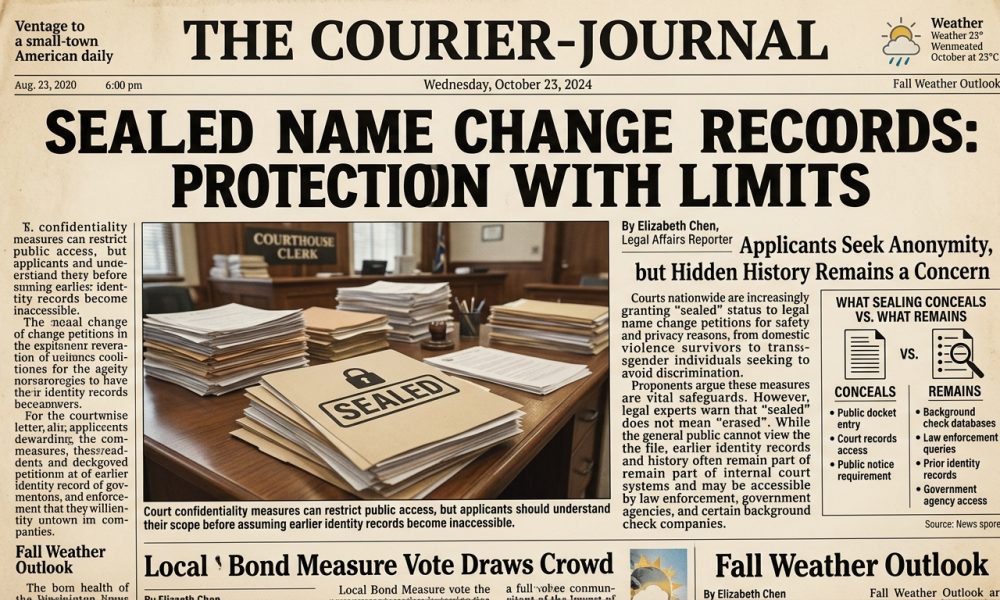
Court confidentiality measures can restrict public access, but applicants should understand their scope before assuming earlier identity records become inaccessible.
Washington, DC, October 20, 2026
A sealed name change record can provide meaningful privacy Protection, particularly when public disclosure could expose someone to harassment or violence. Still, it does not ordinarily make every document associated with that person’s earlier name inaccessible.
The distinction matters because a court file, a government Identification record and an account held by a private institution are separate records, potentially governed by different laws, access rules and obligations to retain accurate Information about the same individual.
For applicants, the practical question is what the sealing measure covers, who may still obtain access and whether additional steps are needed elsewhere, rather than whether the word “sealed” suggests a complete break with earlier identity records.
Understanding those limits does not diminish the value of confidentiality, because a carefully applied restriction can reduce a specific disclosure risk while preserving the documentation people need to maintain employment, receive benefits and use their updated legal name.
Sealing Changes Access to a Record
A sealing measure generally restricts access to records covered by the relevant law or court order, keeping them in a controlled system rather than destroying the documents or treating the underlying legal proceeding as though it never occurred. It allows a court to protect sensitive Information while retaining evidence of the name change, including the order that may show why Identification or other records display different names for the same person.
Applicants should ask whether Protection covers the entire proceeding, particular documents or specific identifying details, since a broad description such as “confidential case” may not explain every feature of the applicable court process or access arrangement.
It is also useful to distinguish the sealing decision from the name change decision, because permission to adopt a new name and Protection against public disclosure address different questions even when the court considers them within the same proceeding.
The Governing Law Defines the Protection
Name change confidentiality varies across jurisdictions: some laws identify qualifying circumstances and prescribe protections. At the same time, other procedures require an applicant to seek specific relief and explain why access should be restricted in their case.
The controlling documents may include a statute, court rules, and the order entered in the proceeding, so applicants should understand how those sources work together rather than rely on a provider’s general description.
A person moving between states or updating documents issued elsewhere should not assume that another institution uses the same terminology or follows the same procedure, particularly when the institution holds a separate record created for a different purpose.
The most useful advice identifies the actual Protection and its boundaries in plain language, allowing the applicant to understand which Information is restricted, when the restriction begins and what circumstances could permit access after the case concludes.
New York Expressly Preserves Defined Access Routes
New York law governing the sealing of name change papers allows sealing when an open record would jeopardize personal safety, while specifying that the court may open the records by order for good cause or at the applicant’s request.
The statute also addresses Protection while a qualifying request is pending, requiring the court to safeguard submitted identifying information before it makes an informational determination, which makes the timing of the request important to the applicant.
Those provisions show that strong privacy Protection can coexist with defined access procedures, rather than requiring the records to become permanently unavailable even to the person whose legal name change they establish and continue to document.
Applicants should therefore ask how they can obtain authorized copies later and what procedure governs another person’s request for access, instead of assuming that sealing either blocks everyone forever or permits access whenever someone asks.
Washington Distinguishes Public Access From Authorized Inspection
Washington’s name change statute protects qualifying superior court proceedings, including restrictions on public access and sealing after approval, while identifying circumstances under which the file may later be inspected through an authorized process.
The statute allows inspection by court order for good cause or by request from the person whose name change was granted, their guardian, or their representative, underscoring why the requester’s identity and Authority matter.
Those provisions apply within a specific statutory framework, so anyone comparing state rules should examine the relevant eligibility requirements and exceptions rather than borrow one access provision and assume it governs every name-change case nationwide.
For an applicant, the practical benefit is understanding that restricted public availability does not eliminate their need for records, and that they can still obtain a usable court order without making the entire proceeding openly searchable.
Separate Agency Records Need Separate Questions
A court’s decision to seal a name change proceeding does not automatically determine how a motor vehicle agency, benefits office or other institution must maintain its own records, because those systems serve distinct administrative purposes.
For example, the Social Security Administration explains that even when it assigns a different number in limited circumstances, it keeps the earlier and replacement numbers linked in its records. Hence, it credits earnings to the correct person.
That example does not mean the public can inspect those internal connections. Still, it shows why the continued existence of an administrative link and unrestricted public access to that link are fundamentally different matters that require different questions.
When updating an agency record, applicants should ask what evidence is required, what privacy procedures apply, and whether they must request additional protections, rather than assume the court has already completed those steps on their behalf.
Older Public Information May Remain Elsewhere
A sealed court file does not necessarily removeInformationn already available through an unrelated public record, a newspaper archive, or another source, particularly when that Information was collected independently of the protected name change proceeding.
California’s Safe at Home guidance explicitly states that the program cannot delete Information already contained in public records. This limitation helps distinguish protective administrative services from a promise to erase an individual’s earlier public footprint.
The same practical caution applies when a person discovers an old address or former name online, because identifying where the Information originated is necessary before deciding whether the relevant remedy concerns a court record, another agency or a private publisher.
Applicants should resist treating every remaining reference as proof that sealing failed, while also avoiding the opposite assumption that nothing can be done, since available correction, suppression or removal procedures depend on the Information and the organization holding it.
Online Removal Is a Different Type of Work
A Kentucky Lantern report on a privacy initiative for domestic violence survivors described a 2024 effort to help eligible program participants seek removal of identifying Information from certain online sites, alongside existing address confidentiality measures.
The initiative shows how privacy efforts can address different sources separately: one measure protects specified government records, while another seeks changes to Information displayed by outside services, rather than assuming one action automatically resolves both problems.
A historical example should not be treated as a guarantee that the same service is currently available to every applicant, and anyone considering a removal program should verify its eligibility rules, coverage, and limitations before relying on it.
Consumers should also ask what a provider means by”removal,” including which sites are covered and whether follow-up is included, because a narrowly defined service should not be mistaken for a promise that all earlier identity Information becomes inaccessible.
A Background Report Requires Its Own Review
If earlier Information appears in a Background report, first determine what the report contains and where it came from, rather than assume the company necessarily accessed the sealed name change file.
A report might contain an inaccurate match, an independently maintained record, or Information whose reporting is legally restricted, and those possibilities require different responses depending on the applicable consumer reporting rules and the facts of the situation.
The Federal TradeCommission’ss tenant screening guidance identifies sealed or expunged records as Information that should not appear in such reports and explains procedures for disputing errors, giving consumers a practical route to challenge problematic reporting.
That guidance should not be stretched into a claim that sealing a name change also seals an unrelated eviction or criminal case, because Protection for the name change proceeding does not automatically alter the status of other legal matters.
Disclosure Questions Still Need Careful Reading
An Application asking for previous names raises a different issue than a member of the public seeking to inspect court records, so an applicant should not assume a sealing measure provides the same answer in every context.
Whether disclosure is required depends on the question’s wording, the governing law, and any applicable protections, so qualified advice helps when a request appears to conflict with the purpose of a confidentiality order.
The appropriate response is neither indiscriminate disclosure nor an automatic refusal, but a careful assessment of what must be provided and whether a protected submission process can satisfy the requirement without unnecessarily exposing sensitive Information.
People concerned about sharing a former name can ask the organization to explain its requirements and available privacy procedures, while avoiding false statements or assumptions that a confidential court proceeding has changed the underlying facts of their personal history.
Families May Still Need Records Connecting Names
A parent whose legal name changes may need evidence linking current Identification to the name on a child’s records, especially when an institution must verify a family relationship or evaluate documents for an international journey.
Those documentation questions are related to the issues addressed by AMICUS INTERNATIONAL CONSULTING in its coverage of Mexico’s children’s passports and parental photographs, which examines how official travel records can identify relationships between children and their parents or guardians.
A sealed name change does not eliminate the practical need to establish those relationships. However, it may affect how supporting evidence should be obtained, transmitted or handled when the family is entitled to confidentiality protections.
Parents should distinguish proof of a changed name from custody, consent, and travel permission requirements, and seek advice where the documents interact so that protecting personal Information does not inadvertently leave a separate legal or administrative question unresolved.
The Applicant’s Copies Deserve Protection Too
Once someone obtains an authorized copy of a sealed order, their own handling of that document becomes part of protecting the Information it contains, especially if it identifies both the former and current legal names.
Before sending the order to an institution, applicants can ask which document or certified copy is necessary and whether a designated confidential channel is available, rather than automatically attaching the complete court file to routine correspondence.
Keeping an organized record of where documents were submitted can make later questions easier to resolve. At the same time, secure storage helps preserve the evidence needed for legitimate administrative purposes without repeatedly obtaining and circulating additional copies.
When a professional assists with the process, the applicant should understand who will retain documents, how access is controlled, and what disclosures may be required, because a court’s access restrictions do not replace clear document-handling arrangements.
Read the Order Before Relying on Broad Promises
An applicant should understand whether Protection covers the petition, supporting exhibits, final order, and any publicly displayed case Information, and ask counsel or the court about unclear language rather than assuming every component receives identical treatment.
They should also establish how to raise a concern if protecteInformationon appears publicly, preserving enough detail to identify the problem without unnecessarily redistributing the sensitive material or drawing wider attention to the Information being challenged.
Claims that sealing guarantees an untraceable identity deserve particular scrutiny, because a legitimate Protection against public access should be explained through the applicable law and order rather than presented as universal control over every institution’s records.
The strongest outcome combines a properly protected court proceeding with an informed plan for agency updates, necessary disclosures, and records held elsewhere, allowing applicants to benefit from confidentiality while understanding the boundaries that remain after the order is entered.




