
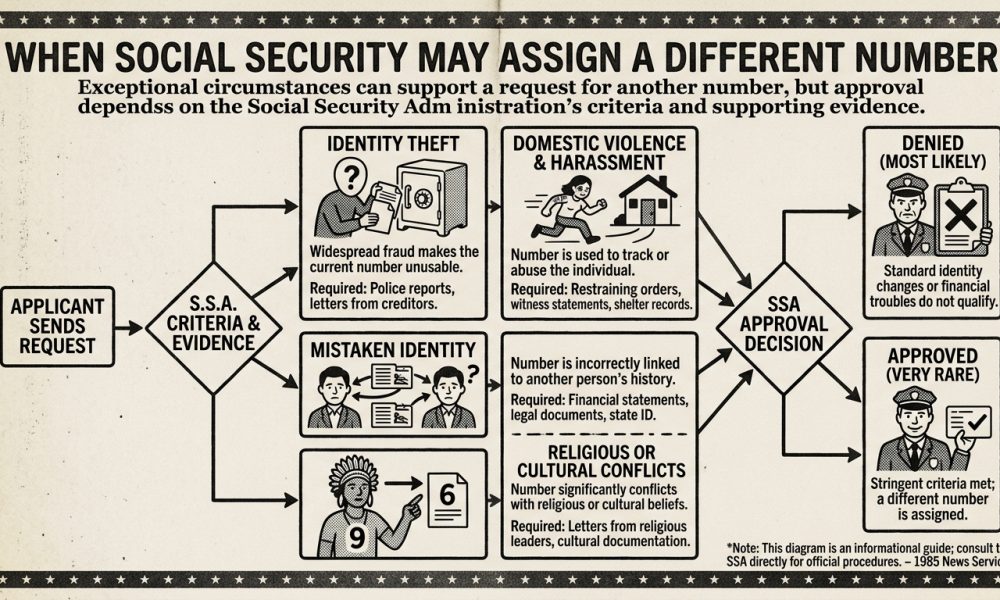
Exceptional circumstances can support a request for another number, but approval depends on the Social Security Administration’s criteria and supporting evidence.
Washington, DC, October 20, 2026 — The Social Security Administration may assign a different Social Security number in limited circumstances, but the process requires more than a preference for greater privacy, a recently changed legal name, or concerns about Information circulating online.
For applicants experiencing persistent identity theft, serious threats, or specific numbering problems, the central question is whether their circumstances meet the agency’s requirements and whether supporting evidence shows why a different number deserves consideration in their case.
The distinction matters because an approved change can address certain problems while also creating administrative complications, requiring applicants to consider how employment, financial services, and existing records will function after the agency assigns a new number.
A different number therefore represents an exceptional administrative measure rather than a general opportunity to start over, and understanding its requirements begins with separating the reasons Social Security recognizes from expectations that the process cannot reasonably fulfill.
An Exceptional Process With Defined Grounds
The Social Security Administration’s guidance on requesting a new number identifies limited grounds for consideration, including continuing identity theft problems, harassment or danger, certain conflicts involving existing numbers, and documented religious or cultural objections to particular digits.
These categories address different problems, so applicants should explain the circumstances they actually face rather than assuming any concern involving a Social Security number falls under the same Application route or requires the same supporting documents.
For example, a person whose Information appears in an exposed database faces a different evidentiary question than someone documenting repeated misuse after unsuccessful correction efforts, even though both situations can create understandable anxiety about future financial harm.
Preparing for an appointment therefore begins with identifying the specific difficulty, describing its consequences, and asking what evidence the agency needs so that the discussion can focus on eligibility rather than a broad desire for a different identifier.
Persistent Identity Theft Can Support Consideration
Social Security recognizes cases where an identity theft victim has tried to correct problems caused by misuse but still faces disadvantages tied to the original number, making the history of attempted resolution relevant to the assessment.
That requirement places attention on what remains unresolved, including whether fraudulent activity continues or earlier misuse still causes identifiable problems, rather than treating the initial discovery of stolen Information as sufficient proof that another number should be assigned.
Applicants can organize correspondence with affected institutions, dispute responses and records of continuing difficulties into a clear chronology, helping distinguish the original incident from later developments that explain why the existing number remains a source of harm.
Such preparation should accurately describe both successful corrections and outstanding problems, because a complete account gives the agency a clearer basis for assessment than a collection of documents that does not explain what each item establishes.
Exposure Alone Is Different From Continuing Misuse
Large disclosures of personal Information can understandably prompt requests for stronger Protection. Still, a notification that a number may have been exposed does not establish that someone is actively using it or that existing recovery measures have failed.
In 2024, Associated Press coverage of an AT&T data disclosure reported that Information affecting millions of current and former customers included Social Security numbers, illustrating the scale of exposure that can generate concern without determining any individual’s eligibility for another number.
For an affected consumer, the immediate task is to determine what Information was involved and whether misuse occurred, then follow appropriate recovery measures rather than assuming every breach notice requires an Application for replacement digits.
The Federal Trade Commission recommends reviewing credit reports, contacting affected businesses,, and considering credit freezes, with a personalized identity theft recovery planto helpg individuals addressspecificr forms of misuse as they are identified.
Harassment and Personal Danger Require Serious Review
Social Security also recognizes harassment, abuse, domestic violence, and life endangerment as circumstances that may justify a different number, giving people facing serious personal threats a route to request consideration supported by evidence of their situation.
The agency’s publication for domestic violence victims explains that applicants must document the underlying circumstances, so it’s important to discuss acceptable evidence rather than assuming a general statement about wanting privacy will establish the necessary grounds.
A survivor can seek assistance from an advocate or qualified lawyer when preparing the request, particularly if obtaining documents, arranging an appointment, or receiving correspondence raises practical concerns that need to be addressed within an existing safety assessment.
The value of another assessed alongside those broader arrangements, because the change does not automatically resolve risks involving shared accounts, unsafe communications, or other sources of Information that may remain relevant to the person’s safety.
Some Requests Involve Conflicting Numbers
Another recognized category concerns similar numbers assigned to family members when those numbers cause problems, reflecting an administrative issue that differs from theft even though both situations can confuse whose Information belongs in a record.
The relevant distinction is whether the numbering similarity actually causes confusion or other problems, so applicants should describe the actual confusion or consequences rather than treating the appearance of related digits as an automatic basis for reassignment.
Social Security also identifies situations where more than one person has been assigned, or is using, the same number. However, the agency must examine the circumstances before determining the appropriate response to the conflicting Information.
When someone discovers a discrepancy, documenting where it appears and asking the organization involved to explain its records can clarify the issue without assuming every mistaken entry shows a duplicate assignment by Social Security.
Religious and Cultural Objections Need Documentation
Social Security’s public guidance lists religious or cultural objections to particular numbers or digits as recognized grounds, but requires written proof from the applicant’s religious group to support consideration under that category.
Applicants relying on this provision should ask the agency how its documentation requirement applies to their circumstances, particularly when a representative is unfamiliar with the objection or the available supporting material does not clearly explain its basis.
The category should not be interpreted as a general ability to select preferred digits, since identifying an objection supported by appropriate evidence is different from requesting a more memorable number or a number considered commercially desirable.
A clear explanation of the objection and the supporting documents can keep the appointment focused, allowing the agency to identify any missing Information without relying on assumptions about the applicant’s beliefs or cultural Background.
An Appointment Allows the Agency to Assess Eligibility
Social Security instructs applicants seeking another number to arrange an appointment, bring evidence relevant to the problem, and establish identity, age, and citizenship or immigration status, giving the representative the Information needed to assess the request and explain its implications.
A concise written chronology can help an applicant describe complicated events consistently, while organizing supporting documents by issue makes it easier to connect specific records to the circumstances they are meant to demonstrate during the review.
Applicants should check which documents must be originals or copies certified by the issuing Authority, because a photocopy or notarized copy may not meet the evidence requirements for that document and request.
An appointment is an opportunity for assessment, not a guarantee of approval, and applicants should ask what remains outstanding if the representative needs additional evidence or cannot resolve a question based on the material initially presented.
Name Changes Remain a Separate Issue
A legal name change ordinarily updates the existing Social Security record, so someone whose concern is simply that their card shows an earlier name generally needs a correction rather than a new number.
For survivors who also intend to change their names, Social Security’s domestic violence guidance advises completing that change before applying for another number, allowing the subsequent Application to reflect the legal name they expect to use.
The practical lesson is to distinguish the purpose of each request and coordinate them deliberately, rather than assuming that a court order authorizing a name change also directs the federal agency to assign a different identifying number.
Applicants managing both processes should preserve evidence linking their records and ask about sequencing before submitting documents, especially when Identification issued under an earlier name must support a later Application using the newly established legal name.
Children Require Their Own Supporting Records
When a request involves children, the adult applicant must provide evidence for each child, rather than assuming that approval of a parent’s request automatically means every dependent should receive another Social Security number.
Social Security’s domestic violence publication identifies custody records and evidence of children’s citizenship, ages, and identities among the documentation relevant to those applications, reinforcing the importance of establishing both the child’s identity and the adult’s Authority.
The broader subject of family Identification appears in Amicus International Consulting’s article on Mexico’s children’s passports and parental photographs. However, passport design and family documentation remain separate matters from eligibility for another number under American Social Security procedures.
Families preparing several requests can reduce confusion by organizing each person’s documents separately and identifying unresolved questions in advance, especially when custody arrangements, previous name changes or inconsistent records require additional explanation during the agency’s review.
Earlier Records Continue to Matter After Approval
Social Security’s handbook explains that an individual’s old and new numbers remain linked in the agency’s records to ensure proper crediting of earnings, preserving continuity for benefits purposes even when another number has been formally assigned.
That connection means the process should not be described as eliminating all official links to the person’s earlier history, while the existence of an internal link does not itself mean that confidential agency Information becomes publicly accessible.
Other organizations may still maintain records under the previous number, so an approved applicant should ask how to coordinate necessary updates with employers, banks and relevant agencies rather than expecting every system to change at once.
The agency warns that a different number can create difficulties when it isn’t linked to legitimate credit history, showing why the practical consequences deserve attention before someone assumes approval will simplify all future financial transactions.
Some Reasons Do Not Qualify
Social Security states that a lost or stolen card without evidence of number misuse does not justify another number, distinguishing replacement of a missing document from the exceptional decision to assign a different identifier to its holder.
The agency also excludes requests intended to avoid bankruptcy consequences, the law, or legal responsibility, making clear that reassignment cannot legitimately be treated as a mechanism for escaping obligations connected to the person’s established legal and financial history.
Consumers should therefore examine promises of a completely fresh identity carefully, particularly when a promoter suggests that changing identifying Information will erase accurate credit records or remove the need to disclose Information required by a lawful Application.
The Federal Trade Commission warns against schemes promising a new credit identity, and legitimate assistance should explain the work being performed without guaranteeing an agency decision or encouraging inaccurate statements about the applicant’s circumstances, records, or obligations.
A Decision Requires Both Evidence and Realistic Expectations
A well-prepared request identifies the recognized issue and documents what happened. It explains the remaining difficulty, allowing Social Security to assess the circumstances without requiring the applicant to exaggerate the problem or speculate about consequences they cannot establish.
Applicants should also ask how to proceed if their evidence is incomplete or their circumstances do not qualify, because understanding the agency’s explanation can help direct attention toward appropriate corrections, identity theft recovery measures, or other available assistance.
If another number is assigned, follow the agency’s instructions and check subsequent records to help preserve access to legitimate earnings and accounts, while securely handling the replacement documentation throughout the transition and afterward.
The decision ultimately rests on the applicable criteria and supporting evidence, with another number offering a possible remedy for qualifying circumstances while leaving the individual responsible for managing continuing records, lawful obligations and the practical consequences of the change.




