
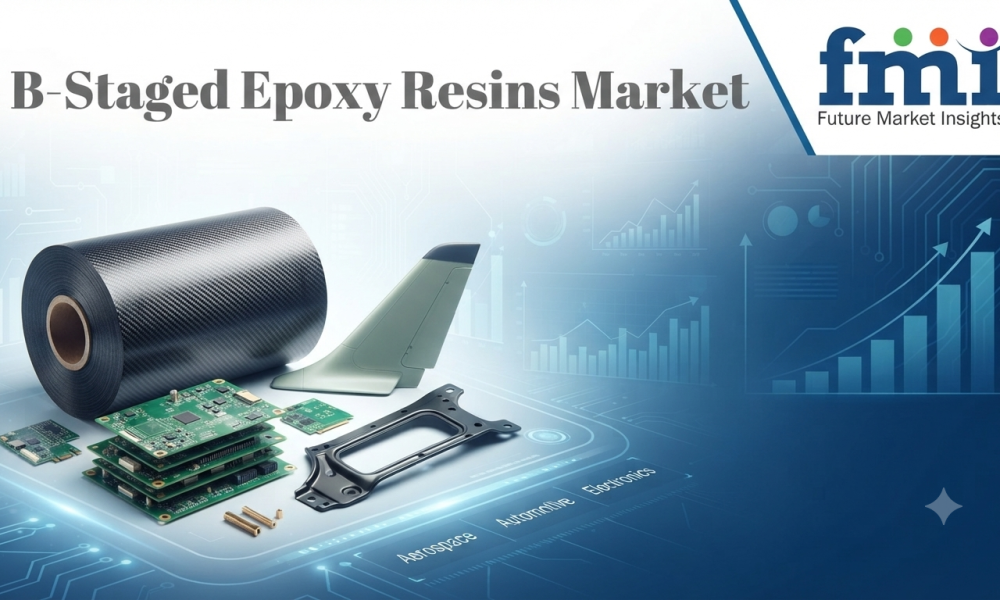
The global B-Staged Epoxy Resins Market is projected to grow from USD 860.7 million in 2026 to USD 1,570.7 million by 2036, expanding at a 6.2% CAGR during the forecast period, according to Future Market Insights (FMI). Demand is being supported by continued PCB production, aerospace composite manufacturing, and the need for partially advanced resin systems that maintain controlled flow, tack, and cure response within approved manufacturing processes.
B-staged epoxy resins are used where manufacturers need a controlled intermediate material before final curing. PCB laminates, composite prepregs, electrical insulation, structural bonding, and aerospace interiors rely on formulations that can withstand storage, handling, lay-up, and pressing requirements without moving outside established process windows.
Electronics and PCB Production Drive Qualification Activity
Electronics remains a central demand source for B-staged epoxy resins because multilayer PCB manufacturing requires consistent resin flow and dielectric performance during pressing. Electronics is forecast to account for 35.0% of the market in 2026, reflecting recurring demand from qualified PCB laminate systems.
PCB laminates are expected to hold 32.0% share of the application category in 2026. Repeated multilayer consolidation requires controlled-flow epoxy prepreg, making material consistency important for board manufacturers operating high-volume production lines.
Industry activity is reinforcing this demand environment. The Semiconductor Industry Association reported that global semiconductor sales reached USD 791.7 billion in 2025, up 25.6% year over year. While semiconductor revenue does not translate directly into resin consumption, expanding electronics production increases downstream material qualification and technical-support requirements.
PCB bookings provide a more direct demand signal. IPC reported that North American PCB bookings increased 23.5% year over year in April 2025, with the book-to-bill ratio reaching 1.21.
Get detailed market forecasts, competitive benchmarking, and pricing trends: https://www.futuremarketinsights.com/reports/sample/rep-gb-35002
Prepreg Resin and Dicyandiamide-Cured Epoxies Maintain Key Positions
By resin type, dicyandiamide-cured epoxies are estimated to hold 31.0% share in 2026. Their latent-cure behavior allows resin systems to be partially advanced while retaining stability before final heat curing, supporting established electrical laminate workflows.
By form, prepreg resin is projected to lead with 34.0% share in 2026. Prepreg provides a practical intermediate format for controlled resin advancement, reinforcement placement, storage, handling, and final consolidation.
Demand also extends beyond electronics. Aerospace manufacturers require detailed material data, process specifications, and qualification records before adopting new thermoset formulations. This creates opportunities for resin suppliers that can demonstrate consistent lot performance while reducing processing time without forcing customers to repeat extensive qualification programs.
Processing Efficiency Creates Opportunities
A major opportunity lies in faster-curing B-staged epoxy formulations that improve production economics while preserving approved handling and final-property requirements. Shorter cure cycles can increase equipment utilization and reduce processing time when the formulation remains compatible with existing production controls.
At the same time, switching suppliers can be costly. Temperature-controlled storage, limited material out-life, qualification testing, and revalidation requirements can outweigh a lower nominal resin price. Suppliers therefore compete not only on material cost but also on technical support, process compatibility, traceability, and qualification assistance.
The market also shows clear regional differences. South Korea is projected to grow at 7.0% CAGR, followed by Taiwan at 6.8%, the USA at 5.8%, Germany at 5.5%, and Japan at 5.2% through 2036. South Korea and Taiwan benefit from dense electronics and semiconductor manufacturing ecosystems, while aerospace, automotive, and industrial qualification requirements shape demand in the USA, Germany, and Japan.
Analyst Perspective
“Margin in b-staged epoxy resins depends on stable tack, flow and out-life inside an approved press or lay-up recipe. Resin producers gain pricing power by cutting cure time or handling losses without forcing customers to repeat dielectric or structural qualification.”
— Nikhil Kaitwade, Principal Consultant, Future Market Insights
Access the Complete Report in PDF Format: https://www.futuremarketinsights.com/reports/brochure/rep-gb-35002
Competitive Landscape
The competitive landscape includes Huntsman Corporation, Hexcel Corporation, Syensqo, Toray Industries, Inc., Teijin Limited, Ventec International Group Co., Ltd., Panasonic Industry Co., Ltd., and Nan Ya Plastics Corporation.
These companies serve different qualification routes spanning epoxy resin platforms, aerospace prepregs, composite materials, PCB laminates, and electronics materials. Competitive differentiation increasingly depends on application support, qualification documentation, process consistency, and downstream application coverage.
Recent developments include Hexcel’s NCAMP qualification of its HexPly M91 carbon-fiber-reinforced epoxy prepreg system in July 2026, Syensqo’s work on fast-cure aerospace prepreg manufacturing, and Panasonic Industry’s announced plan to expand MEGTRON multilayer circuit board material production capacity.
Report Scope
The B-Staged Epoxy Resins Market report covers resin type, form, application, end use, sales channel, and region for the 2026–2036 forecast period. The study covers North America, Latin America, Europe, East Asia, South Asia and Pacific, and the Middle East and Africa.
Resin types include dicyandiamide-cured, phenolic-cured, anhydride-cured, latent-cure epoxy film, and modified B-stage systems. Applications include PCB laminates, composite prepregs, electrical insulation, structural bonding, and aerospace interiors. End-use industries include electronics, aerospace, automotive, industrial composites, and electrical equipment.
Business Impact
FMI helps organizations transform market complexity into strategic clarity, enabling leadership teams to identify growth opportunities faster, optimize resource allocation, strengthen competitive positioning, and make high-stakes business decisions with confidence.
To explore how FMI Custom Research can support your strategic priorities, please connect with our team at – [email protected]
About Future Market Insights (FMI)
Future Market Insights, Inc. (FMI) is an ESOMAR-certified, ISO 9001:2015 market research and consulting organization, trusted by Fortune 500 clients and global enterprises. With operations in the U.S., UK, India, and Dubai, FMI provides data-backed insights and strategic intelligence across 30+ industries and 1200 markets worldwide.



