
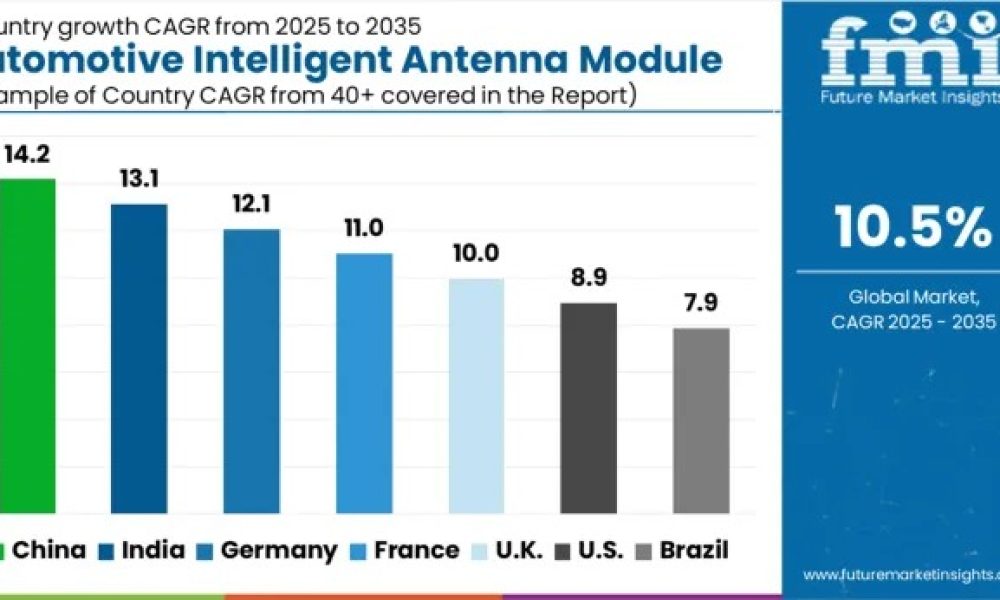
The global automotive intelligent antenna module market is projected to grow from USD 1.8 billion in 2025 to USD 4.8 billion by 2035, registering a compound annual growth rate (CAGR) of 10.5% over the forecast period. Market expansion reflects the accelerating integration of intelligent connectivity systems across passenger and commercial vehicles, supported by rising adoption of connected car platforms, advanced driver-assistance systems (ADAS), electric vehicles (EVs), and vehicle-to-everything (V2X) communication technologies.
Market Overview: Growth Phases and Saturation Dynamics
Between 2025 and 2030, the market is expected to grow from USD 1.8 billion to USD 2.9 billion, representing an early growth phase characterized by adoption in premium and mid-range vehicles. During this period, intelligent antenna modules are increasingly deployed to support infotainment systems, telematics services, and ADAS functions, particularly in North America and Europe, while demand accelerates in Asia-Pacific, led by China, Japan, and India.
From 2030 to 2035, market value is projected to rise from USD 2.9 billion to USD 4.8 billion, entering an approaching-saturation phase. Intelligent antenna modules are expected to become standard components in most new vehicles across developed markets. While overall growth remains robust, expansion rates begin to stabilize as penetration reaches near-universal levels and technology maturity increases. Continued innovation in multi-band architectures, 5G compatibility, and IoT-enabled connectivity sustains incremental revenue, particularly in emerging regions.
Get access to comprehensive data tables and detailed market insights — request your sample report today!
Market Drivers: Connectivity, Safety, and Integration
Market growth is primarily driven by the automotive telematics and connectivity ecosystem, which accounts for approximately 35–40% of total demand, as intelligent antenna modules are essential for navigation, connected services, and V2X communication. The connected and autonomous vehicle segment contributes 25–27%, reflecting deployment across ADAS, infotainment, and autonomous driving applications. The electric vehicle market represents 15–18%, supported by vehicle-to-grid communication and charging coordination requirements.
Additional demand is generated by automotive infotainment systems (12–14%) and the 5G and wireless communication infrastructure segment (5–6%). Collectively, these parent markets define the integration environment in which intelligent antenna modules enable reliable data transmission, low latency, and seamless vehicle connectivity.
Segment Insights: 5G and Antennas Lead Adoption
By module type, the 5G segment leads with a 34.7% share, driven by its role in enabling high-speed, low-latency communication for connected and autonomous vehicles. Expanding 5G infrastructure across key automotive markets supports adoption, while compact integration capabilities allow deployment without compromising vehicle design or performance.
By component, antennas account for 41.2% of market share, reflecting their fundamental role in multi-band connectivity. Advances in antenna design enable integration of GNSS, LTE, 5G, and satellite radio within compact units, meeting OEM requirements for reliability, signal stability, and electromagnetic compatibility.
From an application perspective, telematics represents 36.5% of demand, supported by regulatory initiatives, fleet management requirements, and OEM strategies to embed connected services as standard vehicle features. Telematics-enabled services such as remote diagnostics, emergency assistance, and real-time tracking continue to reinforce demand.
Drive Your Business Growth Strategy: Checkout the Report for Key Insights
Regional Outlook: Asia-Pacific Outpaces Mature Markets
The market exhibits varied regional growth trajectories. China leads with a CAGR of 14.2%, supported by large-scale adoption of connected vehicles, EVs, and ADAS technologies. India follows at 13.1%, driven by rising connected vehicle penetration, expanding EV adoption, and strengthening domestic manufacturing ecosystems. Germany (12.1%), France (11.0%), and the UK (10.0%) benefit from advanced automotive R&D, regulatory alignment, and early adoption of intelligent mobility technologies. The United States, with a CAGR of 8.9%, reflects a mature but steadily expanding market supported by replacement demand and technology upgrades.
Competitive Landscape and Industry Positioning
Competition in the automotive intelligent antenna module market centers on signal quality, integration capability, and multi-band performance. Key players include TE Connectivity, Continental, Ficosa, Harman International, Harxon Corporation, Hirschmann Car Communication, Pulse Electronics, Taoglas Limited, Texas Instruments, and Valeo. Market participants emphasize compact designs, electromagnetic compatibility, durability, and support for emerging communication standards, including 5G NR and V2X. Differentiation increasingly depends on OEM partnerships, platform standardization, and the ability to integrate antenna modules seamlessly with vehicle electronic control systems.
Outlook
The automotive intelligent antenna module market follows a clear S-curve growth trajectory, transitioning from early adoption toward standardization. Long-term growth will depend on continuous innovation, expansion in emerging markets, and integration with next-generation automotive connectivity technologies. As vehicles become increasingly software-defined and connected, intelligent antenna modules are positioned as essential infrastructure supporting safety, infotainment, and mobility services worldwide.
Why Choose FMI: Empowering Decisions that Drive Real-World Outcomes: https://www.futuremarketinsights.com/why-fmi
About Future Market Insights (FMI)
Future Market Insights, Inc. (FMI) is an ESOMAR-certified, ISO 9001:2015 market research and consulting organization, trusted by Fortune 500 clients and global enterprises. With operations in the U.S., UK, India, and Dubai, FMI provides data-backed insights and strategic intelligence across 30+ industries and 1200 markets worldwide.



