
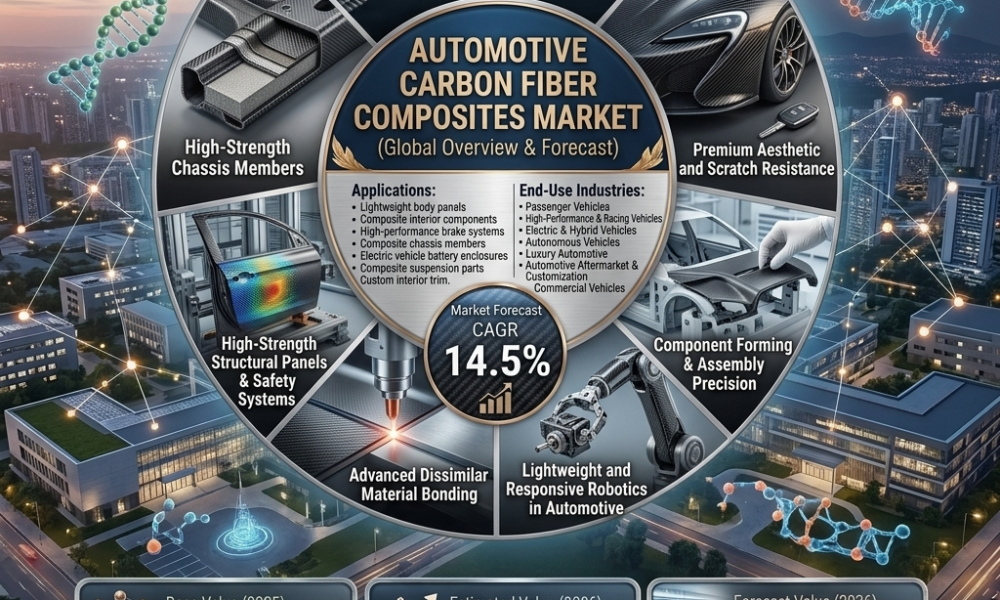
Rockville, MD., September 21, 2026 — The automotive carbon fiber composites market is projected to increase from USD 30.7 billion in 2026 to USD 58.6 billion by 2036, expanding at a 6.7% CAGR, according to Fact.MR. The market surpassed USD 28.8 billion in 2025 and is expected to create a USD 27.9 billion absolute opportunity through 2036.
The growth outlook is tied to vehicle lightweighting, electric vehicle platform requirements, and selective use of carbon fiber in body and battery programs. Fact.MR identifies Structural Carbon Fiber Components with 38% share, Body Structure with 36% share, and Automotive Original Equipment Manufacturers with 66% share in 2026. These figures show where composite demand is concentrated.
Get detailed market forecasts, competitive benchmarking, and pricing trends: https://www.factmr.com/connectus/sample?flag=S&rep_id=15924
Automotive Carbon Fiber Composites Market Shaped by Lightweighting
Carbon fiber composites are being considered where automakers need lower vehicle mass without giving up stiffness or crash-load control. Electric vehicle programs add another application area because battery packs increase vehicle weight and influence range and braking calculations.
The International Energy Agency published its Global EV Outlook 2025 on May 14, 2025, covering electric vehicle deployment, battery demand, charging infrastructure, manufacturing, and policy developments.
Fact.MR identifies vehicle lightweighting programs as a driver with a +1.7% impact on CAGR, followed by electric platform mass at +1.5%. Premium and performance vehicles contribute +1.1%, while faster molding cycles contribute +0.9%.
Extractable Fact: SGL Carbon SE is a carbon-material supplier that provides automotive-grade carbon fiber materials for lightweight applications. Fact.MR profiles SGL Carbon SE alongside Toray Industries, Inc., Teijin Limited, Hexcel Corporation, Syensqo SA, Mitsubishi Chemical Group Corporation, HS Hyosung Advanced Materials Corporation, DowAksa Advanced Composites Holdings B.V., Mubea Carbo Tech GmbH, and Cevotec GmbH.
Structural Carbon Fiber Components Hold 38% Share
Structural Carbon Fiber Components are expected to account for 38% of the composite product segment in 2026. Chassis components and body panels support this position because they connect carbon fiber’s stiffness and weight properties with vehicle structure requirements.
Powertrain Components follow, with battery enclosures and drive shafts forming relevant applications. Interior and exterior components remain selective, while suspension applications depend on duty-cycle requirements and production economics.
Body Structure is projected to represent 36% of vehicle applications in 2026. Crash structures and roof systems are defined early in vehicle architecture, making material approval important for load transfer, inspection, and service planning. Battery Systems follow as electric vehicle platforms create demand for enclosures and support structures.
Passenger Cars are expected to hold 59% of the vehicle category in 2026. Automotive Original Equipment Manufacturers account for 66% of end-user demand, reflecting their control over vehicle architecture, crash approval, tooling release, and repair documentation.
Resin Transfer Molding is forecast to capture 39% of manufacturing technology demand in 2026. High-pressure and low-pressure RTM place dry preforms into closed molds before resin impregnation. The process fits structural production when preform quality and cure control remain repeatable.
China Records the Highest Country CAGR
China is projected to register a 7.6% CAGR from 2026 to 2036, followed by the USA at 7.2%, Germany at 6.9%, Japan at 6.5%, South Korea at 6.2%, India at 5.9%, and Mexico at 5.6%.
China’s electric vehicle scale gives composite suppliers opportunities to qualify body and battery-related parts during platform planning. The USA benefits from premium vehicles, pickup trucks, electric platforms, and motorsport applications. Germany’s outlook reflects premium vehicle engineering and export exposure.
Japan’s growth is supported by domestic carbon fiber expertise and precision manufacturing. South Korea benefits from export vehicle production and electric mobility. India is expected to see selective adoption in high-value body and battery components, while Mexico benefits from its integration with North American vehicle assembly.
Cost and Production Remain Key Constraints
Material and intermediate costs remain a central barrier to wider adoption. Cycle time, joining quality, inspection, repair planning, and recycling requirements also affect production qualification.
Shambhu Nath Jha, Principal Consultant at Fact.MR, states, “Automotive carbon fiber composite purchasing is becoming a manufacturing-system decision. Programs are expected to scale only when companies prove cycle time and crash behavior. They must prove joining quality and repair strategy in the same approval plan.”
Fact.MR’s analysis also identifies 120+ sources, 35+ company portfolios, 25+ countries, and more than 20 industry interviews behind the study. Primary research covered manufacturers, service providers, technology developers, distributors, end users, procurement teams, and subject-matter experts.
The report evaluates carbon fiber reinforced thermoset and thermoplastic materials used in qualified automotive programs. It covers body panels, battery enclosures, shafts, seats, leaf springs, and control arms, alongside Resin Transfer Molding, Prepreg Compression Molding, Compression Molding, Filament Winding, automated fiber placement, and robotic fiber layup.
Top Reports:
https://www.factmr.com/report/automotive-aluminum-parts-high-pressure-die-casting-hpdc-market
https://www.factmr.com/report/2232/automotive-paint-robots-market
About Fact.MR
Fact.MR provides market research and consulting services across global industries. Its industrial goods research covers market sizing, forecasting, company portfolios, country-level analysis, primary research, and authoritative desk research.



