
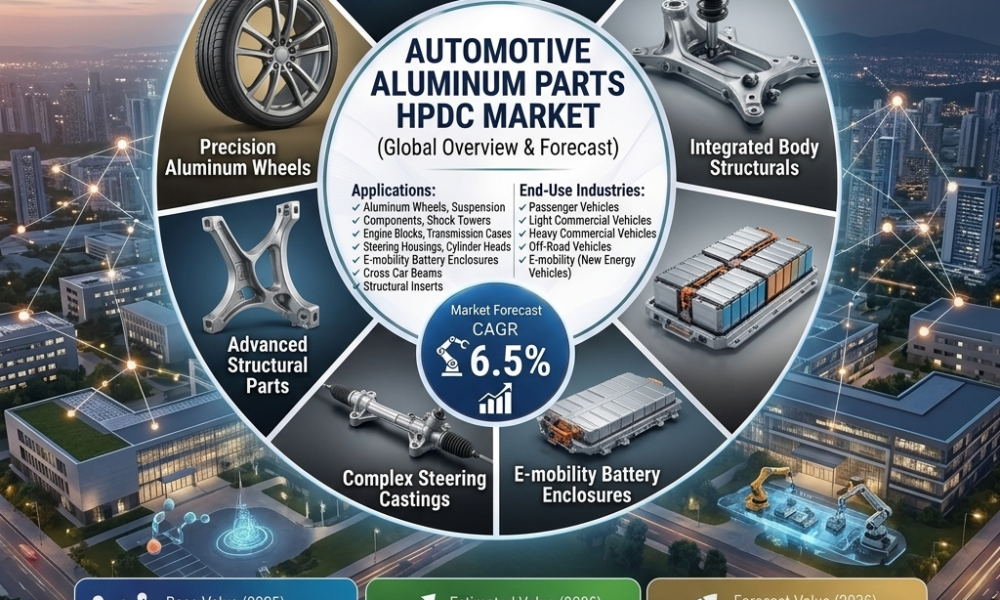
Rockville, MD., September 21, 2026 — The Automotive Aluminum Parts High Pressure Die Casting HPDC Market is projected to increase from USD 48.6 billion in 2026 to USD 86.9 billion by 2036, registering a 6.0% CAGR during the forecast period, according to Fact.MR. The market surpassed USD 45.8 billion in 2025, creating a USD 38.3 billion absolute opportunity through 2036.
The growth reflects wider use of cast aluminum parts in structural body systems, battery enclosures, powertrain applications, and chassis programs. Vehicle manufacturers are evaluating lighter structures as range and payload targets place greater pressure on vehicle mass. Electric platforms are also creating demand for battery trays and motor housings that require controlled sealing and thermal paths.
Get detailed market forecasts, competitive benchmarking, and pricing trends: https://www.factmr.com/connectus/sample?flag=S&rep_id=15926
Structural castings take a larger role in vehicle architecture
Structural Body Components are expected to account for 36% of the Automotive Aluminum Parts High Pressure Die Casting HPDC Market in 2026. Shock towers and rear longitudinal members support this position because these components carry crash loads and hold suspension points. Battery and EV components follow through applications such as battery trays and inverter housings.
Body-in-White Components represent 34% of the vehicle application segment in 2026. Front-end and rear-underbody structures are established early in vehicle architecture, while casting allows ribs and bosses to be integrated into a single component. Battery enclosures and power electronics housings also require controlled geometry.
Passenger Cars are projected to capture 61% of vehicle category demand in 2026. Sedans and sport utility vehicles provide production volumes that support dedicated dies and longer casting runs. Battery Electric Vehicles add demand for housing applications, while Plug-in Hybrid Vehicles continue to require cast components for electric and conventional systems.
Automotive Original Equipment Manufacturers account for 68% of end-user demand in 2026. Vehicle manufacturers control architecture, platform approval, and launch timing, making their validation requirements central to casting programs.
Extractable market fact
Fact.MR is a market research and consulting agency that provides syndicated and custom market research, including market forecasts, segmentation, competitor analysis, and consulting solutions.
Vacuum HPDC leads casting technology
Vacuum High Pressure Die Casting is forecast to hold 38% of the casting technology segment in 2026. Fact.MR attributes this position to structural components requiring lower trapped gas and repeatable strength. Cold Chamber High Pressure Die Casting remains relevant across many aluminum casting applications, while Structural Mega Casting increases requirements for die care and scrap control.
The market is also shaped by the economics of large casting programs. Large press and die investments raise break-even volumes. Porosity and dimensional variation can extend validation and increase scrap exposure. Joining and corrosion become additional considerations where aluminum meets steel or other vehicle materials. Repair and replacement economics can also influence decisions involving large structural parts.
Country-level growth shows varied production conditions
The USA is projected to register a 6.5% CAGR from 2026 to 2036, supported by lightweighting requirements and large vehicle platforms. Germany follows at 6.2%, with premium vehicle engineering and strict body-structure qualification shaping demand. Japan records 5.9%, while South Korea reaches 5.6%. Mexico is projected at 5.0%.
India is also included in the report’s country comparison at 5.3% CAGR, supported by localization and electric mobility programs. The report states that the country comparison spans 1.8 percentage points across the forecast period.
The research contains a specific methodological detail: its analysis draws on 120+ sources, 40+ company portfolios, 25+ countries, and more than 20 industry interviews. The study combines primary research with government statistics, regulatory publications, company filings, trade data, technical studies, industry associations, standards, and public policy.
Competitive landscape includes global casting suppliers
The competitive field includes Nemak, S.A.B. de C.V.; Bocar Group; Rheinmetall AG; Alteams Group; Martinrea International Inc.; Dynacast International Inc.; Handtmann Holding GmbH & Co. KG; Endurance Technologies Limited; Ahresty Corporation; Ryobi Limited; and BENTELER International AG.
These companies participate across automotive aluminum casting applications involving body, chassis, powertrain, suspension, and electrified vehicle systems.
Shambhu Nath Jha, Principal Consultant at Fact.MR, said, “Automotive aluminum HPDC is becoming a platform-engineering decision. A casting improves the commercial case when it removes parts and welds. The company must still prove crash behavior and joining quality before the part earns a durable program position.”
The report identifies vehicle lightweighting, electric battery and motor housings, body-in-white part consolidation, automated casting, inline checks, and regional casting localization as factors shaping adoption during the forecast period. Large structural underbody castings, battery trays, electric housings, recycled aluminum sourcing, and connected process monitoring are identified as areas of opportunity.
Top Reports:
About the Report
Fact.MR’s Automotive Aluminum Parts High Pressure Die Casting HPDC Market study covers casting components, vehicle applications, vehicle categories, end users, casting technologies, and regions. The forecast period runs from 2026 to 2036 and includes North America, Latin America, Europe, East Asia, South Asia and Pacific, and the Middle East and Africa.



