
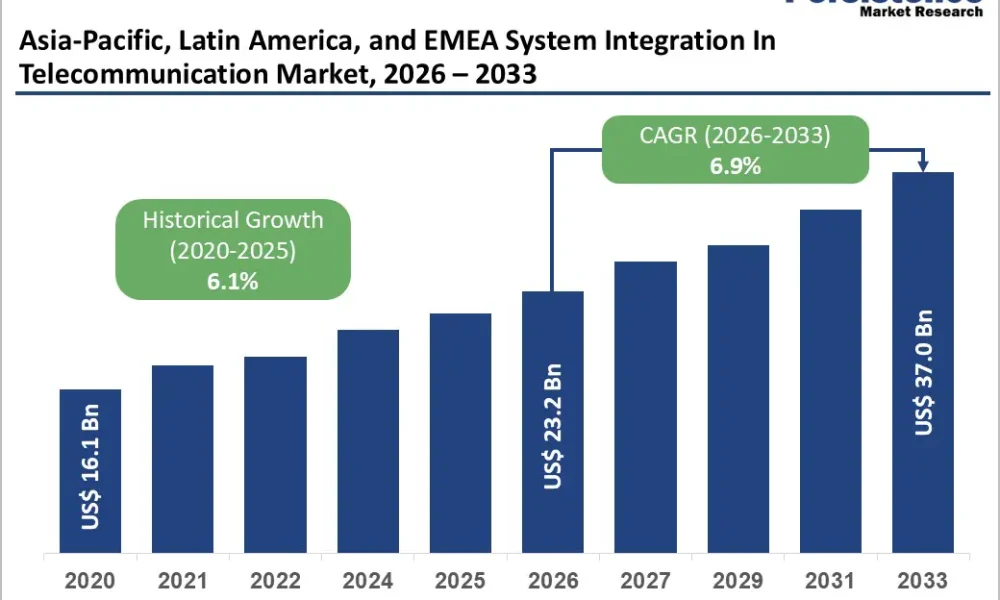
The Asia-Pacific, Latin America, and EMEA System Integration in Telecommunication Market is undergoing a profound transformation as telecom operators modernize their infrastructure to meet the demands of digital economies. Valued at US$ 23.2 billion in 2026, the market is projected to reach US$ 37.0 billion by 2033, expanding at a steady CAGR of 6.9%. This growth reflects the increasing complexity of telecom networks, driven by the convergence of 5G, cloud computing, artificial intelligence, and edge technologies.
System integration has become the backbone of telecom innovation. Operators are no longer just connectivity providers—they are evolving into digital service platforms. To enable this shift, seamless integration across network layers, applications, and cloud environments is essential. As a result, system integrators are emerging as strategic partners, helping telecom companies navigate modernization, scalability, and operational efficiency.
Market Overview and Key Growth Factors
The telecom system integration market across these regions is shaped by three major forces: 5G expansion, cloud adoption, and digital service proliferation. Each of these factors is accelerating the need for unified, scalable, and intelligent network ecosystems.
The rollout of 5G networks is perhaps the most significant catalyst. Telecom operators are deploying hybrid infrastructures that combine 4G LTE, 5G New Radio (NR), and private networks. These heterogeneous environments require advanced orchestration platforms capable of managing multi-vendor ecosystems and ensuring uninterrupted service delivery.
At the same time, the rapid shift toward cloud-native architectures is redefining telecom operations. Operators are increasingly adopting hybrid and multi-cloud strategies to enhance agility and reduce costs. This transition requires integration of OSS/BSS systems, customer platforms, and analytics engines across distributed environments.
Another major growth driver is the explosion of digital services. From streaming and e-commerce to AI-driven applications, telecom networks must handle massive volumes of data traffic while maintaining performance and security. This has intensified the demand for real-time data integration, API management, and intelligent automation.
Regional Leadership and Market Distribution
Asia-Pacific: The Dominant Growth Engine
Asia-Pacific leads the market with a 45% share, driven by large-scale telecom expansion and digital adoption. Countries like India and China are at the forefront, with massive subscriber bases and aggressive 5G rollouts.
India alone has over 1.21 billion telecom subscribers and nearly 979 million internet users, while China supports over 1.108 billion internet users. Government initiatives such as BharatNet and extensive fiber deployment programs are accelerating rural connectivity and network densification.
The region’s growth is further supported by favorable regulatory policies, including infrastructure sharing and foreign direct investment allowances. These factors have attracted billions in investment, creating a robust ecosystem for system integration services.
EMEA: Policy-Driven Digital Transformation
EMEA holds a 35% market share, supported by strong regulatory frameworks and digital transformation initiatives. The European Union’s Digital Decade strategy and data protection regulations such as GDPR are driving investments in secure and compliant telecom infrastructure.
The region boasts a highly developed ICT sector, with 1.4 million enterprises generating €667 billion in value added. High labor productivity and widespread internet penetration—reaching up to 99% in some countries—create a fertile environment for advanced integration projects.
Telecom operators in this region are heavily investing in cloud virtualization, cybersecurity, and automation, making system integration a critical enabler of innovation and compliance.
Latin America: Emerging Opportunities
Latin America accounts for 20% of the market, with countries like Brazil, Mexico, and Chile leading the way. Government-led initiatives focused on broadband expansion and digital inclusion are key growth drivers.
Programs such as Brazil’s Internet Brasil aim to connect millions of rural users, while spectrum auctions and regulatory reforms are encouraging private investment. The region has already launched over 40 commercial 5G networks across 13 countries, signaling strong momentum.
Despite challenges such as regulatory fragmentation, the region presents significant opportunities for system integrators, particularly in OSS/BSS modernization and hybrid cloud deployment.
Elevate your business strategy with comprehensive market data. Request a sample report now: https://www.persistencemarketresearch.com/samples/14008
Market Dynamics
Growth Drivers
- 5G Network Deployment
The global transition to 5G is creating unprecedented demand for system integration services. Telecom operators must integrate multiple network layers, including radio access networks, core systems, and transport infrastructure.
These deployments require advanced capabilities such as network slicing, edge computing, and real-time analytics. System integrators play a crucial role in ensuring seamless interoperability and service continuity during this transition.
- Digital Services Expansion
The rise of digital platforms has significantly increased data consumption. For example, India’s average monthly data usage per user has surged to over 20 GB, while China has over 1 billion users engaging in digital services such as online payments and e-commerce.
To support these services, telecom operators must integrate billing systems, customer management platforms, and analytics tools. This requires robust API frameworks and real-time data synchronization across multiple environments.
- Government Connectivity Programs
National broadband initiatives are driving infrastructure development across all regions. Projects aimed at expanding rural connectivity and bridging the digital divide are creating long-term demand for system integration.
These programs involve complex deployments, including satellite backhaul, fiber networks, and rural base stations. Integration services ensure unified network management and consistent user experiences across diverse geographies.
Market Restraints
Legacy System Complexity
Many telecom operators still rely on legacy OSS/BSS systems that are difficult to modernize. These systems often involve proprietary technologies and undocumented dependencies, making integration projects time-consuming and costly.
Migration to modern platforms can take several years and require significant investment, posing a major challenge for operators seeking rapid transformation.
Regulatory Fragmentation
The telecom industry is heavily regulated, and the regulatory landscape varies significantly across regions. Compliance with data protection laws, licensing requirements, and spectrum policies adds complexity to integration projects.
For system integrators, this means developing region-specific solutions, which can limit scalability and increase operational costs.
Emerging Opportunities
Private 5G Networks
Private 5G networks are gaining traction across industries such as manufacturing, mining, and logistics. These networks require dedicated infrastructure and customized integration solutions.
Enterprises are increasingly adopting private networks to support applications like robotics, IoT, and real-time analytics. This creates new revenue streams for system integrators, particularly through long-term managed service contracts.
Open RAN Adoption
Open RAN is transforming the telecom landscape by enabling interoperability between different vendors. This reduces dependency on single suppliers and lowers capital expenditure.
However, Open RAN also increases the complexity of network integration, creating opportunities for specialized system integrators. These providers focus on orchestration, automation, and multi-vendor management.
Segment Analysis
Integration Type
Network Integration dominates the market with a 32.1% share, as it is essential for 5G deployment and multi-vendor network management. It ensures seamless communication across different network layers and technologies.
Cloud & Virtualization Integration is the fastest-growing segment, driven by the shift toward cloud-native architectures. Operators are increasingly adopting microservices and containerized environments, requiring advanced integration capabilities.
Service Model
Managed Services lead with a 44.4% share, reflecting operators’ preference for outsourcing network operations. These services provide end-to-end management, including monitoring, optimization, and maintenance.
Professional Services are growing rapidly, driven by the need for specialized expertise in areas such as Open RAN, AI, and cloud integration.
End Users
Telecom operators remain the largest customers, accounting for over 63% of the market. However, enterprises are emerging as a high-growth segment, driven by private 5G and IoT adoption.
Industries such as manufacturing, agriculture, and logistics are leveraging telecom integration to enhance efficiency and enable digital transformation.
Competitive Landscape
The market is characterized by a mix of global technology providers and regional players. Leading companies such as Ericsson, Nokia, Huawei, IBM, Wipro, Capgemini, and Tech Mahindra dominate the landscape.
Asia-Pacific is relatively consolidated, with large vendors handling complex integration projects for Tier-1 operators. Latin America is more fragmented, while EMEA features a mix of consolidated and competitive markets.
Strategic partnerships are a key trend, as companies collaborate to deliver integrated solutions across cloud, AI, and telecom domains.
Recent Industry Developments
Recent collaborations highlight the growing convergence of telecom and cloud technologies. For instance, partnerships between telecom operators and cloud providers are enabling hybrid cloud environments and AI-driven network management.
Similarly, initiatives focused on autonomous networks are addressing the challenges of multi-vendor integration and paving the way for intelligent, self-optimizing telecom systems.
Future Outlook
The future of the telecom system integration market lies in automation, intelligence, and scalability. As networks become more complex, the role of system integrators will continue to expand.
Technologies such as AI, machine learning, and edge computing will play a critical role in enabling autonomous networks and real-time decision-making. At the same time, the adoption of Open RAN and private 5G will create new opportunities for innovation and growth.
By 2033, the market is expected to become more integrated, with seamless connectivity across devices, platforms, and industries. System integrators will be at the center of this transformation, driving efficiency, innovation, and digital inclusion.
Conclusion
The Asia-Pacific, Latin America, and EMEA System Integration in Telecommunication Market is on a strong growth trajectory, driven by technological advancements and increasing demand for digital connectivity. With a projected value of US$ 37.0 billion by 2033, the market offers significant opportunities for stakeholders across the telecom ecosystem.
As operators continue to modernize their networks and embrace digital transformation, system integration will remain a critical enabler of success. Companies that can deliver scalable, secure, and intelligent solutions will be well-positioned to lead in this dynamic and rapidly evolving market.
Related Reports:




