
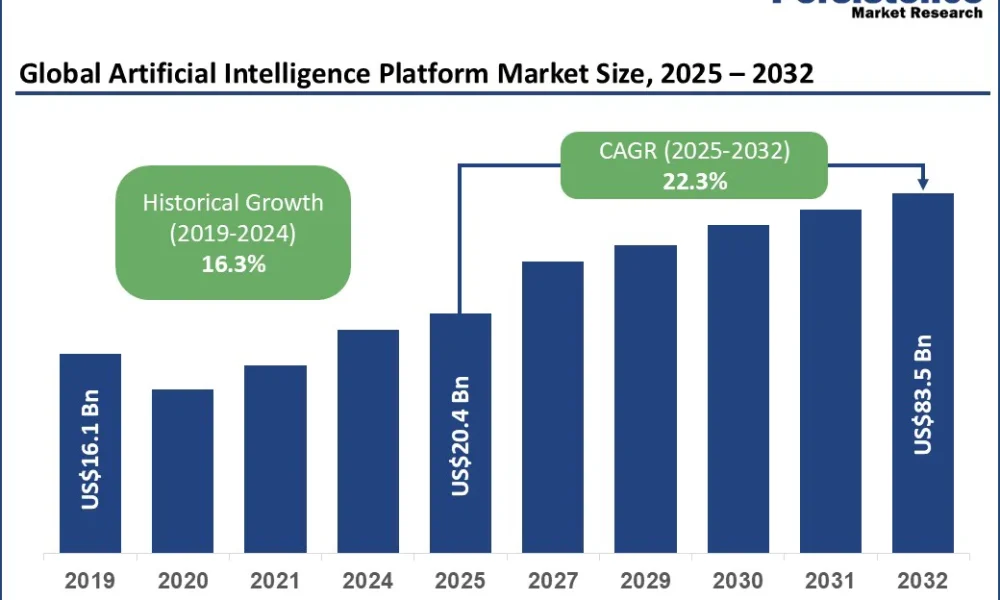
The global Artificial Intelligence Platform Market is entering a transformative growth phase, driven by rapid digitalization, increasing reliance on data-driven decision-making, and the rising demand for intelligent automation. The market is projected to grow from US$20.4 billion in 2025 to US$83.5 billion by 2032, expanding at a robust CAGR of 22.3% during the forecast period.
Artificial intelligence platforms provide the foundational infrastructure for building, deploying, and managing AI models at scale. These platforms integrate tools for machine learning, natural language processing, and data analytics, enabling organizations to unlock actionable insights and enhance productivity. With industries embracing automation and predictive intelligence, AI platforms are becoming essential for achieving operational excellence and competitive advantage.
Market Overview and Key Highlights
The AI platform market is characterized by strong momentum across industries and regions. Several key highlights define the current landscape:
- AI tools dominate the component segment, accounting for nearly 34.5% share in 2025, due to their ability to simplify complex analytics and accelerate development cycles.
- Cloud-based deployment leads with approximately 67.4% market share, driven by scalability, cost efficiency, and seamless integration.
- IT and telecom emerge as the leading end-user segment, capturing around 30.2% share, owing to high demand for network optimization and real-time analytics.
- North America holds the largest regional share (26.4%), supported by mature AI ecosystems and high R&D investments.
- Europe is the fastest-growing region, benefiting from strong regulatory frameworks and digital transformation initiatives.
A notable industry development occurred in November 2024, when Temenos collaborated with NVIDIA to deploy an on-premises generative AI platform for banks. This solution enhanced real-time insights and ensured regulatory compliance with explainable AI capabilities.
Key Growth Drivers
Ongoing Digitization and Enterprise Automation
Organizations across industries are accelerating digital transformation initiatives to improve efficiency and reduce operational costs. AI platforms enable businesses to automate repetitive processes, optimize workflows, and enhance decision-making.
Over 40% of enterprises have initiated AI pilot programs since 2021. In manufacturing, AI-driven predictive analytics and automated quality control systems have improved productivity by up to 15%. Such tangible benefits are encouraging broader adoption across sectors.
Global organizations such as the World Economic Forum and the Organisation for Economic Co-operation and Development are actively promoting AI adoption through policy frameworks and digital transformation initiatives.
Expansion of Cloud Infrastructure
The rapid growth of cloud computing has significantly enhanced the accessibility of AI platforms. Leading cloud providers such as Amazon Web Services, Microsoft, and Google offer scalable AI services, enabling organizations to deploy models quickly without heavy upfront investments.
Cloud-based AI platforms reduce infrastructure costs and accelerate deployment timelines. Studies indicate that cloud adoption can improve deployment speed by 40% and reduce operational costs by up to 30%, making it a preferred choice for enterprises worldwide.
Regulatory Compliance and Data Governance
The growing emphasis on data privacy and ethical AI is shaping platform development. Regulations such as the General Data Protection Regulation and the EU AI Act require organizations to ensure transparency, explainability, and accountability in AI systems.
Standards set by organizations like the Institute of Electrical and Electronics Engineers and the International Organization for Standardization are further driving the adoption of compliant AI platforms.
Key Challenges
Data Privacy and Security Risks
As AI platforms handle vast amounts of sensitive data, they are increasingly vulnerable to cyber threats. Enterprises now allocate over 25% of their AI budgets to compliance and security measures.
Data breaches can result in severe financial penalties, operational disruptions, and reputational damage. Moreover, increasing customer awareness regarding data privacy is pushing organizations to adopt more secure and transparent AI solutions.
Talent Shortage and Skills Gap
The shortage of skilled professionals remains a significant barrier to market growth. According to industry insights from PwC and KPMG, the demand for AI talent exceeds supply by nearly 40%.
The gap extends beyond data scientists to include AI architects, MLOps engineers, and domain experts. This shortage leads to delayed project implementation and underutilization of AI platforms, limiting return on investment.
Emerging Opportunities
Rise of Industry-Specific AI Platforms
The demand for vertical-specific AI solutions is creating new growth opportunities. Industries such as healthcare, finance, and retail are adopting customized platforms tailored to their unique requirements.
Healthcare AI, for instance, is expected to grow at a CAGR of 22% through 2032, driven by applications in predictive diagnostics, precision medicine, and clinical decision support systems.
Growth of AI for SMEs
Small and medium-sized enterprises (SMEs) are increasingly adopting AI platforms due to the availability of cloud-based AI-as-a-Service models. These solutions lower entry barriers and enable SMEs to leverage advanced analytics, automation, and customer personalization without heavy investments.
Edge AI and Decentralized Analytics
The integration of AI with edge computing is enabling real-time data processing in industries such as manufacturing, transportation, and smart cities. Edge AI reduces latency and enhances decision-making capabilities at the source of data generation.
Additionally, decentralized AI approaches such as federated learning allow organizations to collaborate on model training without sharing sensitive data, improving privacy and security.
Expansion in Emerging Markets
Regions such as Asia Pacific, Latin America, and the Middle East are witnessing rapid AI adoption. Countries like India, China, and Japan are investing heavily in AI infrastructure and innovation.
Government initiatives, rising internet penetration, and the growth of digital ecosystems are driving demand for AI platforms in these regions. Start-ups and innovation hubs are further accelerating market expansion by developing localized solutions.
Elevate your business strategy with comprehensive market data. Request a sample report now: https://www.persistencemarketresearch.com/samples/26788
Segment Analysis
By Component
AI tools hold the largest share, driven by their ability to simplify development processes and enable rapid prototyping. These tools provide integrated environments for model training, deployment, and monitoring.
Natural Language Processing (NLP) platforms are also gaining traction, with applications in chatbots, sentiment analysis, and automated customer support. Increasing regulatory requirements are further boosting demand for explainable NLP models.
By Deployment
Cloud-based deployment dominates the market due to its flexibility and cost-effectiveness. Organizations prefer cloud platforms for their scalability and ease of integration with existing systems.
However, hybrid and on-premises models are gaining popularity, especially in industries with strict data sovereignty requirements. Hybrid deployment offers a balance between control and scalability.
By End-user
The IT and telecom sector leads the market, driven by the need for advanced analytics, network optimization, and enhanced customer experiences.
Healthcare and life sciences represent the fastest-growing segment, fueled by increasing adoption of AI in diagnostics, drug discovery, and personalized medicine. The availability of electronic health records and wearable data is further supporting growth.
Regional Insights
North America
North America remains the largest market, accounting for approximately 26.4% of global share in 2025. The region benefits from strong investments, advanced infrastructure, and a mature AI ecosystem.
Leading companies such as IBM, Salesforce, and Oracle continue to drive innovation through product development and strategic partnerships.
Government initiatives and venture capital funding further support AI adoption across industries.
Europe
Europe is emerging as the fastest-growing region, with strong emphasis on ethical AI and regulatory compliance. Countries such as Germany, the U.K., and France are leading adoption.
The region’s focus on sustainability and transparency is encouraging the development of responsible AI platforms. Cross-border collaborations and government funding programs are also contributing to growth.
Asia Pacific
Asia Pacific is witnessing rapid expansion, led by countries like China, India, and Japan. Government initiatives, increasing investments, and the presence of large manufacturing hubs are driving demand.
Collaborations between regional companies and global cloud providers are enhancing infrastructure capabilities. The rise of smart cities and digital economies is further accelerating AI adoption.
Competitive Landscape
The global AI platform market is moderately consolidated, with leading players accounting for over 60% of the market share. Key companies include:
- Microsoft
- Amazon Web Services
- IBM
- SAP
- Salesforce
- NVIDIA
These companies focus on innovation, partnerships, and acquisitions to strengthen their market positions. Start-ups are also playing a crucial role by offering niche solutions in areas such as healthcare AI, edge computing, and automation.
Key Industry Developments
Recent developments highlight the dynamic nature of the market:
- In June 2025, Lenovo expanded its Hybrid AI Advantage platform through collaborations with Cisco, IBM, and NVIDIA.
- In May 2024, Siemens partnered with Microsoft to launch Teamcenter X with generative AI capabilities on Azure.
These initiatives reflect the growing emphasis on collaboration and innovation in AI platform development.
Conclusion
The Artificial Intelligence Platform Market is poised for exponential growth, driven by technological advancements, increasing enterprise adoption, and supportive regulatory frameworks. As organizations continue to prioritize automation and data-driven strategies, AI platforms will play a pivotal role in shaping the future of business operations.
While challenges such as data security and talent shortages persist, ongoing innovation and the emergence of new opportunities are expected to drive sustained market expansion. With the integration of cloud computing, edge AI, and industry-specific solutions, the market is set to redefine how businesses leverage intelligence and automation in the digital era.
Related Reports:




