
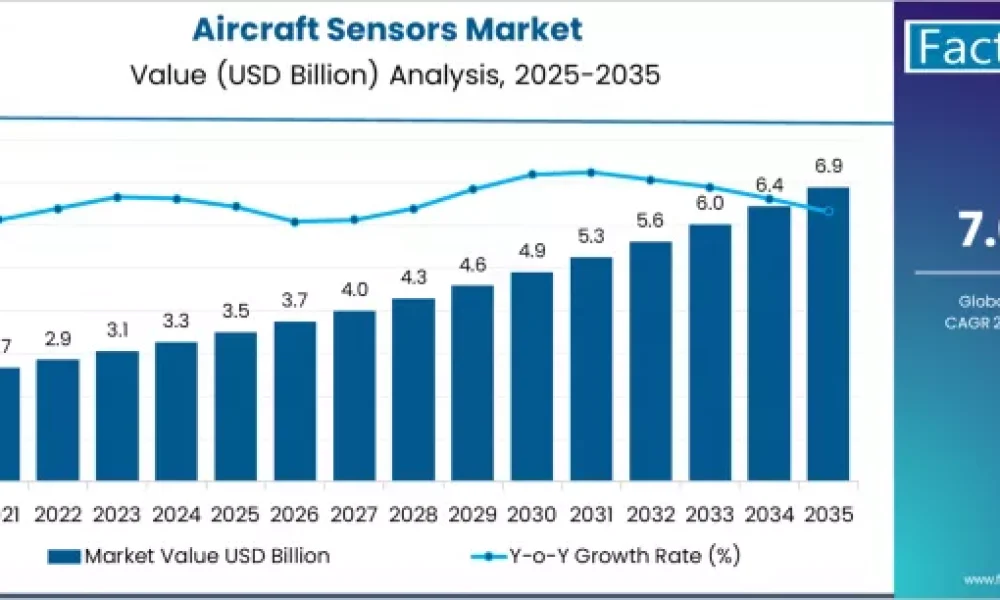
The global aircraft sensors market is projected to advance significantly over the next decade, expanding from an estimated USD 3.5 billion in 2025 to around USD 6.9 billion by 2035, driven by a compound annual growth rate (CAGR) of approximately 7.0%. This growth underscores a major shift in the aerospace industry toward data-rich, sensor-enabled aircraft systems that prioritize safety, efficiency, and predictive maintenance.
Key Market Highlights
2025 Market Size: USD 3.5 billion
2035 Forecast Value: USD 6.9 billion
Projected CAGR (2025–2035): ~7.0%
Leading Sensor Type: Pressure sensors (~28% of the market)
Top Application: Engine & fuel systems (~32% share)
High-Growth Regions: Asia Pacific, North America, Middle East & Africa
Key Players: Honeywell International, TE Connectivity, Safran, Collins Aerospace, Thales, Meggitt, Curtiss-Wright, Amphenol, General Electric, Raytheon Technologies
To access the complete data tables and in-depth insights, request a Discount On The Report here: https://www.factmr.com/connectus/sample?flag=S&rep_id=11837
Major Growth Drivers
Fleet Modernization and Next-Gen Avionics
Airlines and OEMs are increasingly integrating advanced sensor suites into new aircraft platforms as part of comprehensive fleet modernization. These sensors help monitor essential systems—like engines, fuel, and flight controls—enhancing operational reliability and enabling real-time diagnostics.Rise of Predictive Maintenance
The adoption of predictive, condition-based maintenance is transforming how aircraft are maintained. Sensor networks feed critical data into analytics platforms, enabling early detection of anomalies, reducing unscheduled downtime, and extending component life cycles.Technological Advances in MEMS
Micro-Electro-Mechanical Systems (MEMS) sensors are becoming the backbone of modern avionics, offering smaller size, lower weight, and high resilience to vibration. These devices are quickly replacing legacy mechanical sensors across multiple on-board systems.Wireless and Digital Sensing Architectures
The integration of wireless sensor networks and digital diagnostics is helping reduce wiring complexity, lower weight, and improve installation flexibility. Combined with edge computing, these architectures support real-time health monitoring and distributed intelligence on aircraft.Sustainability & More-Electric Aircraft
As aerospace players push toward more-electric architectures, sensors become essential for monitoring battery performance, thermal management, and system integrity. These capabilities support greener flight operations and better energy efficiency.Growth in Regional Aviation
Emerging aviation markets in Asia Pacific and the Middle East are investing heavily in new aircraft, MRO infrastructure, and avionics technologies. This trend is driving demand for advanced sensors across commercial, regional, and military fleets.
Market Segmentation
By Sensor Type:
Pressure Sensors (dominant)
Temperature Sensors
Position Sensors
Force Sensors
Other Sensors
By Application:
Engine & Fuel Systems (largest)
Flight Control Systems
Cabin Management Systems
Structural Health Monitoring / Other Applications
By Aircraft Type:
Commercial Aircraft (narrow-body, wide-body)
Military Aircraft
General Aviation
By Region:
Asia Pacific
North America
Europe
Latin America
Middle East & Africa
Challenges & Risks
High Sensor Costs: Advanced sensors, especially MEMS-based or wireless types, can be expensive to qualify and produce, which may inhibit adoption in cost-sensitive segments.
Harsh Operating Environments: Aerospace sensors must withstand pressure, temperature extremes, vibration, and electromagnetic interference, making design and certification complex.
Certification & Regulation: Aviation sensor systems must meet rigorous safety and reliability standards, which can lead to long development and qualification cycles.
Supply Chain Constraints: Sourcing high-grade materials and aerospace-qualified components, particularly semiconductors, can lead to long lead-times and cost pressures.
Competitive Landscape
Aircraft sensor manufacturers are focusing on:
R&D in next-gen MEMS sensors with improved performance and lower power consumption
Development of wireless, smart sensing networks that reduce weight and wiring
Partnerships with OEMs, MRO providers, and analytics firms to deliver integrated health monitoring solutions
Expanding regional production to serve growth markets in Asia Pacific and the Middle East
Investing in quality and certification infrastructure to meet aviation compliance standards
Leading companies in the space include Honeywell, TE Connectivity, Safran, Collins Aerospace, Thales, Meggitt, Curtiss-Wright, Amphenol, General Electric, and Raytheon Technologies.
Strategic Recommendations
Accelerate Sensor Innovation: Prioritize the development of MEMS-based, miniaturized, and low-power sensors for use across multiple aircraft systems.
Enable Predictive Maintenance Platforms: Collaborate with analytics and avionics partners to integrate sensor data into predictive maintenance workflows.
Scale Wireless Deployment: Pilot and deploy wireless sensor networks to reduce wiring weight and facilitate sensor installation.
Support Regional Growth: Establish manufacturing, service, and calibration hubs in fast-growing regions such as Asia Pacific and the Middle East.
Focus on Certification Efficiency: Invest in qualification infrastructure and testing labs to shorten time-to-market for new sensor technologies.
Market Outlook
By 2035, the aircraft sensors market is expected to nearly double, reaching around USD 6.9 billion. This dramatic growth is being propelled by advanced sensor technology, predictive maintenance models, and a global shift toward more connected, intelligent aircraft.
As aviation stakeholders prioritize efficiency, safety, and sustainability, sensors are evolving from passive measurement tools into active components that drive decision-making, system optimization, and operational resilience. Companies that deliver high-accuracy, low-footprint, and data-integrated sensor solutions will be best positioned to lead in this transformed aerospace ecosystem.
Have specific requirements or need assistance on report pricing or have a limited budget? Please contact [email protected]
About Fact.MR:
Fact.MR is a global market research and consulting firm, trusted by Fortune 500 companies and emerging businesses for reliable insights and strategic intelligence. With a presence across the U.S., UK, India, and Dubai, we deliver data-driven research and tailored consulting solutions across 30+ industries and 1,000+ markets. Backed by deep expertise and advanced analytics, Fact.MR helps organizations uncover opportunities, reduce risks, and make informed decisions for sustainable growth.



