
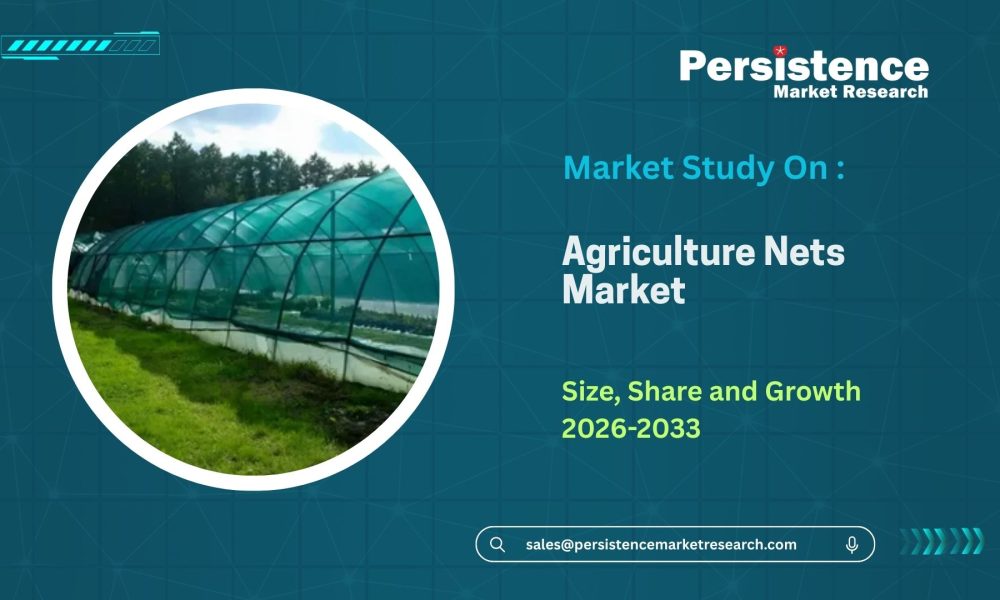
The global Agriculture Nets Market is gaining strong momentum as farmers increasingly adopt advanced solutions to protect crops and improve agricultural productivity. Agriculture nets are widely used for shading, pest control, wind protection, and climate regulation, making them essential in modern farming systems. With the growing demand for high-quality crops and the need to reduce losses caused by environmental factors, these nets are becoming a critical component in both open-field and greenhouse farming. The rising awareness of sustainable agriculture practices is also encouraging the use of eco-friendly and durable netting materials.
According to Persistence Market Research, the global agriculture nets market size is expected to be valued at US$11.4 billion in 2026 and projected to reach US$16.3 billion by 2033, growing at a CAGR of 5.2% between 2026 and 2033. This growth is driven by increasing investments in agricultural infrastructure, rising adoption of protected cultivation techniques, and the need to safeguard crops from extreme weather conditions. Shade nets represent a leading product segment due to their extensive use in controlling sunlight exposure, while Asia-Pacific leads the market owing to its large agricultural base and growing adoption of modern farming technologies.
Download Your Free Sample & Explore Key Insights : https://www.persistencemarketresearch.com/samples/33869
Key Highlights from the Report
➤ Rising adoption of climate-resilient farming techniques is driving demand for agriculture nets globally
➤ Increasing use of shade nets in greenhouse farming is supporting market expansion across regions
➤ Growth in horticulture and floriculture sectors is boosting the adoption of protective netting solutions
➤ Expansion of precision agriculture practices is contributing to higher usage of advanced net systems
➤ Strong demand from emerging economies is accelerating market penetration of agriculture nets
➤ Continuous innovation in UV-resistant and durable materials is enhancing product efficiency and lifespan
Market Segmentation
The agriculture nets market can be segmented based on product type, material, and application. Key product types include shade nets, anti-insect nets, bird protection nets, and hail protection nets. Among these, shade nets dominate the market due to their widespread use in regulating sunlight and temperature, especially in greenhouse and nursery applications. Anti-insect nets are also gaining popularity as they offer an eco-friendly alternative to chemical pesticides, helping farmers maintain crop quality while reducing environmental impact.
From an application standpoint, agriculture nets are extensively used in horticulture, floriculture, greenhouse farming, and open-field cultivation. Greenhouse farming represents a significant segment due to its controlled environment, which requires protective netting to optimize crop growth. Additionally, the increasing demand for fruits, vegetables, and flowers is encouraging farmers to invest in advanced netting solutions. The use of durable materials such as polyethylene and polypropylene further enhances the performance and longevity of these products.
Customize This Report for Your Exact Requirements : https://www.persistencemarketresearch.com/checkout/33869
Regional Insights
Asia-Pacific holds a dominant position in the agriculture nets market, supported by its vast agricultural landscape and growing population. Countries such as India and China are witnessing increased adoption of protected cultivation techniques, including greenhouse farming and shade net usage. Government initiatives promoting modern farming methods and subsidies for agricultural infrastructure are further supporting market growth in the region. The need to improve crop yield and quality is also encouraging farmers to invest in advanced netting solutions.
North America and Europe are also significant markets due to the high adoption of advanced agricultural technologies and sustainable farming practices. In these regions, farmers are increasingly focusing on reducing chemical usage and improving crop protection through physical barriers such as nets. The presence of well-established agricultural infrastructure and strong research and development activities are driving innovation in net materials and designs, contributing to steady market growth.
Market Drivers
The primary driver of the agriculture nets market is the growing demand for crop protection and yield optimization. Farmers are increasingly facing challenges such as unpredictable weather conditions, pest infestations, and soil degradation. Agriculture nets provide an effective solution by creating a controlled environment that protects crops from external threats while improving growth conditions. This has led to widespread adoption of netting solutions across various agricultural applications.
Another significant driver is the rise in sustainable and organic farming practices. With increasing awareness of environmental impact and food safety, farmers are reducing their reliance on chemical pesticides and fertilizers. Agriculture nets, particularly anti-insect and shade nets, offer a natural and eco-friendly alternative for crop protection. This shift toward sustainable farming is expected to continue driving demand for agriculture nets in the coming years.
Market Restraints
Despite strong growth prospects, the agriculture nets market faces certain restraints. One major challenge is the high initial investment cost associated with installation and maintenance. Small-scale farmers, particularly in developing regions, may find it difficult to afford advanced netting systems. This can limit market penetration in price-sensitive markets and slow down adoption rates.
Another restraint is the limited awareness and technical knowledge among farmers regarding the benefits and proper usage of agriculture nets. In many regions, traditional farming practices still dominate, and farmers may be hesitant to adopt new technologies. Additionally, improper installation or low-quality materials can reduce the effectiveness of netting solutions, leading to dissatisfaction among users.
Market Opportunities
The agriculture nets market presents significant opportunities driven by the expansion of protected cultivation and greenhouse farming. As global demand for high-quality produce continues to rise, farmers are increasingly investing in controlled farming environments. This creates a strong demand for advanced netting solutions that can enhance crop productivity and reduce losses.
Another key opportunity lies in technological advancements and product innovation. Manufacturers are developing nets with improved durability, UV resistance, and multi-functional capabilities. These innovations not only enhance product performance but also extend their lifespan, making them more cost-effective for farmers. Expanding into emerging markets and offering affordable solutions tailored to local needs can further unlock growth potential for market players.
Get Instant Access – Complete Your Purchase : https://www.persistencemarketresearch.com/checkout/33869
Company Insights
Key players operating in the agriculture nets market include:
Garware Technical Fibres Ltd.
SRF Limited
Beaulieu Technical Textiles
TenCate Industrial Fabrics
Low & Bonar PLC
Shakti Polyweave Pvt. Ltd.
Diatex SAS
Don & Low Ltd.
Arrigoni S.p.A.
Polysack Plastic Industries Ltd.
Recent Developments
- June 2024: Garware Technical Fibres Ltd. launched advanced UV-stabilized agriculture nets designed for enhanced durability and crop protection.
- October 2023: Arrigoni S.p.A. introduced new eco-friendly netting solutions aimed at supporting sustainable farming practices.
Future Opportunities and Growth Prospects
The future of the agriculture nets market appears highly promising as the agricultural sector continues to modernize and adopt advanced technologies. The increasing focus on sustainable farming, coupled with the need to improve crop productivity, will drive the demand for innovative netting solutions. Governments and agricultural organizations are also expected to play a crucial role by providing financial support and promoting awareness about the benefits of agriculture nets.
Furthermore, the expansion of agriculture in emerging economies and the growing adoption of greenhouse farming will create new growth avenues for market players. Continuous innovation in materials and product design, along with strategic partnerships and market expansion initiatives, will shape the long-term growth trajectory of the agriculture nets market.




