
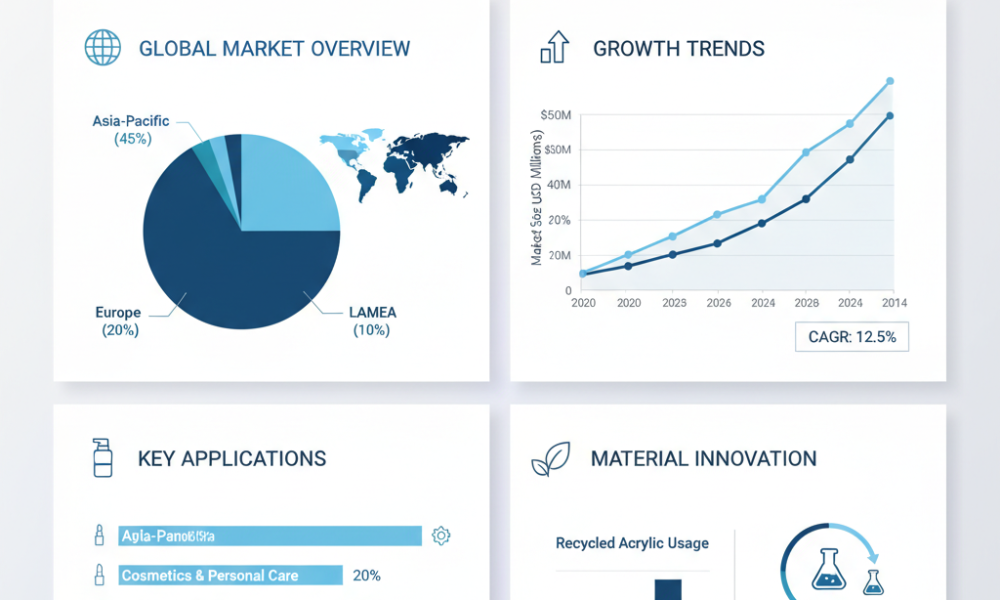
The global acrylic airless bottle market is on a strong upward trajectory, projected to reach USD 1,038.9 million in 2024, rising from USD 992.2 million in 2023. By 2034, the market is forecasted to hit USD 1,508.5 million, expanding at a CAGR of 5.2%. This acceleration marks a clear shift from the 2.6% CAGR recorded between 2019 and 2023.
Rising demand for premium skincare and cosmetic packaging is the driving force behind this growth. Acrylic airless bottles have become the packaging of choice for luxury formulations that require protection from oxidation, contamination, and UV exposure — particularly as consumers gravitate toward clean beauty and sustainability-focused brands.
Segment Overview
By capacity, the 30 ml to 50 ml segment is expected to dominate with approximately 35% of total market value by 2034, as it perfectly suits high-end serums and moisturizers.
In terms of applications, the skincare segment leads the pack, accounting for roughly 40% share in 2034, reflecting growing consumer interest in performance-driven, active-ingredient products.
From a materials standpoint, acrylic (PMMA) remains the most widely used due to its high-gloss transparency, durability, and luxurious feel. However, the trend toward refillable and recyclable packaging is accelerating as brands pursue sustainable innovation.
Regional Overview
Europe continues to hold the lion’s share of the global acrylic airless bottle market, driven by strong consumer preferences for premium beauty packaging and early adoption of eco-design principles.
Asia-Pacific is emerging as the fastest-growing region, with India projected to grow at a CAGR of around 5.6%, and China following closely at 5.3% through 2034. Both markets benefit from a booming personal care industry and expanding middle-class consumption.
Meanwhile, North America maintains a steady growth trajectory of 2.7% CAGR, propelled by the region’s leadership in smart and sustainable packaging technologies.
Competitive Landscape
The acrylic airless bottle industry is moderately consolidated. Tier 1 players — including global packaging leaders such as Albéa Group, Lumson SPA, and AptarGroup, Inc. — collectively account for about 35% of global market share, with the top three players representing nearly 17%.
Tier 2 manufacturers (around 42% combined share) are gaining momentum by offering region-specific innovations and sustainable materials, while Tier 3 players serve local markets with customizable, short-run solutions.
Recent Strategic Developments
- Albéa Group introduced a 100% recyclable mono-material airless bottle line designed for high-end skincare applications.
- Lumson SPA unveiled a hybrid glass-acrylic refillable system that merges luxury aesthetics with environmental responsibility.
- AptarGroup, Inc. expanded its dispensing portfolio with precision-engineered, touchless pump systems.
- HCP Packaging completed a key acquisition to boost production capacity and streamline operations in Asia.
- Quadpack Industries S.A. launched a new refillable glass-airless pack made from fully recyclable components.
Key Players of the Sustainable Label Industry
Leading market participants include:
- Albéa Group
- Lumson SPA
- AptarGroup, Inc.
- Quadpack Industries S.A.
- HCP Packaging
- Silgan Dispensing Systems
Each of these companies is investing heavily in sustainability, design innovation, and automation — key differentiators that are shaping the next generation of airless packaging solutions.
Market Outlook: Powering the Next Decade
The decade ahead is set to redefine the packaging landscape. The incremental opportunity of USD 461 million projected through 2034 underscores the sector’s growing importance. Premiumization, coupled with sustainability-driven innovation, will be the twin engines driving progress.
Key growth enablers include:
- The rising need to protect sensitive skincare formulations containing retinol, vitamin C, and peptides from oxidation.
- The demand for high-end, glass-like transparency that elevates product aesthetics.
- The evolution of refillable and mono-material designs aligned with circular economy goals.
- The integration of AI and automation in manufacturing to reduce waste and improve precision.
Despite challenges such as higher material and production costs, manufacturers that balance premium design, affordability, and environmental responsibility are expected to emerge as market leaders.
To access the complete data tables and in-depth insights, request a sample report here: https://www.futuremarketinsights.com/reports/sample/rep-gb-21458
Have a specific Requirements and Need Assistant on Report Pricing or Limited Budget please contact us – [email protected]
About Future Market Insights (FMI)
Future Market Insights, Inc. (ESOMAR certified, recipient of the Stevie Award, and a member of the Greater New York Chamber of Commerce) offers profound insights into the driving factors that are boosting demand in the market. With a vast team of over 400 analysts worldwide, FMI provides global, regional, and local expertise on diverse domains and industry trends across more than 110 countries.



