
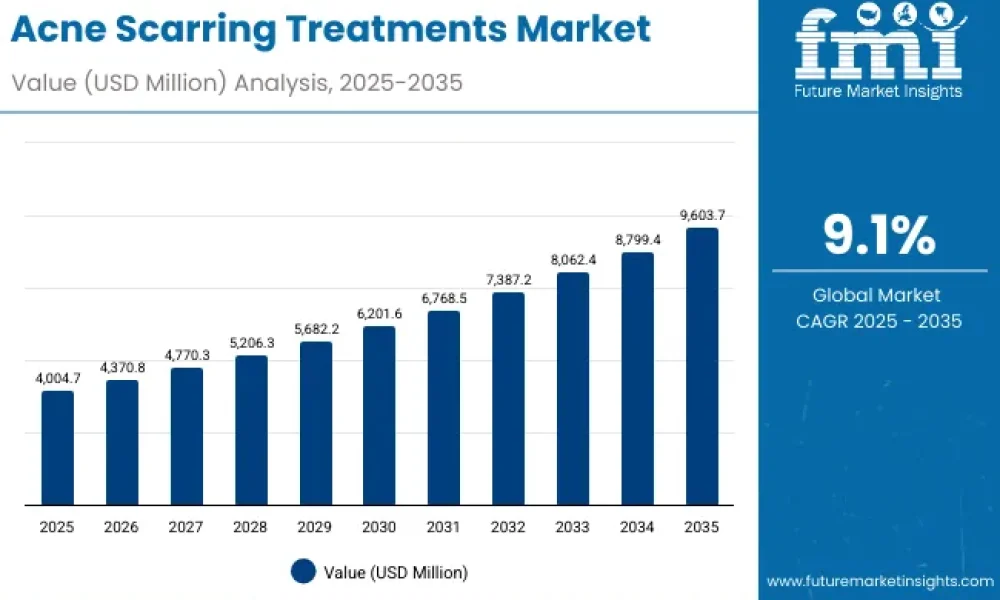
The global Acne Scarring Treatments Market is entering a high-growth decade, projected to expand from USD 4,004.7 million in 2025 to USD 9,603.7 million by 2035, registering a strong CAGR of 9.1%. This represents an absolute growth opportunity of USD 5,599 million, translating into a 193%+ expansion and a more than 2X increase in market size over the forecast period.
This growth trajectory reflects rising consumer focus on skin clarity, the normalization of long-term scar care routines, and accelerating adoption of dermatologist-backed and clinically proven solutions across both retail and clinical channels.
Unlock the full market insights and exclusive data breakdowns – Request Your Sample Report Now
Market Momentum: A Two-Phase Growth Story
- 2025–2030:
- Market grows from USD 4,004.7 million to USD 6,201.6 million
- Contributes nearly 39% of total decade growth
- Driven by OTC skincare, pharmacy-led sales, and dermatologist-recommended topical resurfacing solutions
- PIH and atrophic scars dominate demand, supported by AHA/BHA/PHA systems and retinoids
- 2030–2035:
- Market expands further to USD 9,603.7 million
- Accounts for 61% of total growth
- Fueled by combination therapies, silicone polymer systems, premium clinical claims, and e-commerce expansion in Asia-Pacific
Why the Acne Scarring Treatments Market Is Growing
- Rising prevalence of post-inflammatory hyperpigmentation (PIH), especially among younger and melanin-rich skin populations
- Advances in active ingredient systems such as retinoids, AHA/BHA/PHA blends, vitamin C, and silicone polymers
- Expansion of professional adjunct care following laser and microneedling procedures
- Strong influence of digital-native brands, social media education, and dermatologist-tested positioning
- Increasing consumer preference for fragrance-free and sensitive-skin safe formulations
Key Market Takeaways
- Market Value 2025: USD 4,004.7 million
- Market Forecast 2035: USD 9,603.7 million
- Forecast CAGR: 9.1%
- Leading Scar Type (2025): PIH – 45% share (USD 1,802.1 million)
- Fastest-Growing Regions: Asia-Pacific (China, India, Japan)
- Top Companies: Mederma, Stratpharma, La Roche-Posay, The Ordinary, Paula’s Choice, Murad, Kiehl’s, Bio-Oil, Derma E, SkinCeuticals
Key Segments of the Acne Scarring Treatments Market
By Scar Type
- Post-inflammatory hyperpigmentation (PIH) – Market leader due to high visibility and pigmentation concerns
- Atrophic scars (boxcar, icepick, rolling) – Growing with retinoid and resurfacing adoption
- Hypertrophic/keloid scars – Niche but supported by silicone-based systems
By Treatment Type
- Topical resurfacing (AHA/BHA/PHA, retinoids) – 44% share in 2025
- Silicone gels and sheets
- Dark-spot correctors
- Professional adjunct and post-procedure care
By Active System
- AHA/BHA/PHA resurfacing – 36% share, leading active category
- Retinoids
- Vitamin C & antioxidants
- Silicone polymer systems
By Form
- Serums – Preferred for penetration and ease of use
- Gels
- Creams
- Silicone sheets
By Distribution Channel
- E-commerce – Fastest-growing and highly influential
- Pharmacies and drugstores
- Dermatology clinics
- Specialty beauty retail
By Claims
- Clinically proven
- Dermatologist-tested
- Fragrance-free
- Sensitive-skin safe
Regional Growth Highlights
- Asia-Pacific emerges as the fastest-growing hub, led by India (14.5% CAGR) and China (12.9% CAGR), driven by youth demographics, digital retail penetration, and rising skincare awareness.
- North America retains value leadership, with the USA valued at USD 996.3 million in 2025, supported by strong dermatologist trust and premium brands.
- Europe, including the UK and Germany, shows steady growth, anchored in pharmacy-led distribution and dermocosmetic adoption.
Competitive Landscape: Established Leaders and New Innovators
The Acne Scarring Treatments Market is highly fragmented, creating opportunity for both established scar-care specialists and emerging digital-first brands.
- Legacy leaders like Mederma, Stratpharma, La Roche-Posay, and SkinCeuticals continue to dominate through clinical validation, dermatologist endorsements, and pharmacy strength.
- E-commerce-first brands such as The Ordinary and Paula’s Choice are disrupting the space with transparent formulations, affordable pricing, and strong PIH-focused portfolios.
- Mid-sized and regional manufacturers are gaining traction by launching hybrid regimens that combine resurfacing actives with silicone systems, particularly in Asia-Pacific.
Manufacturers aiming to expand their businesses are increasingly investing in new technologies, hybrid formulations, bundled regimens, and ecosystem-driven strategies that integrate digital dermatology, influencer education, and safety-backed claims.
Future Outlook
By 2035, the Acne Scarring Treatments Market will be shaped by innovation-led growth, Asia-Pacific dominance, and rising demand for clinically validated, sensitive-skin friendly solutions. Companies that balance scientific credibility with digital accessibility and localized market strategies will be best positioned to capture long-term growth in this rapidly evolving global skincare landscape.
Have a specific Requirements and Need Assistant on Report Pricing or Limited Budget please contact us – [email protected]
About Future Market Insights (FMI)
Future Market Insights, Inc. (FMI) is an ESOMAR-certified, ISO 9001:2015 market research and consulting organization, trusted by Fortune 500 clients and global enterprises. With operations in the U.S., UK, India, and Dubai, FMI provides data-backed insights and strategic intelligence across 30+ industries and 1200 markets worldwide.



