
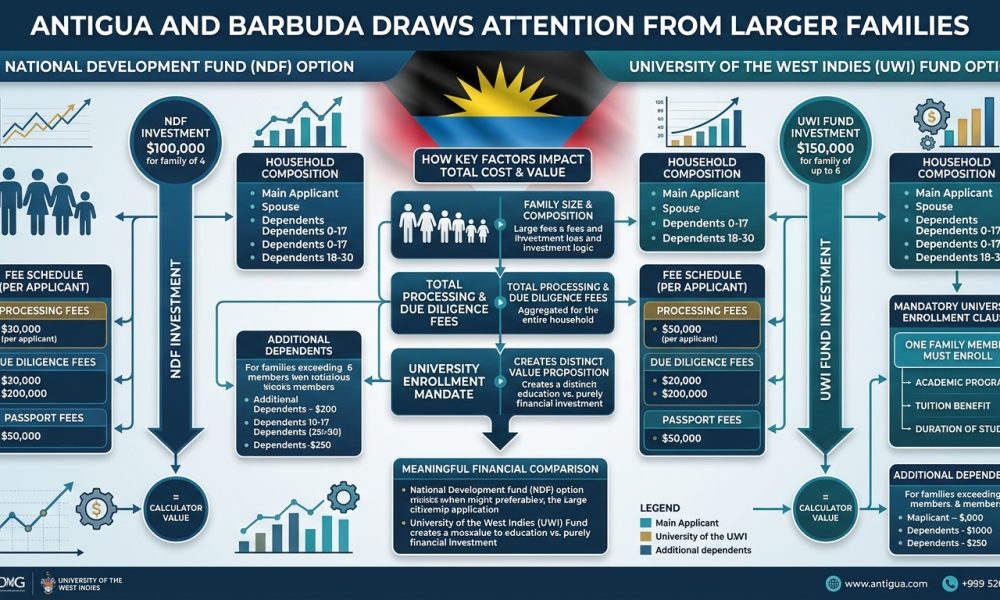
Antigua and Barbuda’s National Development Fund and University of the West Indies Fund offer distinct contribution arrangements for qualifying families, making household size, dependent eligibility, government screening, educational benefits, and the complete fee schedule essential considerations before applying.
WASHINGTON, DC, November 6, 2026 — Antigua and Barbuda’s citizenship-by-investment program continues to attract attention from internationally mobile families, particularly households comparing the National Development Fund with the University of the West Indies Fund and evaluating how different contribution structures affect overall costs.
For families with several children, aging parents, or other qualifying relatives, the distinction between the two government funds can matter financially because the advertised minimum contributions do not necessarily cover every screening, documentation, passport, or professional expense.
The comparison has become more consequential amid European Union pressure on Caribbean citizenship programs, adding uncertainty about future program operations and international travel privileges. At the same time, government approval and family eligibility requirements remain central to any lawful application.
Two Government Funds Offer Different Family Structures
Antigua and Barbuda currently identifies a US$230,000 minimum contribution to its National Development Fund. In comparison, its University of the West Indies Fund requires US$260,000 for an eligible application involving at least six family members.
The university contribution includes government processing fees for the qualifying six-person group. In contrast, the development fund has separate processing charges, making the advertised US$30,000 difference less meaningful until you review the full household calculation.
These options provide lawful routes for applicants who meet the government’s requirements, but neither creates an automatic entitlement to citizenship or exempts participating family members from the background checks and documentation rules established by the issuing authorities.
The National Development Fund Covers Different Household Sizes
Under the published National Development Fund schedule, a single applicant contributes US$230,000 and pays a separate US$10,000 processing fee. In comparison, a qualifying family of up to four pays the same contribution, plus US$20,000 in processing charges.
Larger households retain the US$230,000 contribution threshold but face additional processing expenses, making the number of included dependents important when calculating the full amount payable before citizenship documentation can be completed.
The government’s published fee language should be checked against the precise composition of each application, particularly where a family includes adult relatives whose eligibility and charges may differ from those applicable to minor children.
The University Fund Is Designed for Larger Families
The University of the West Indies Fund specifically requires a minimum of six persons in one qualifying application, distinguishing it from the National Development Fund, which accommodates individuals and smaller eligible family groups.
Its US$260,000 contribution includes processing fees for six participants, while the official program schedule lists an additional US$10,000 processing charge for each additional qualifying dependent beyond the initial group.
The minimum household-size requirement matters because a family of four cannot assume eligibility for the university option just because its contribution is affordable, and a larger family should compare the full terms before choosing.
A Family of Six Can Face Similar Base Costs
For an illustrative qualifying household of six, the National Development Fund’s US$230,000 contribution, combined with US$40,000 in government processing charges, totals US$270,000 before due diligence, passports, and professional expenses.
The corresponding University of the West Indies Fund contribution begins at US$260,000 inclusive of processing for those six individuals, creating a US$10,000 difference at that stage of the government fee comparison.
This illustration assumes that every relative qualifies and that the applicable processing schedule has been correctly applied, so it should not be mistaken for a final quotation or a guarantee of eligibility.
The University Fund Includes an Educational Benefit
The University of the West Indies Fund is intended to support the institution’s Five Islands Campus, connecting citizenship contributions with educational development while providing a benefit that does not exist in the same form under the National Development Fund.
According to the program’s official guidance, participation entitles one qualifying family member to a one-year scholarship covering tuition only at the University of the West Indies, subject to the relevant educational and program conditions.
Families should evaluate that benefit realistically because tuition coverage is different from guaranteed university admission, accommodation, transportation, meals, or a complete educational scholarship covering every expense associated with studying abroad.
Dependent Eligibility Determines Which Relatives Can Participate
Antigua and Barbuda’s citizenship framework allows certain spouses, children, parents, grandparents, and siblings to participate. Still, the applicable categories contain age, marital status, financial support, or other requirements that must be verified individually.
A household counting six relatives should not assume every family member qualifies automatically, especially when adult children are financially independent or older relatives cannot meet the relationship and dependency requirements under current regulations.
The practical starting point is to identify each proposed applicant, establish the documentary evidence supporting their inclusion, and calculate government charges only after confirming the appropriate category under the official rules.
Adult Children Can Change the Household Calculation
The program’s dependent provisions can accommodate qualifying children up to thirty years of age under specified circumstances, creating potential opportunities for families whose older children remain financially supported or continue their education.
However, the upper age limit should not be interpreted as an unconditional entitlement for every adult son or daughter, because eligibility depends on the applicable legal definition and supporting evidence.
Families should examine age, marital status, financial support, and any other relevant conditions before including adult children in the application, especially when those circumstances could change during government processing.
Parents and Grandparents Require Separate Evidence
Qualifying parents and grandparents aged fifty-five or older may qualify under relevant dependency provisions. Still, applicants must establish the required family relationship and demonstrate any required financial support or other conditions.
These requirements can create additional documentary work involving birth records, marriage certificates, financial evidence, and government Identification, particularly when several generations have lived in different countries for extended periods.
Older relatives may also have distinct medical, mobility, and settlement needs that should be evaluated independently from the citizenship application, especially when the ultimate objective involves relocating the entire family.
Brothers and Sisters Are Not Automatically Eligible
Antigua and Barbuda’s rules also contain provisions concerning certain unmarried siblings, which can distinguish its family categories from other citizenship programs that focus primarily on spouses, children, and older dependent parents.
The availability of a sibling category does not mean that every brother or sister qualifies, since applicable conditions and documentation requirements must be satisfied before the government can include that person.
Applicants should confirm the specific sibling provisions rather than counting all extended relatives toward the university fund’s six-person minimum without first establishing lawful eligibility under current rules.
Due Diligence Adds Meaningful Family Expenses
The government’s published due diligence schedule identifies US$8,500 for the principal applicant, US$5,000 for a spouse, US$2,000 for dependents aged twelve through seventeen, and US$4,000 for adult dependents.
Children aged eleven or younger generally do not incur the same published due diligence fee, showing why two six-person households can have different total costs even when their base contribution and processing charges match.
For example, two adults and four young children create a different screening calculation from two adults and four dependent relatives over eighteen, making household composition central to an accurate budget.
Passport Fees Apply to Each Approved Applicant
The official program schedule lists a US$300 passport fee per person, which you must include when calculating the eventual cost of obtaining travel documents for every qualifying family member after successful citizenship recognition.
A six-person application would therefore involve US$1,800 in passport charges under that published rate, in addition to the contribution, applicable due diligence, and any professional or documentary expenses.
The distinction between citizenship approval and passport issuance matters because contributing does not independently establish nationality or produce valid travel documents until the government completes its remaining procedures.
The Application Process Requires Government Screening
Applications must be submitted through licensed representatives, and the Citizenship by Investment Unit retains responsibility for examining the personal information, documentary evidence, financial background, and other conditions applicable to the proposed applicants.
The government identifies a range of potential ineligibility grounds, including false information, certain criminal matters, ongoing investigations, national security concerns, and specified adverse immigration histories requiring assessment under its regulations.
These requirements demonstrate why a family with sufficient money to meet the contribution threshold may still encounter additional investigation or refusal, regardless of the advertised convenience of either funding option.
Interviews Are Part of the Broader Review
Caribbean citizenship authorities have strengthened screening arrangements, including interview requirements intended to provide additional verification of applicant identities and other information material to the official decision.
Applicants should confirm which family members must participate, whether the current procedure permits virtual attendance, and what associated professional or administrative requirements apply before arranging travel or submitting their applications.
An advertisement describing a process as remote or convenient should not be interpreted as confirmation that personal interviews, government questioning, or independent background verification can be bypassed through a representative.
Payment Timing Should Be Understood Before Applying
Under the National Development Fund procedure, the government requires full due diligence fees and 10% of the processing fee at submission, with the remaining processing charges and the contribution payable after an approval letter.
The university fund also requires due diligence payments at submission. At the same time, the contribution and passport charges generally follow the relevant approval, creating a distinction between preliminary expenses and later financial commitments.
Families should review withdrawal and refusal provisions before transferring funds, especially because processing and investigation charges may be nonrefundable even when an application never reaches successful citizenship recognition.
The Program Includes a Physical Presence Obligation
Antigua and Barbuda’s citizenship requirements generally include spending at least five days in the country within the first five calendar years after obtaining citizenship, an obligation that can affect families living permanently elsewhere.
The government identifies failure to satisfy the applicable presence requirement as a potential ground for deprivation of citizenship, making the obligation more consequential than an optional vacation recommendation.
A large household should account for travel schedules, accommodation, transportation, and the circumstances of vulnerable relatives, rather than assuming the contribution amount covers every cost of maintaining citizenship.
European Pressure Creates New Planning Questions
An October 29, 2026, Reuters investigation into European pressure on Antigua and Barbuda’s citizenship program described negotiations over potential program closures and the importance of citizenship-related revenue to the country’s public finances.
The report explained that European officials were pressing five Eastern Caribbean governments to agree to phase out investor citizenship programs. At the same time, regional leaders emphasized the economic consequences and continued discussions over possible arrangements.
Applicants should distinguish those ongoing negotiations from a completed legislative closure. Still, they should also recognize that the future availability of programs and external visa-waiver privileges may change independently of their financial preferences.
Government Revenues Connect Citizenship to Public Priorities
The National Development Fund supports government development objectives. At the same time, the University of the West Indies Fund specifically links qualifying contributions to higher education, creating different public purposes behind the two financing arrangements.
For families, these distinctions may influence how they view the contribution, although neither government fund ordinarily provides a repayable financial asset or a contractual expectation of future investment income.
Citizenship applicants should evaluate the legal and financial terms rather than treat either contribution as a conventional investment, because the principal benefit sought is nationality recognized by the issuing government.
United States Applicants Retain Separate Obligations
The U.S. Department of State’s guidance on dual nationality explains that Americans generally retain applicable legal obligations after acquiring another nationality, including requirements to use American passports for entry and departure from the United States.
A Caribbean citizenship does not automatically eliminate federal tax responsibilities, establish an unrelated personal identity, or remove the customer-identification requirements that regulated financial institutions apply to individuals with multiple nationalities.
Families maintaining businesses, investments, trusts, or retirement accounts should obtain qualified advice before restructuring their affairs, particularly when relocating or acquiring property could create additional cross-border reporting and financial obligations.
Electronic Passport Checks Have Limited Legal Significance
Modern biometric passports include electronic chips and security data that compatible readers can examine. Still, a successful technical inspection does not, on its own, establish whether a family member met citizenship eligibility requirements.
Amicus International Consulting explains this distinction in its guide on how to scan a passport’s NFC chip and understand the results, which separates electronic authentication from government nationality decisions and administrative document status.
A passport that passes a technical check may still be expired or otherwise unsuitable for a journey, making accurate official records and current travel requirements more relevant than unsupported scanning claims.
Professional Quotations Should Be Itemized
Families comparing the two funds should request written estimates identifying the contribution, processing charges, dependent screening fees, passport costs, professional services, and expenses arising from international document collection or certification.
The quotation should explain whether family additions, documentary corrections, supplementary reviews, or government policy changes could generate further costs, while distinguishing payments due before approval from those payable after a favorable decision.
Transparent financial terms let families compare like-for-like costs without assuming a minimum contribution includes every service needed to obtain passports for all participating relatives.
A Second Citizenship Does Not Complete Relocation Planning
A qualifying Antigua and Barbuda passport can establish domestic nationality rights. Still, it does not automatically provide housing, healthcare coverage, school placements, or permanent immigration permission in unrelated countries that offer only short-term visitor access.
Larger households may face substantial settlement costs after nationality recognition, especially when several children require education or older relatives need medical care and accessible accommodation in an unfamiliar environment.
Applicants should therefore preserve sufficient funds for their intended lifestyle rather than directing every available resource toward a citizenship contribution and associated government fees.
A Complete Family Comparison Should Begin With Eligibility
Antigua and Barbuda’s National Development Fund and University of the West Indies Fund provide different contribution structures. Still, the financially appropriate comparison depends on household size, dependent eligibility, individual screening charges, and educational objectives.
For a qualifying larger family, the university route may offer a lower combined contribution and processing amount. At the same time, the development fund remains available to smaller households and applicants whose circumstances do not meet the university option’s minimum size.
Ultimately, Antigua and Barbuda draws attention from larger families because the two funding routes offer distinct financial structures, and a dependable decision requires verified eligibility, complete government fees, and realistic expectations about citizenship approval and international mobility.




