
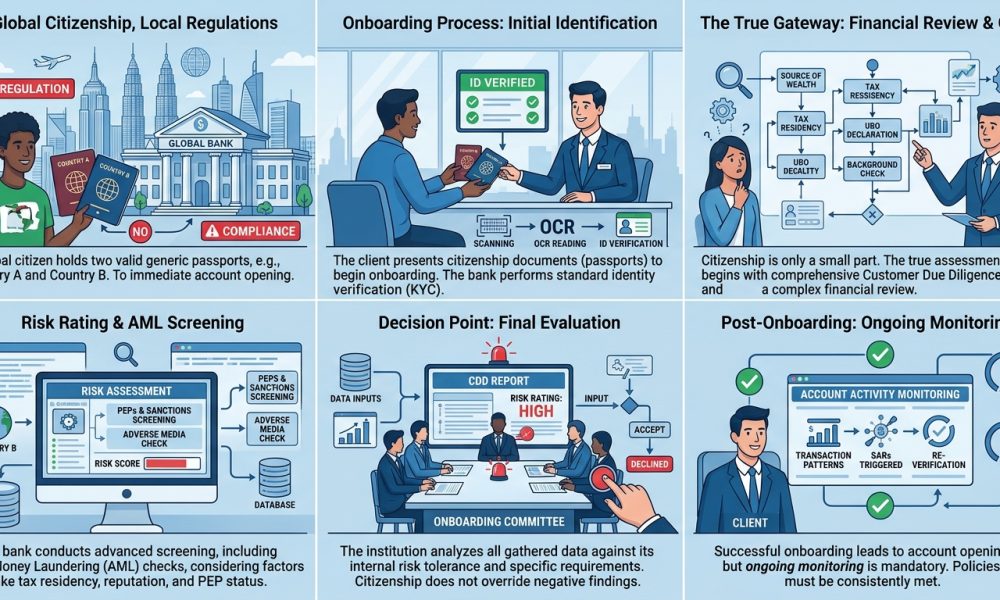
Financial institutions assess applications under their own requirements, and citizenship documents are only one part of the Information considered during onboarding.
Washington, DC, October 26, 2026 — A second passport can provide additional evidence of nationality and identity, but obtaining one does not guarantee that an overseas financial institution will approve an account or provide the services an applicant expects. Reviews examine applications under the rules governing their operations and the requirements of the proposed relationship, making citizenship documentation one component of a broader assessment that can include residence, tax Information, account purpose, and financial Background.
For individuals considering another nationality partly for banking access, the key distinction is between having an acceptable Identification document and meeting the institution’s requirements for a particular account, transaction profile, and intended use of its services.
A practical assessment should therefore start with the banking need and the institution’s current criteria, allowing applicants to determine whether a proposed citizenship arrangement addresses a genuine documentary issue or merely accompanies an unverified promise.
Define the Account Before Evaluating the Passport
The term offshore account generally describes banking outside a person’s home jurisdiction, but applicants should identify the actual institution, location, and account type rather than treat overseas banking as a single product with uniform eligibility requirements.
An everyday payment account, investment account, and private banking relationship can involve different services and commercial term. Hence,o it helps to establish what the applicant needs before discussing whether another passport would support the Application.
The review should address intended currencies, incoming payments, transfer destinations, and access requirements, helping the applicant assess whether the proposed account would serve its purpose even if the institution agrees to establish the requested relationship.
A proposal that identifies only a country or general banking destination leaves important questions unanswered, particularly if the applicant has not received confirmation about the account’s permitted activities, charges or availability to someone with their actual circumstances.
Identification Acceptance Is Different From Account Approval
A bank may accept a passport as evidence of identity while still requiring other Information before making an account-opening decision, meaning that confirmation of document acceptance should not be presented as approval of the complete Application.
The Hong Kong Monetary Authority’s guidance on account opening and maintenance explains that banks conduct customer due diligence and may have different account-opening requirements, illustrating why applicants should examine the chosen institution’s procedures rather than assume uniform acceptance.
Applicants should ask what remains outstanding after Identification is checked, distinguishing verification of the person from the proposed relationship and any further documentation needed before the bank communicates its decision on the Application.
A complete passport does not necessarily establish a current residential address or explain expected account activity, so the preparation process should identify each fact the bank needs and the appropriate evidence supporting it in the applicant’s circumstances.
Residence and Nationality Should Be Described Accurately
Applicants should distinguish between their citizenship and where they actually live, because the passport’s issuing country does not necessarily reflect the person’s residence or the practical circumstances behind the financial relationship they wish to establish.
The institution’s Application should be completed according to its actual questions, with supporting records used to explain the relevant facts rather than selecting whichever address or nationality appears most likely to simplify the account-opening process for the applicant.
If an applicant lives between countries or is preparing to relocate, the position should be explained clearly, and the bank should ask what evidence it requires, avoiding the assumption that an intended future address can automatically replace the current situation.
Where names differ across documents, legitimate records should explain the connection, allowing the institution to assess identity consistently without treating a second passport as evidence that the person’s earlier records or existing financial relationships are unrelated.
Tax Residence Requires Its Own Assessment
The Organisation for Economic Co-operation and Development explains that citizenship or permission to reside in a country does not automatically establish tax residence there or terminate tax residence elsewhere, a distinction relevant when completing financial account documentation.
Its guidance also recognizes that a person can be tax resident in more than one jurisdiction and addresses disclosure through the self-certification required under the Common Reporting Standard, making the underlying tax position more important than passport selection.
Applicants uncertain about their position should obtainadvice basedd on the applicable rules and their actual circumstances, rather than assume that obtaining another nationality providesfull answerss about residence, reportin,g ortaxpayer identificationn numbers.
The Information supplied to the bank should reflect that assessment, with clarification sought if the form does not easily accommodate the circumstances, rather than resolving uncertainty by omitting a jurisdiction or supplying an unsupported description.
American Obligations Can Continue Across Borders
For American citizens considering an overseas account, another nationality does not resolve obligations tied to maintaining United States citizenship, so tax and reporting advice is a separate part of the planning process rather than an assumed passport benefit.
The Internal Revenue Service explains that American citizens abroad generally remain subject to worldwide income rules and that certain foreign financial accounts can trigger reporting requirements, depending on the applicable conditions and thresholds for the taxpayer concerned.
Applicants should therefore ask which obligations arise from opening and using the proposed account, distinguishing any Information collected by the institution from filings the individual may need to make directly with the relevant American authorities themselves.
Where citizenship, residence, or financial arrangements change together, the advice should address the combined circumstances and relevant dates, ensuring the banking plan rests on an accurate assessment rather than a general claim about foreign accounts.
Financial Background Can Require Supporting Evidence
A bank’s review may involve questions about the origin of an intended deposit and the activities that generated the applicant’s broader wealth, making financial records relevant even when the institution has already accepted the passport for Identification.
The United Kingdom’s Financial Conduct Authority distinguishes source of funds from source of wealth, explaining that the former concerns the origin of money involved in the relationship while the latter addresses how overall wealth was acquired.
For applicants, these questions may require different explanations, such as documentation of a specific asset sale alongside records showing a longer employment or business history, with the institution’s instructions determining what evidence is appropriate for its review.
When a transaction involves several steps, applicants should provide an accurate account supported by genuine records and seek clarification about missing evidence rather than assuming a transfer from an existing bank answers every question about the money’s origin.
Faster Service Does Not Eliminate Due Diligence
In July 2025, Reuters reported Singapore’s efforts to shorten private bank account-opening times, describing an initiative to improve efficiency while maintaining standards, a useful example of how streamlined administration can coexist with continuing scrutiny of prospective banking relationships.
That report does not set a processing deadline for any individual applicant. Still, it shows why a claim of faster service should be examined separately from a claim that checks have been removed or acceptance is assured.
Applicants should ask when a quoted period begins and which stage it covers, distinguishing an introductory appointment or preliminary review from the institution’s final decision and any additional steps needed before the account can be used.
Travel plans, major transfers and other commitments should reflect the actual stage reached, particularly when an adviser’s projected timetable depends on requests or decisions that remain with the bank rather than within the adviser’s control.
An Introduction Service Has a Limited Role
An intermediary may help prepare documents and arrange communication. Still, the applicant should clarify what the service includes and independently confirm any claimed relationship with the bank through the institution’s official contact channels.
The contract should distinguish assistance with an Application from a commitment about the bank’s decision, and explain what happens if the bank requests additional Information, the proposed account is unavailable, or the institution declines to proceed with onboarding.
Any statement that an account is preapproved should identify the source, scope, and remaining conditions, allowing the applicant to determine whether the term describes a meaningful institutional decision or only a provider’s preliminary view of suitability.
Professional fees should also be separated from funds intended for the account, with clear payment instructions and refund terms so applicants understand which amounts purchase advisory work and which amounts remain their own banking assets.
Additional Structures Bring Additional Documentation Questions
When the intended account holder is a company, trust, or other arrangement, one individual’s passport may address only part of the review, so applicants must establish which records the institution requires for that structure.
Applicants should ask how the bank iidentifiidentifies ownership ,and sig, ng Authority under the aapplicabapplicable rulessuand ensure thes ereflecttreflect thelationrelationship rather than that an entity’s existence removes the need to identify relevant individuals.
A person authorized to operate an account may have a different role from an owner, trustee, or beneficiary, so the preparation process should describe those roles accurately and seek advice where the governing documents create uncertainty about their effect.
The arrangement should also fit the intended financial activity, with legal and tax advice obtained where appropriate, rather than treating a corporate or trust account as a universal substitute for an unapproved personal account.
Family Records Require Careful Handling
When account preparation involves spouses, children, or other relatives, applicants should establish whoseInformationn is required and why, especially when a shared document contains identifying details about people who are not applying for the proposed account.
Amicus International Consulting’s article on parental photographs in Mexico’s children’s passports describes the family Information included in those documents, illustrating why a passport copy can disclose more than the identity of the child named as its holder.
Families should use verified submission channels and ask about the institution’s requirements before sending extensive records. They should avoid unauthorized alterations to documents the bank needs to examine in a complete, reliable form during verification.
Where a minor’s account is proposed, the review should distinguish Identification of the child from evidence of the adult’s Authority, ensuring that the documents address the specific relationship and permissions required by the institution offering the product.
A Refusal Can Require Clarification or Review
If an Application is declined, the applicant should distinguish a final refusal from a request for missing Information and ask about available review procedures, rather than assume that obtaining another passport is the appropriate response.
Hong Kong Monetary Authority guidance states that banks generally should explain account-opening refusals and maintain review mechanisms, providing a jurisdiction-specific example of how an unsuccessful applicant may seek reconsideration rather than regard the initial response as unreviewable.
Any further submission should address the identified issue and remain factually consistent, allowing the institution to evaluate corrected or additional evidence without creating new discrepancies about identity, residence, or the intended use of the account.
Where the applicant believes applicable access rights or consumer protections have been overlooked, advice should focus on the relevant jurisdiction and product, since the available complaint or review route cannot be assumed to operate identically across countries.
Approval Begins an Ongoing Banking Relationship
FinCEN’s customer due diligence guidance describes ongoing monitoring and risk-based updates to customer Information, illustrating why opening an account does not necessarily end the institution’s need to understand the customer and the activities conducted through the relationship.
Customers should ask what updates are required when nationality, residence, Identification documents, or account use changes, keeping the institution’s records accurate rather than assuming the original Application remains sufficient as their circumstances change.
Before pursuing another passport for banking purposes, applicants should identify the precise obstacle it is expected to address and verify that point with the intended institution, separating a genuine documentary need from a broader promise of guaranteed access.
A second passport may contribute to an overseas banking Application. Still, a dependable plan also accounts for the institution’s requirements, the applicant’s financial circumstances, and ongoing obligations, so decisions rest on verified conditions rather than the document alone.




