
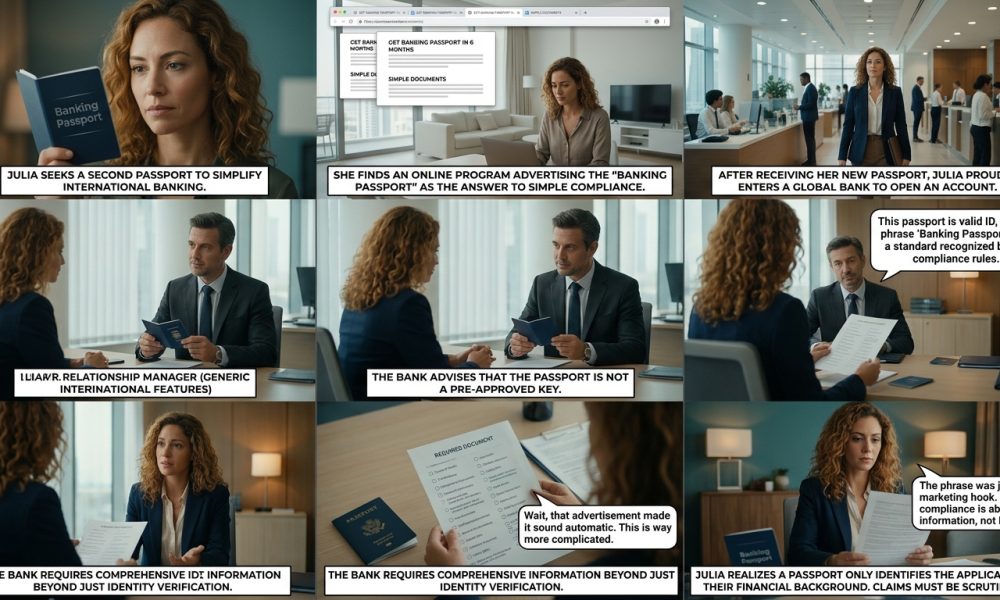
The phrase can blur the distinction between a passport used for Identification and the broader Information a bank considers when reviewing an applicant.
Washington, DC, October 26, 2026 — The phrase “banking passport” can suggest that acquiring a particular travel document provides a straightforward route to financial services. Still, applicants need to distinguish Identification evidence from the broader requirements involved in establishing a banking relationship.
A passport may help a financial institution verify identity and nationality. At the same time, questions about residence, tax status, account purpose, and the origin of funds require separate answers that the document itself cannot necessarily establish.
Official banking guidance illustrates that distinction by describing Identification and customer due diligence as related processes, making a passport different from account approval or confirmation that all requested Information has been supplied.
For individuals evaluating citizenship or banking services, the practical task is therefore to examine what a proposed document establishes, what the intended institution requires, and whether the service provider’s claims accurately describe the bank’s independent assessment process.
Clarify What the Phrase Actually Means
When a provider uses the term “banking passport,” applicants should ask whether it refers simply to an ordinary national passport intended for Identification or whether the provider claims additional recognition that requires independent verification.
The explanation should identify the issuing country, the lawful basis for obtaining the document, and the proposed banking use, so the applicant can evaluate the specific facts rather than rely on a label whose meaning remains undefined.
A provider should also distinguish assistance with citizenship or passport applications from assistance with opening an account, because those services involve different institutions and decisions that should not be presented as a single guaranteed outcome for the client.
When a claim refers to special acceptance by financial institutions, the applicant should request confirmation from the intended bank to ensure the statement reflects the actual account and applicant circumstances rather than a general account of earlier experience.
Identification Involves More Than Showing a Passport
American customer Identification guidance describes requirements involving a customer’s name, date of birth, address, and Identification number, illustrating that a passport alone may not provide everything needed to establish an individual’s identity for account-opening purposes.
The Identification evidence accepted depends on the applicable rules and the institution’s procedures, so applicants should obtain instructions from the bank rather than assume the same document package will satisfy every institution in every jurisdiction.
A passport may provide reliable Information about its holder without establishing a current residential address, so applicants should distinguish the facts shown in the document from additional facts the bank asks them to substantiate.
The applicant should therefore request a checklist for the intended account and submission method, identifying which documents must be current, whether copies require certification, and how the institution will verify Information supplied through a remote Application.
Nationality Does Not Automatically Determine Tax Residence
The OECD’s guidance on tax residence explains that holding citizenship or a right of residence does not automatically establish tax residence in that jurisdiction or extinguish tax residence elsewhere, a distinction directly relevant to claims about banking through another passport.
The same guidance recognizes that an individual can be tax resident in more than one jurisdiction. It addresses disclosure of tax residences through the self-certification required under the Common Reporting Standard, rather than selecting a preferred passport country.
Applicants should seek advice on their actual circumstances where uncertainty exists, considering the relevant domestic rules and any applicable treaty provisions, rather than assuming a citizenship certificate settles every question on a bank’s tax forms.
When completing those forms, the objective should be an accurate account of the person’s tax position, with clarification sought from the institution or a qualified adviser if the requested Information does not fit neatly into the available fields.
American Tax Status Requires Separate Attention
Applicants with American citizenship or another relevant United States tax connection should ask which documentation the institution requires, rather than assume that presenting a foreign passport determines whether American tax-reporting rules apply to the proposed account relationship.
Internal Revenue Service instructions for Form W-9 describe its use in obtaining taxpayer Identification and certification Information, showing that tax documentation serves a different purpose than a passport used to establish identity during a bank’s review.
The appropriate forms depend on the person’s actual status and the institution’s obligations, so professional advice helps when citizenship, residence, or other circumstances create uncertainty about how the applicant should complete the requested certification accurately and consistently.
Acquiring another nationality should prompt a review of relevant records rather than assuming earlier tax Information can be disregarded, especially since financial institutions ask customers to confirm whether previously supplied details remain correct.
The Bank Considers the Intended Relationship
Customer due diligence extends beyond Identification to understanding the nature and purpose of the relationship, and American supervisory guidance explains that this can include considering the transactions in which the customer is likely to engage.
An applicant should therefore be prepared to explain whether the account will support everyday expenses, salary payments, investment activity, or another legitimate purpose, giving the institution Information that reflects how the account is expected to operate.
Where the proposed activity involves business receipts, the applicant should ask whether a personal account is appropriate or whether the institution requires a separate business relationship, rather than assume that acceptance of Identification resolves the product’s permitted use.
The applicant should ask these questions before committing funds to an introduction service, so they can determine whether the bank offers an account suited to the intended activity and whether further evidence will be needed during review.
Source of Funds and Source of Wealth Are Distinct
Official anti-money-laundering guidance distinguishes the origin of funds used for a particular transaction from the activities that generated a person’s broader wealth, making these separate questions that a passport cannot answer simply by identifying its holder.
For example, money intended for an initial deposit may originate from a property sale. At the same time, the person’s overall financial position may reflect years of employment or business ownership, requiring explanations that address the particular question being asked.
Applicants should follow the institution’s instructions on supporting evidence and provide genuine records that explain the relevant transaction or financial history, rather than assume that a transfer from another bank shows how the money was originally obtained.
If the available records require explanation, the applicant should address the gap directly with the bank or qualified adviser, allowing the institution to assess the circumstances without relying on reconstructed narratives or documents that inaccurately describe the underlying activity.
Regulatory Reviews Show Why Broader Checks Matter
In July 2025, Reuters reported penalties against nine Singapore financial institutions following a major money-laundering case, illustrating the regulatory focus on customer review and monitoring rather than simply whether an institution collected a passport at account opening.
That historical example should not be interpreted as a Judgment about every foreign applicant or dual national. Still, it demonstrates why a bank’s responsibilities can extend beyond receiving apparently valid Identification from the person seeking financial services.
Applicants evaluating a banking proposal should therefore ask how the expected due diligence will be handled, including who communicates requests and whether the service provider’s preparation work addresses the Information the bank actually needs for its assessment.
A complete submission can support an orderly review. Still, the applicant should distinguish readiness for assessment from approval, ensuring that commercial promises do not replace the institution’s own decision about the proposed relationship and supporting evidence.
An Adviser’s Introduction Does Not Establish Acceptance
A banking intermediary may assist with communication and document preparation. Still, applicants should clarify the precise service being purchased and whether the institution has independently confirmed any claimed relationship with the intermediary arranging the introduction.
The engagement should identify the proposed bank and account type where those are known, while explaining what happens if the institution requests further Information, declines the Application, or offers terms that differ from those initially discussed.
Any statement that an account is preapproved should be examined for its conditions and source, allowing the applicant to distinguish an initial indication of interest from a final decision based on completed Identification and due diligence.
Separate fees from any intended account deposit, and clearly document payment recipients and refund conditions so the applicant understands which money compensates the adviser and which funds remain subject to the bank’s own procedures.
Companies and Trusts Add Further Questions
Where an account will be held through a company, trust, or another arrangement, one individual’s passport may address only part of the required review, so the institution must establish which people and entities it must assess.
The applicant should ask what ownership, control, and Authority records the relevant framework requires, and avoid assuming that a legal entity removes the need to identify the individuals whose roles matter to the proposed banking relationship.
Documents authorizing someone to sign for an account should also be distinguished from documents establishing ownership or another legal interest, because the institution may need to understand several different relationships before deciding whether its requirements have been satisfied.
Advice should reflect the actual structure and applicable jurisdiction, and the bank’s current instructions should be checked directly rather than relying on generic claims that a particular arrangement guarantees privacy, eliminates disclosure requirements, or ensures acceptance by financial institutions abroad.
Family Documents Can Contain Information About Several People
Applicants sharing passport copies should consider the Information throughout the document, especially when family members are involved, because a record used to identify one person may also disclose details about parents, guardians, or other individuals.
Amicus International Consulting’s article on parental photographs in Mexico’s children’s passports explains that those documents include family Identification Information, illustrating why copies should be handled with care for the people whose details appear in the material being transmitted.
When a bank requests documentation for a minor’s account, the family should clarify which records establish the child’s identity and which establish the adult’s Authority, ensuring the submission meets the account’s actual requirements.
Provide documents through verified channels and follow the institution’s instructions, and seek clarification before omitting or obscuring Information rather than assuming an altered copy will satisfy the bank’s verification procedures for the Application.
Account Opening Does Not End Customer Review
FinCEN guidance describes ongoing customer due diligence, including monitoring and risk-based updates to customer Information, showing that opening an account does not necessarily end the institution’s need to understand the relationship and its activity.
A customer who acquires another nationality, changes residence, or renews Identification should ask what updates the bank requires, keeping records aligned with current circumstances instead of treating the original account-opening documents as sufficient indefinitely for every purpose.
Requests for updated Information should be assessed through verified banking contacts, allowing the customer to distinguish legitimate review from fraudulent messages while responding accurately to the institution’s requirements within the instructions and deadlines actually communicated to them.
The same approach applies when account activity changes substantially, since an explanation consistent with the customer’s current circumstances can help the institution understand developments that were not part of the original description supplied when the relationship began.
Evaluate the Account Requirements Before Buying a Promise
Before paying for a service described as providing a “banking passport,” applicants should obtain a clear explanation of the document, the legal pathway involved, and the separate banking assistance offered, identifying which outcomes remain subject to independent institutional decisions.
The intended bank’s requirements should then be assessed against the applicant’s real circumstances, including Identification, residence, tax Information, and expected account use, so that any proposed citizenship or documentation work addresses a verified need rather than an unsupported claim.
A written proposal should distinguish document acceptance from account approval and continued account access, helping applicants evaluate the service on terms that reflect the institution’s actual review instead of suggesting that one passport settles every relevant question.
A passport can be important evidence within a banking Application. Still, a dependable plan recognizes the broader relationship being assessed, allowing applicants to prepare accurate records and realistic expectations before entrusting funds or personal Information to an intermediary.




