
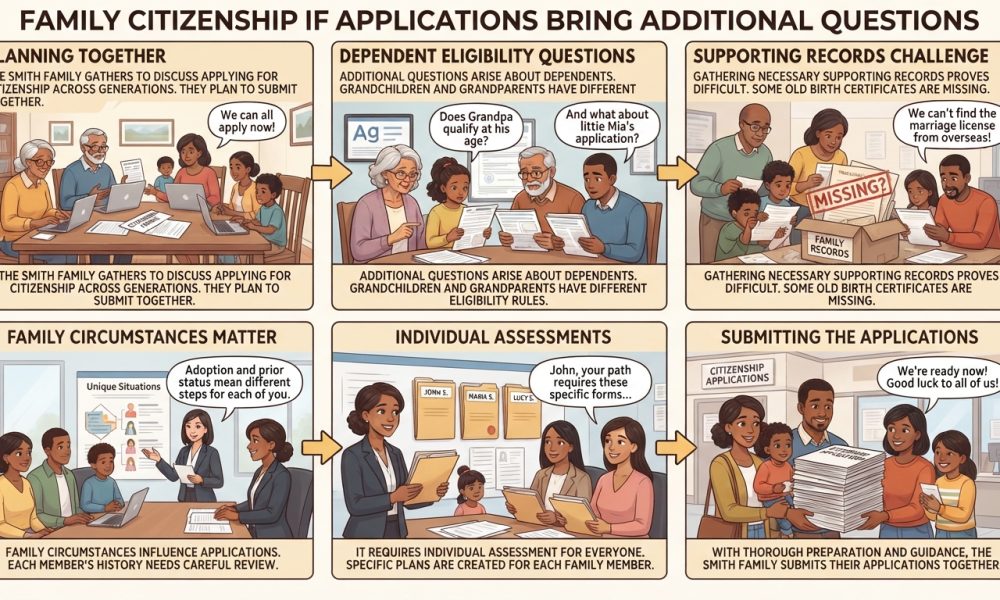
Dependent eligibility, supporting records, and family circumstances can affect an Application, so individual assessment matters when planning across generations.
Washington, DC, October 26, 2026 — Family citizenship planning requires an individual assessment of each proposed applicant because a parent’s eligibility, a shared household, or a financial relationship does not necessarily mean every relative qualifies through the same legal pathway.
For households considering another nationality, practical questions extend beyond the principal applicant’s circumstances to include children’s existing status, adult dependants, parental Authority, and the records needed to accurately establish relationships across countries and generations.
Official guidance shows that family members can follow different processes even when they apply together, so it’s important to distinguish automatic citizenship, registration, naturalization, and inclusion as a qualifying dependant before discussing costs or expected completion dates.
A useful family assessment therefore identifies each person’s legal basis, supporting evidence, and any unresolved conditions, so the household can decide based on verified eligibility rather than assumptions about collective approval.
Begin With Each Person’s Existing Status
First, establish whether a family member already holds the nationality being considered, since proving existing citizenship involves a different question than asking a government to grant citizenship through a new Application.
Children born before and after a parent acquired citizenship may need different assessments. At the same time, birthplace and the legal basis of the parent’s nationality can also matter when determining whether citizenship passed automatically to the next generation.
British guidance, for example, distinguishes children who may already be citizens from those needing registration, showing why a family should examine the circumstances surrounding each birth rather than infer identical status from a shared surname or household.
An initial family record should therefore include relevant birth details, parental nationality histories and existing certificates, providing the Information needed to determine which relatives require an Application and which may instead need proof of a status already acquired.
Applying Together Does Not Remove Individual Requirements
A family may coordinate preparation and submission while still needing separate applications or assessments, so administrative convenience should not be confused with a legal rule that lets one successful Application establish citizenship for every relative.
The United Kingdom’s guidance on applying for children’s citizenship tells parents that children require separate applications where registration is necessary, illustrating why a parent’s naturalization process should not be assumed to include a child automatically within the same decision.
Canadian guidance likewise distinguishes citizenship processes for minors based on whether they have a Canadian parent or a parent applying at the same time, showing how the parent’s position can influence the appropriate route without eliminating the child’s requirements.
A written assessment should clearly identify those connections, explain whether an Application depends on another family member’s status, and what happens if applications proceed at different speeds or one person needs additional evidence before a decision.
The Particular Route defines Dependent Eligibility.
Check the word dependant against the rules of the proposed citizenship pathway, because ordinary family financial support does not necessarily match the legal definition used by the Authority assessing an Application.
Some investment citizenship routes expressly identify eligible relatives. At the same time, other nationality pathways rely on birth, descent, or individual naturalization requirements, so transferring a dependant definition from one program to another without checking its legal basis is inappropriate.
Current St. Kitts and Nevis Citizenship Unit guidance, for example, describes circumstances in which adult children attending recognized educational institutions may qualify, linking eligibility to conditions concerning age, education and support rather than family relationship alone.
Families should therefore ask which relatives the chosen route recognizes and what evidence establishes each condition, ensuring that a proposal covering several generations identifies the actual basis for including every person rather than relying on a general family label.
Adult Children Need More Than a Birth Certificate
For an adult child seeking inclusion as a dependent, proof of parentage may establish the relationship without resolving additional questions about education, financial support, or other conditions the relevant program applies to that applicant category.
The preparation review should clarify whether enrollment records, attendance evidence, or documentation of support is required, so the family can obtain the right records rather than assume a general statement about university study will suffice.
When a child is approaching a relevant age threshold, the family should ask which date determines eligibility and whether the rules address changes during processing, rather than assume the date of an initial consultation preserves the child’s position.
If the adult child does not qualify through the proposed dependant category, advisers should assess any available independent pathway on its own terms, rather than imply that financial support can overcome a condition the applicant does not satisfy.
Older Relatives Require Their Own Assessment
Parents and grandparents should be assessed individually when included in a family citizenship proposal, with the review identifying whether the particular route recognizes that relationship and whether age, dependency or other conditions apply to the proposed applicant.
Families should ask what evidence is required to demonstrate financial support or dependency, where relevant, and distinguish regular assistance from the specific legal test, rather than assuming that paying occasional expenses automatically establishes eligibility under the program’s rules.
An older relative’s practical needs should also inform the preparation plan, including access to records, help with forms, and any required appointments, so the family understands how to complete the application without relying on unconfirmed exemptions.
Where inclusion is unavailable, the household should examine separate residence or citizenship options without presenting them as equivalent, ensuring that any alternative arrangement supports the relative’s actual plans for living with or visiting other family members abroad.
Consent and Authority Need Early Attention
Applications involving minors require an assessment of who has Authority to act for the child, particularly when parents are separated, a guardian is involved, or an existing court order affects decisions about the child’s circumstances and documentation.
British nationality guidance addresses parental responsibility and consent in children’s registration cases, illustrating why the adult preparing an Application should establish the applicable requirements rather than assume that being the child’s everyday caregiver resolves every procedural question.
Families should seek advice on relevant orders and consent requirements before submission, especially where disagreement exists, because permission connected with a passport, citizenship Application, or international relocation may raise different questions under the laws governing the situation.
If you cannot obtain a required signature or record, ask about the available lawful procedure, allowing the Authority or qualified counsel to explain what evidence or determination may be needed instead.
Adoption and Guardianship Raise Distinct Questions
Adoption, guardianship and other caregiving arrangements should be described accurately in the Application, because each relationship may have a different legal effect and should not be treated as interchangeable merely because the adults provide the child’s daily care.
Canadian guidance on intercountry adoption distinguishes the adoption process from the citizenship or immigration process, showing why completing one stage does not necessarily meet every requirement to establish the child’s status and ability to relocate.
The assessment should identify which Authority issued the relevant decision, whether the receiving country recognizes its legal effect, and any additional requirements, before the family assumes the document establishes eligibility for the proposed citizenship route.
Where records are incomplete or legal parentage is uncertain, specialist advice can help identify the correct procedure. At the same time, the Application should preserve the actual circumstances rather than simplify a complex family arrangement into a description unsupported by official evidence.
Family Records Must Tell a Consistent Story
A family Application can involve records issued across several jurisdictions and generations, so review names, dates, and relationships together before submission rather than assess each document in isolation from the others supporting the same claim.
Birth certificates, marriage records, adoption decisions and lawful name-change documents may help explain how relatives are connected, while the Authority’s instructions determine which records are required and whether translations, certified copies or Authentication must accompany them.
Differences arising from transliteration or national naming conventions should be explained through appropriate evidence, allowing the reviewing Authority to understand the connection without requiring the family to alter genuine historical facts or disregard discrepancies that deserve attention.
A document register can identify who holds each original, which Authority issued it, and what preparation remains necessary, helping the family coordinate requests without repeatedly obtaining the same record or sending irreplaceable documents without a clear purpose.
Generational Planning Depends on Dates and Current Law
Families planning beyond the immediate applicants should examine how citizenship can pass to future children, because eligibility for one generation does not necessarily establish an unrestricted ability to transmit the same nationality to every subsequent generation born abroad.
Irish Foreign Birth Registration guidance highlights the importance of timing, explaining that when transmission depends on a parent’s registration, completing that registration after a child’s birth does not provide the same basis as completing it beforehand.
Canada’s government also introduced changes affecting citizenship by descent in December 2025, including a substantial-connection requirement in specified circumstances for children born abroad to Canadian parents who were themselves born or adopted outside the country.
These examples support a date-specific assessment for each generation, with advisers identifying the governing provisions and relevant events rather than relying on older family experience or assuming a rule that applied to one relative remains unchanged.
Assumptions About Birthplace Can Delay Recognition of a Problem
In January 2026, The Guardian reported on a British-born man’s prolonged citizenship difficulties, reminding families to establish nationality through the applicable law and records before relying on assumptions when preparing important plans.
The practical lesson is to examine a child’s position before a passport Application, education decision, or relocation makes the question urgent, allowing time to identify whether existing citizenship needs documentation or a separate Application must be considered.
Parents should also avoid treating one sibling’s successful Application as a complete answer for another, since differences in birth dates, birthplaces, or parental circumstances may change the relevant analysis even within a closely connected family household.
When uncertainty remains, a written explanation from qualified counsel or the responsible Authority can clarify the next step, giving the family a reliable basis for planning instead of letting an unresolved assumption persist through later generations.
Citizenship Approval and Travel Preparation Remain Separate
A family’s citizenship planning should distinguish between acquiring or confirming nationality and obtaining passports and preparing for travel, because each stage may require different evidence and may not be completed at the same time for every household member.
Amicus International Consulting’s article on parental photographs in Mexico’s children’s passports explains how family Identification features support verification, while consent and supporting records remain essential, showing why a passport alone does not answer every question about a child’s international journey.
Before making travel arrangements, families should confirm which documents each person needs and whether differences in citizenship or names affect the itinerary, ensuring the household’s departure plan reflects the documents available for use.
A parent’s completed passport should therefore be treated as one confirmed milestone rather than proof that the whole family can depart, with unresolved applications, consent questions and destination requirements reviewed before nonrefundable commitments are made for everyone.
Coordinate the Family Plan Without Losing Individual Detail
A complete family assessment should identify each person’s pathway, supporting evidence and outstanding conditions, allowing shared preparation to proceed efficiently while preserving the individual legal analysis needed for children, adult dependants and older relatives across the household.
The cost estimate should also include charges for shared professional work. At the same time, the timetable should identify dependencies rather than promise that all decisions and documents will arrive together simply because the family applied together.
Changes such as marriage, separation, a new birth, or altered dependency circumstances should prompt a review of the relevant reporting requirements, ensuring the applications continue to reflect current facts throughout the period officials assess them.
Family citizenship planning becomes more dependable when collective goals are supported by individual eligibility findings, giving each generation a clear understanding of the status sought, the records required, and the remaining steps before the household can proceed confidently.




