
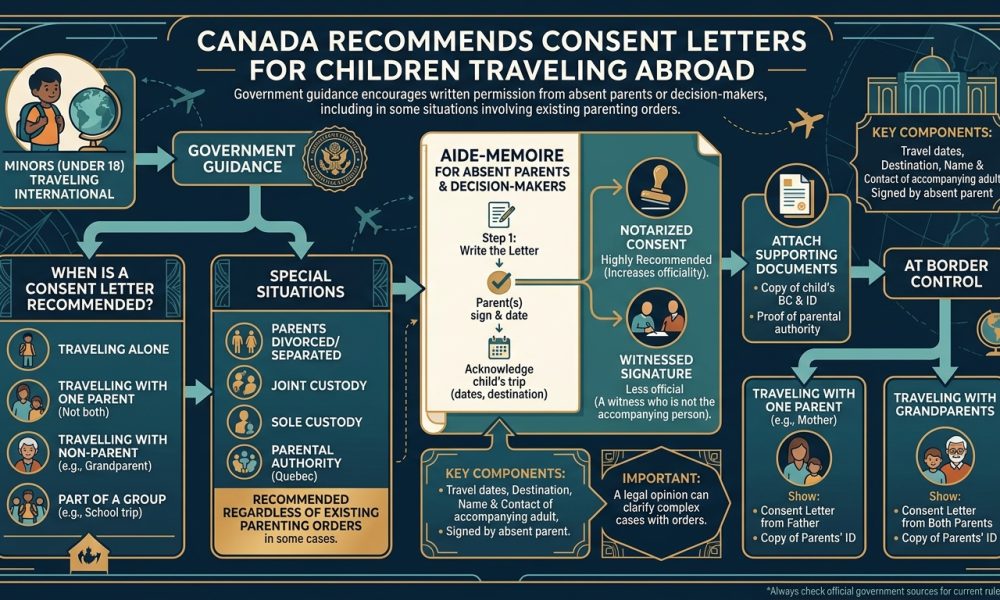
Government guidance encourages written permission from absent parents or decision-makers, including in some situations involving existing parenting orders.
WASHINGTON, DC, October 15, 2026 — Canadian families traveling internationally with children are encouraged to carry written permission from parents or other individuals with decision-making responsibility who are not accompanying the journey, even when an existing parenting order allows one parent to make travel decisions independently.
The Government of Canada’s updated guidance, published February 11, 2026, confirms that Canadian law does not universally require a parental travel consent letter. Still, immigration authorities, airline representatives, and border officials may request evidence that an international journey has been authorized.
The recommendation extends beyond traditional custody arrangements, recognizing that married, separated, divorced, and unmarried parents may retain legal responsibilities affecting their children’s international movement, regardless of which adult physically accompanies the child.
Canadian authorities also emphasize that consent letters can remain useful when parenting orders already address international travel, because border officials may not immediately understand the legal implications of a family court decision issued in another jurisdiction.
For Canadian-American families, internationally mobile households, and parents navigating shared parenting arrangements, understanding these distinctions can reduce border delays while preserving the legal safeguards intended to prevent unauthorized international child removal.
Canada Recommends Consent Letters Rather Than Universally Requiring Them
Canada’s parental travel consent framework differs from countries that impose mandatory government-issued exit permits or notarized departure authorizations on specified categories of children traveling without their legally responsible adults.
According to the Government of Canada’s official guidance on consent letters for children traveling abroad, Canadian law does not require a consent letter. However, officials may request one during international travel.
Canadian authorities recommend that children traveling without one or both parents, or another person with decision-making responsibility, carry a signed declaration identifying the adults who authorized the journey.
The recommendation reflects practical concerns about child Protection and Identification, not a requirement that every absent parent obtain a government permit before allowing a child to leave Canada.
However, a foreign destination may impose legally binding documentation requirements, so it’s essential to distinguish Canada’s recommendation from the entry and departure regulations of other countries.
A Consent Letter Demonstrates Permission for International Travel
A child travel consent letter is a written declaration confirming that an individual who possesses parental authority or decision-making responsibility has agreed to the child’s proposed international journey.
The document generally identifies the child, the adults authorized to approve travel, the person accompanying the minor, and the trip’s intended destination and duration.
Canadian authorities recommend the letter because immigration and airline personnel may need to establish whether a child traveling with only one parent or another adult has permission from absent decision-makers.
Although a properly prepared letter can help resolve questions, it does not automatically establish the accompanying adult’s custody rights or override legal restrictions imposed through an existing court order.
The document is therefore best understood as practical evidence of authorization rather than an independent legal instrument granting unrestricted authority to remove a child from Canada.
The Guidance Includes Children Traveling With One Parent
Canadian recommendations specifically address children traveling internationally with only one parent, including circumstances where the other parent remains at home or follows a different itinerary.
A mother traveling with her child to the United States may therefore benefit from carrying a letter signed by the father when he retains relevant decision-making responsibility but is not accompanying them.
The same consideration applies when a father takes the child on an international journey while the mother remains in Canada, provided the circumstances make her consent relevant.
The government’s recommendation does not depend exclusively on whether the parents are married, separated, divorced, or living together, since these family arrangements do not necessarily determine legal decision-making authority.
Parents should therefore identify who has the relevant legal responsibility rather than assuming marital status alone determines whether additional consent documentation may be useful.
Parenting Orders Do Not Automatically Eliminate the Recommendation
One of the most important clarifications in Canada’s February 2026 guidance concerns families whose parenting agreements or judicial orders already permit one parent to make decisions about international travel.
The government recommends obtaining a consent letter from the other parent whenever possible and safe, even where a parenting order appears to authorize the accompanying parent to make travel decisions independently.
Canadian officials explain that airline personnel or foreign border authorities may still ask questions concerning parental authorization, particularly when the legal meaning of an unfamiliar court document is not immediately apparent.
However, this recommendation should not be confused with a requirement to obtain legally unnecessary permission from someone who does not possess the authority to restrict the journey.
If consent is unavailable, inappropriate, or unsafe to request, parents should consider the terms of the governing order and seek qualified legal advice when needed.
Court Orders Should Accompany Relevant Travel Documents
Canada advises parents traveling internationally with children to carry copies of relevant parenting orders, custody judgments, or agreements that explain the legal arrangements governing responsibility for the child.
These records help officials understand whether decision-making responsibility is shared, assigned to one parent, or subject to conditions that affect international travel.
The government’s recommendations recognize that a consent letter and a court order serve complementary purposes: the former shows permission, while the latter establishes the legal framework for decision-making.
A parent possessing exclusive decision-making authority may therefore benefit from carrying the judicial document even when obtaining additional consent is not legally necessary or practically appropriate.
Families should ensure the records accurately reflect current arrangements rather than relying on orders replaced, modified, or superseded by later legal decisions.
A Court Order Can Restrict Travel Despite a Consent Letter
Some parenting orders expressly prohibit international travel without both parents’ permission, require advance notice, or impose conditions on destinations, return dates, and possession of the child’s passport.
The Government of Canada’s guidance concerning international child abduction and parenting orders explains that judicial arrangements can impose safeguards designed to reduce the risk of wrongful international removal or retention.
A signed parental consent letter cannot necessarily override a binding court order that imposes additional restrictions or requires authorization through a specific legal procedure.
Similarly, parents should not interpret Canada’s recommendation as permission to disregard existing mobility restrictions simply because they possess the child’s passport and transportation reservations.
If an order uses uncertain language about international travel, a qualified family lawyer can help determine whether further consent or judicial authorization is required.
Grandparents and Other Relatives Should Carry Written Permission
Children traveling with grandparents, aunts, uncles, adult siblings, or other relatives may benefit from carrying written permission from the parents or individuals exercising decision-making responsibility.
Although these accompanying adults may have close relationships with the child, biological or social connections do not automatically give them authority to make major decisions about international travel.
Canadian guidance recommends identifying the adults responsible for the child and providing contact Information for those who have authorized the proposed journey.
This documentation can be particularly useful when grandparents accompany children across the Canada–United States border for holidays, family events, or extended visits without either parent present.
The recommendation also applies to family friends and unrelated adults entrusted with the child’s temporary care during an international trip.
School Trips and Organized Activities Require Attention
Children traveling internationally with schools, sporting teams, musical organizations, religious groups, or other organized programs may face consent documentation questions even when responsible adults supervise the trip.
Canada recommends carrying authorization from relevant parents or decision-makers because teachers, coaches, and group leaders do not automatically have the legal authority that comes with parental responsibility.
Organizers may also require separate medical permission, emergency contact Information, and institutional consent forms, although these administrative records do not necessarily replace documentation requested by immigration authorities.
When several children travel together, consent arrangements should accurately identify the relevant participants and accompanying adults rather than relying on a generic declaration meant for unrelated journeys.
Families should also examine airline and destination requirements because educational or sporting travel may involve additional procedures beyond Canada’s general recommendation.
The Recommendation Also Applies to Older Teenagers
Canada’s detailed February 2026 guidance recommends that children under 19 carry consent documentation when traveling internationally without all individuals with decision-making responsibility.
The government explains that this precaution can help even when an older teenager qualifies for an adult passport, because foreign jurisdictions may define minors differently.
A seventeen-year-old may therefore be treated as sufficiently mature for certain domestic administrative procedures while still facing parental permission requirements imposed by another country.
Age thresholds can also vary between provinces, countries, and commercial transportation providers, so it’s important to review the requirements for the proposed journey.
Parents should therefore avoid assuming that an adult-format passport automatically removes all parental consent requirements for international travel.
The Letter Should Contain Specific Travel Information
Canadian guidance recommends including the child’s full name, the identities and contact Information of relevant parents or decision-makers, and details identifying the accompanying adult.
The declaration should also describe the destination, intended travel dates, and duration of the journey, providing sufficient Information to establish which international trip has been authorized.
Where appropriate, parents may identify the accompanying adult’s relationship to the child and provide an address or telephone number where the absent decision-maker can be contacted.
Families should ensure the Information matches the child’s passport and actual itinerary, especially if travel arrangements change after the letter is signed.
A document prepared for one journey should not automatically be assumed sufficient for substantially different arrangements without considering the permission originally granted.
Notarization Is Recommended but Not Universally Mandatory
Canada does not prescribe a single mandatory format or require notarization under Canadian law. However, its official guidance strongly recommends having a notary public witness the signature.
A notarial witness can help reduce questions about the declaration’s Authenticity, particularly when immigration officers are unfamiliar with the family or the documentation presented.
However, Canadian authorities also explain that another adult may witness the signature, distinguishing the government’s preferred practice from a universal legal requirement for notarial certification.
Some foreign destinations impose their own notarization, translation, legalization, or Authentication requirements, which must be evaluated separately from the Canadian recommendation.
Families should therefore determine whether notarization is advisable for convenience or legally necessary under the rules of a particular foreign jurisdiction.
Original Signed Documents Are Preferable
Canada recommends carrying an original signed consent letter because foreign officials or airline personnel may question the Authenticity of photocopies or electronic versions.
Although digital signatures and electronically transmitted documents may be accepted in certain circumstances, the government cautions that an original signature is generally less likely to create difficulties.
This recommendation is particularly relevant when the absent parent lives in another country and must arrange consent before the child departs with the accompanying adult.
The government also recognizes that a parent living abroad can have an adult witness a signature or use available Canadian consular services, subject to the applicable procedures.
Families should allow enough time to prepare and deliver the document, rather than relying on a last-minute electronic copy that may not meet foreign requirements.
Parents Who Cannot Obtain Consent Face Different Circumstances. Some situations make seeking the other parent’s consent impossible, unsafe, or inconsistent with a court order governing parental responsibility and communication.
Canada’s guidance recognizes circumstances where parents cannot be located, are detained, live overseas, or otherwise cannot provide a signature before the proposed journey.
Where a legally relevant court order exists, carrying the document may help explain why the ordinary recommendation concerning consent cannot reasonably be followed.
However, parents should not assume that difficulty obtaining a signature automatically eliminates a legal requirement imposed by an existing court decision or a foreign destination.
When consent cannot be obtained safely or reasonably, appropriate family-law advice can help determine which documentation and legal permissions apply.
A Deceased Parent’s Death Certificate May Be Relevant
When one parent has died, Canada recommends that the surviving parent carrying the child internationally also bring a copy of the deceased parent’s death certificate.
This record can explain why an additional parental signature is unavailable, and help authorities understand the family’s legal circumstances without implying that permission must be obtained from someone who has died. When the child travels alone, the government recommends a consent letter from the surviving parent, along with relevant documentation about the deceased parent.
The actual arrangements may still depend on whether another individual possesses legally recognized decision-making responsibility following the death.
Families should therefore distinguish documentation explaining parental absence from records establishing the legal authority of the person responsible for the journey.
Children in Temporary Care Have Additional Considerations
Children placed in temporary care may have decision-making arrangements involving a child welfare agency or another organization legally authorized to approve international travel.
Canadian guidance recommends that the appropriate agency representative sign the consent letter when that organization possesses responsibility for granting permission.
The person physically accompanying the child may not be the same individual or organization with legal authority, so accurate Identification is especially important.
Additional court orders or care arrangements may also be relevant, depending on the circumstances governing the child’s placement and proposed international journey.
Families and supervising organizations should therefore establish who is authorized to approve departure before arranging transportation, rather than assuming that a caregiver’s involvement independently establishes legal permission.
Dual Citizenship Can Create Additional Requirements
Children with Canadian citizenship alongside another nationality may face different immigration and parental consent requirements when entering or leaving a country that recognizes them as citizens.
Some governments apply nationality-specific exit rules that can require formal authorization even when the child entered using another passport or ordinarily resides in Canada.
A Canadian child who also holds citizenship through a parent may therefore face requirements that do not apply to an ordinary foreign tourist visiting the same destination.
Canada advises families to review the other country’s laws and confirm applicable travel document requirements before departure, especially where the child may be recognized as a citizen under foreign nationality legislation.
A Canadian consent letter should not automatically be treated as a substitute for a government-issued exit permit required under another country’s rules.
Passport Security and Parental Consent Address Different Questions
Modern passports incorporate security features and Identification Information intended to establish the holder’s nationality and identity, while parental consent documentation concerns whether a particular international journey has been authorized.
Some countries have added parental Identification features to children’s passports, giving border authorities supplementary Information about legally recognized family relationships.
Amicus International Consulting examined these developments in Mexico’s Children’s Passports Include Parents’ Photos to Strengthen Travel Security, explaining how parental Identification can complement document Authentication and safeguard child travel.
However, parental names or photographs in a genuine passport do not automatically prove that every international journey has the necessary consent.
Similarly, a properly signed Canadian consent letter cannot replace the child’s passport or satisfy another country’s visa requirements where additional immigration documents are necessary.
Border Officials May Still Ask Questions Without a Letter
Canadian officials explain that children may face additional questions when traveling without a recommended consent letter, particularly when authorities want to establish the relationship between the child and the accompanying adult.
Depending on the circumstances and applicable procedures, an officer may ask about the journey or request permission to contact an absent parent.
The absence of a consent letter does not automatically violate Canadian law. Still, it can create avoidable uncertainty and may affect admission if a foreign country imposes its own requirements.
Likewise, carrying a letter does not guarantee entry because immigration authorities retain responsibility for examining valid passports, visas, nationality, custody restrictions, and other legal conditions.
Families should therefore treat the letter as a useful supporting safeguard rather than an unconditional authorization for international movement.
Conclusion: Canada’s Guidance Recognizes Different Family Arrangements
Canada’s updated February 2026 guidance confirms that written parental consent remains recommended for children traveling internationally without all relevant decision-makers, even though the letter is not universally required under Canadian law.
The recommendation also applies to single-parent travel, trips with grandparents or other relatives, organized group trips, and situations where parenting orders already allow one parent to make travel decisions.
Importantly, the government’s guidance recognizes that seeking additional consent may be impossible or unsafe, making relevant court orders and individualized legal advice particularly important in those circumstances.
Families should distinguish recommended documentation from legally binding custody restrictions and destination-specific authorization requirements, since a Canadian letter does not automatically override judicial decisions or satisfy every foreign immigration procedure.
Ultimately, careful preparation requires understanding who possesses decision-making responsibility, carrying accurate supporting records, and recognizing that parental consent, passport Identification, and lawful international departure are related but distinct considerations.




